


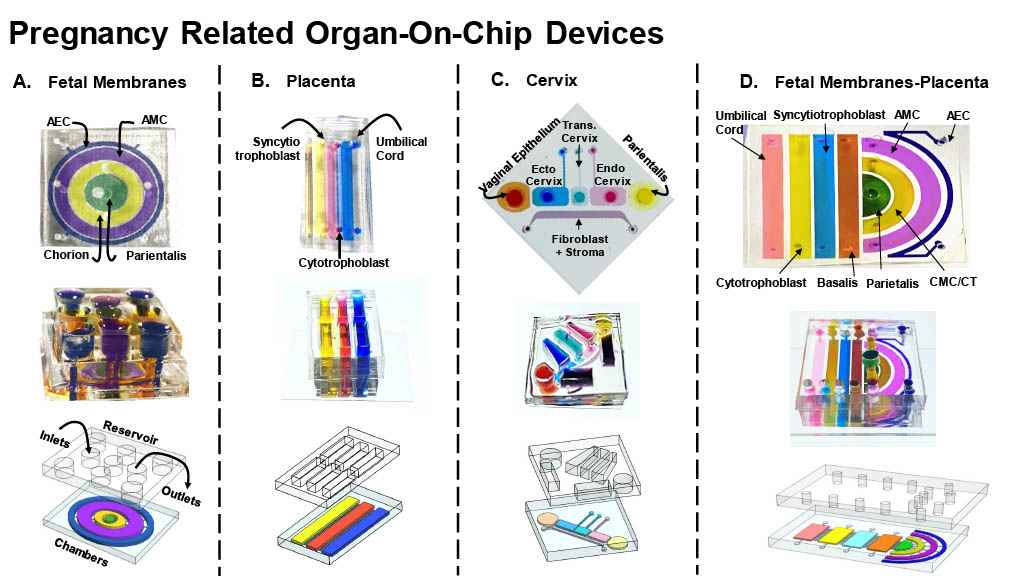
Researchers at the University of Texas Medical Branch have developed a way to study gestational disease thanks to a breakthrough that mimics pregnancy using miniature organ models made up of human cells embedded onto silicon surfaces.
The team, led by Dr. Ramkumar Menon, professor in the Department of Obstetrics and Gynecology, used these devices to successfully test drugs for conditions like preterm birth and pre-eclampsia during pregnancy. This breakthrough in preclinical research is expected to reduce the use of animal models for pregnancy drug trials, expediting clinical trials and the drug approval process. Animal models are often criticized as unreliable because they do not resemble human pregnancy.
The Royal Society of Chemistry’s Lab on a Chip published the UTMB team’s paper featuring this organ-on-a-chip approach to a drug study.
Each organ model in this study, one for the placenta and one for the fetal membrane, is smaller than a human thumb; when combined, these models allow scientists to test on the human reproductive system.
The chips used in the pregnancy model are designed by computer programs and then produced with molds. An etching process creates holes suitable for planting the cells. The chips range in shape and size, depending on the organ they represent. Scientists then load them with the appropriate cell types. For example, the human placenta and fetal membrane are each composed of distinct types of cells, and these devices maintain the cells to resemble these organs during pregnancy. Researchers use this model of pregnancy to understand the mechanisms of gestational disease.
“All of these cell types we already have growing in my lab, so we just replant them on these chips to recreate the organs in the lab,” Menon, who is also director of Basic Science and Translation Research in Obstetrics and Gynecology, said. “In a couple of days, we get an adequate number of cells where we can do experiments, create pregnancy-associated disease states, and test drugs to reverse them to a healthy sate.”
Organ-on-a-chip technology has been used to study health and disease in various organs, but this research marks the first time it has been used in pregnancy-associated preclinical trials.
In the study, led by Lauren Richardson, assistant professor, researchers showed that statin drugs reduce inflammation induced by infection or oxidative stress during pregnancy. Such inflammation can contribute to preterm births, so researchers are eager to find new treatments.
“We have reported on statins before,” Menon said. “We know that statins reduce inflammation induced by infection and oxidative stress experienced by uterine tissues during pregnancy.”
This organ-on-a-chip study recreated the results the lab got previously using animals, validating the use of the miniature reproductive system.
“Once we test a few more drugs or compounds and physiologically validate them either in animals or other systems, then we can eliminate animal models in the very near future,” Menon said.
Menon said the Food and Drug Administration advocates the switch to these new methods to reduce animal testing. Having more reliable results before drug trials could protect pregnant patients and lead to more timely solutions to problems like preterm births, which occurred in 10.5 percent of pregnancies in the US in 2021.
This kind of protocol will make research faster, cheaper, and more reliable than using animal models, Menon said.
Besides Richardson, Dr. Ananth Kumar Kammala (Assistant Professor, UTMB) contributed as the primary author of the study. The study team also included Drs. Maged Costantine (Ohio State University, Columbus, OH), Stephen J Fortunato (Ochsner Medical Center, New Orleans, LA, Robert N. Taylor, (University of Buffalo), and Enkhtuya Radnaa (UTMB). The engineering design of the organ chip was developed by the team at Texas A&M University led by Dr. Arum Han, who is also one of the grant investigators with Dr. Menon.
This study is supported by the grant funding Eunice Kennedy Shriver National Institute of Child Health and Development (NICHD) of the National Institutes of Health (NIH). The National Center for Advancing Translational Sciences (NCATS) has already funded the Menon/Han team to develop more organ models to accelerate drug trials to reduce complications during pregnancy.