Researchers at The University of Texas Medical Branch (UTMB) are seeking older adults to participate in a new study exploring how companion robots can help people manage their health while continuing to live independently at home.
The study, “Health Management at Home with a Companion Robot,” is examining how adults age 65 and older use ElliQ, a social companion robot, in their everyday lives.
Already used by older adults in thousands of homes nationwide, ElliQ is an AI-powered companion designed to support health, well-being, and independent living.
ElliQ supports independence and improves well-being and social connectedness by engaging older adults in conversation, providing medication and appointment reminders, suggesting wellness activities, and offering companionship through interactive dialogue.
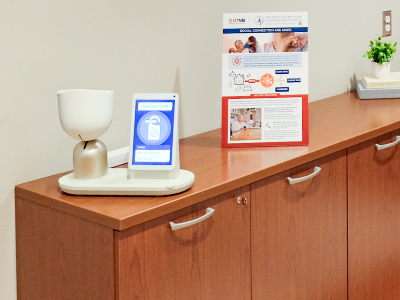
ElliQ is designed to foster independence
and improve well-being and social connectedness
Unlike many smart technologies that respond only to commands, ElliQ can initiate interactions and build personalized context to enhance engagement. According to Intuition Robotics, the company that created ElliQ, 95% percent of program participants reported decreased loneliness, demonstrating its effectiveness in improving daily life and well-being, while 75% reported feeling more socially connected.
Unlike studies conducted primarily in laboratory settings, participants will use ElliQ in their own homes for approximately eight weeks, allowing researchers to better understand how companion technology fits into everyday life.
“A device can work exactly as designed and still not be something a person wants to use. We want to learn how people actually use ElliQ, what they find helpful, and what doesn’t fit into their day,” said Melissa Morrow, PhD, principal investigator of the study and director of the Sealy Center on Aging at UTMB.
“If ElliQ doesn’t fit into someone’s life, that is a finding too. Participants will tell us what works, what doesn’t, and why, and that is what will help older adults, families, and clinicians understand how a tool like this can help and in what situations.”
Bringing age-tech into the home
The research is supported by the Texas Age-Tech at UTMB through $5 million in state funding from the 89th Texas Legislature.
The initiative supports research on technologies such as artificial intelligence and robotics that could help older adults continue living safely at home while easing some of the demands on family caregivers.
Aging in place often becomes more complicated after a major illness, a hospital stay, or changes in mobility. Social isolation, medication management challenges, and chronic health conditions can make it more difficult for older adults to remain independent at home.
Texas Age-Tech brings together expertise from across UTMB in aging research, geriatric care, rehabilitation, population health, artificial intelligence, and other disciplines to identify technologies that could help address those challenges.
Research priorities include predicting changes in health, reducing social isolation, improving physical function and mobility, and supporting medication management.
Older adults helping shape the technology
Researchers say older adults are involved throughout the process, helping shape how new technologies are evaluated and introduced rather than simply testing products after they have been developed.
ElliQ study participants will complete assessments and questionnaires, use ElliQ at home for approximately eight weeks, take part in home visits and phone or virtual check-ins, and provide feedback about their experiences with the device.
Beyond usage patterns, the research team wants to know whether participants find the technology useful, practical, and worth incorporating into everyday life. Their feedback could help inform future efforts to use companion technologies to support health and independence at home
“Much of the work of managing a health condition happens at home, between appointments, when no clinician is in the room,” said Erin Hommel, MD, MS, an associate professor in the UTMB Division of Geriatrics and clinical lead of the Texas Age-Tech Initiative. “If a tool is going to help during those hours, it has to be something people are comfortable using on their own.”
Who can participate
Researchers are currently recruiting participants for the study. Eligible participants must:
- Be age 65 or older.
- Speak English.
- Have access to WiFi.
- Live independently in the community.
- Have at least one ongoing health condition.
- Be interested in using ElliQ in their home for approximately eight weeks.
- Be willing to complete study visits, check-ins, and interviews and meet other eligibility requirements established by the research team.
Compensation is available for eligible participants. For more information about eligibility or participation, contact Abigail Cristocea at alcristo@utmb.edu.
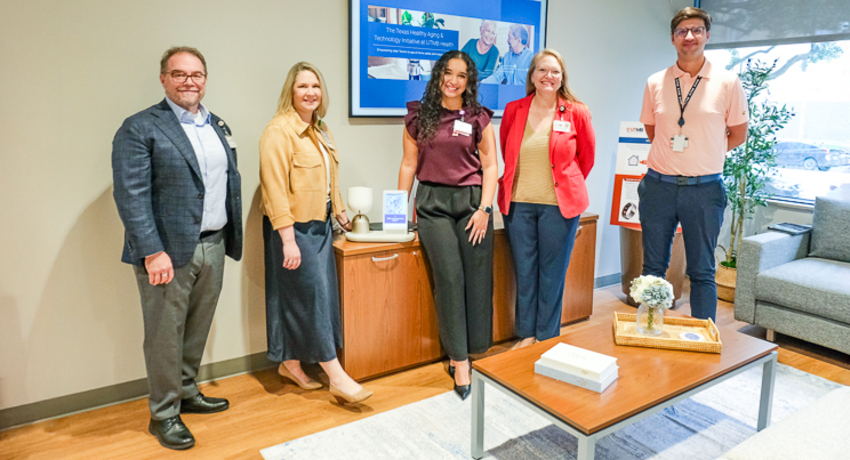
Pictured at top of page: The UTMB Age-Tech team includes, from left, Duane Morrow, PhD, PMP, senior research scientist, School of Health Professions; Erin Hommel, MD, MS, clinical lead of the Texas Age-Tech Initiative; Abigail Cristocea, research coordinator, Sealy Center on Aging; Melissa Morrow, PhD, director of the Sealy Center on Aging; and Brian Downer, PhD, associate professor, Department of Population Health & Health Disparities.