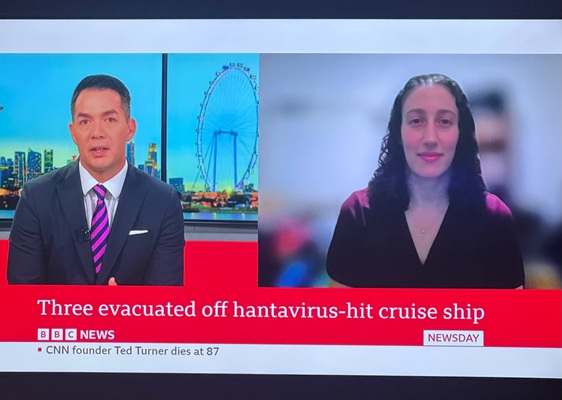
Dr. Corri Levine, Associate Director of the SPECTRE Program at UTMB, recently joined BBC News to discuss the developing hantavirus outbreak linked to the MV Hondius cruise ship.
During the interview, Dr. Levine provided expert insight into current public health considerations surrounding the outbreak, including the importance of early identification, contact tracing, monitoring close contacts, and understanding transmission risks in a setting that differs from historically reported hantavirus cases.
Current reports indicate that the outbreak has involved multiple confirmed and suspected cases associated with the Andes virus species of hantavirus, which is capable of limited person-to-person transmission in close-contact settings. International public health agencies continue monitoring the situation while emphasizing that the overall risk to the general public remains low.
Throughout the interview, Dr. Levine emphasized the importance of evidence-based communication and practical public health measures during emerging infectious disease events. Her discussion reflected the broader mission of the SPECTRE Program to support healthcare preparedness, workforce development, and regional readiness through education, training, and collaboration.
As the HHS Region 6 Regional Emerging Special Pathogens Treatment Center (RESPTC), UTMB and the SPECTRE Program work closely with healthcare facilities, public health partners, emergency response agencies, and regional stakeholders to strengthen readiness for high consequence infectious disease events across Texas, Arkansas, Louisiana, New Mexico, and Oklahoma.
Media engagements like this help reinforce the critical role of trusted scientific communication in supporting public understanding and preparedness during evolving infectious disease situations.