News

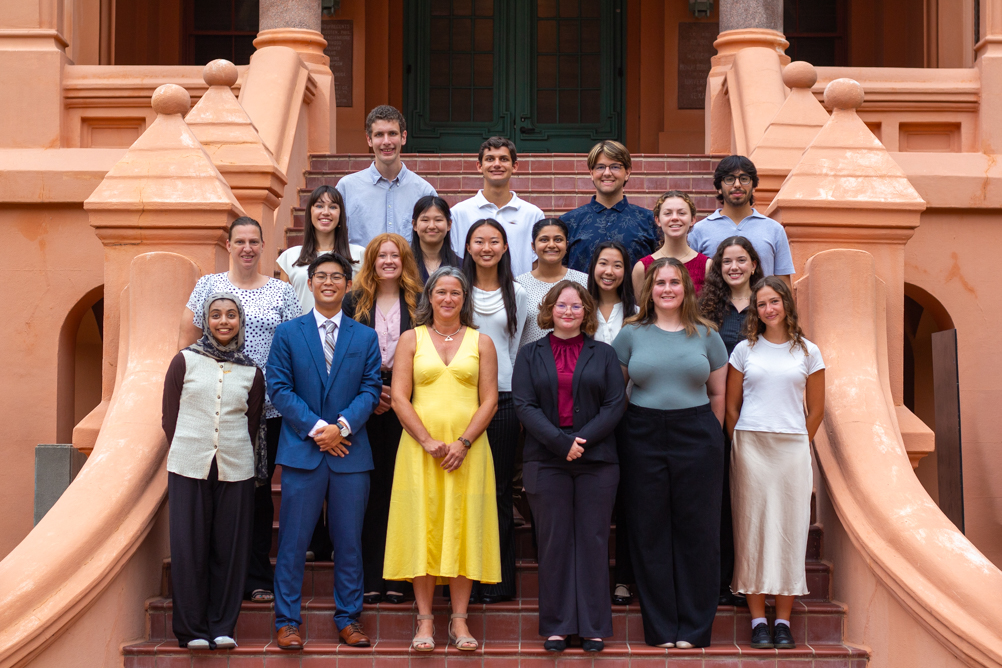
The 2026 SIBDS cohort and mentors pose together on the steps of a UTMB building.

Seventeen Scholars, Eight Questions at UTMB's Summer Biostatistics Poster Session

For seven weeks this summer, seventeen undergraduates traded their own classrooms for real biomedical datasets in Galveston. On Thursday morning, they stood beside their posters on the fourth floor of UTMB Health Clinics and answered questions from faculty, mentors and one another.

It was the culmination of a program that runs each summer from early June into late July, and for several of the students it was the first poster they had ever presented.

The Summer Institute in Biostatistics and Data Science (SIBDS) is, at its core, a workforce program. Sponsored by the National Heart, Lung, and Blood Institute under grant R25HL161715, it brings undergraduates and recent graduates to Galveston for a paid summer of case-based instruction, computer-lab training and mentored research.

What counts as normal
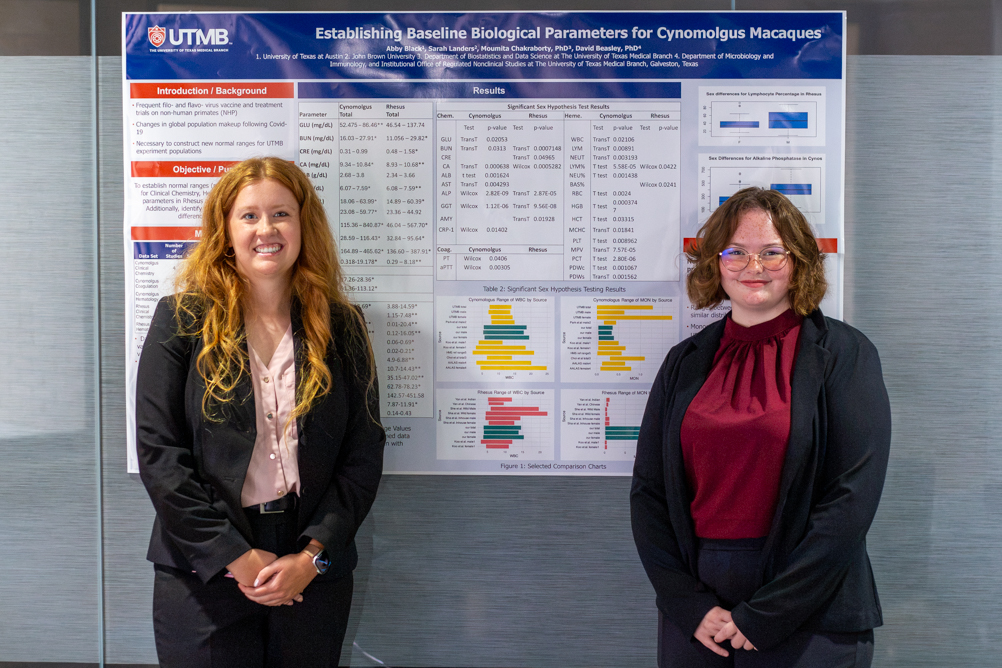
Two SIBDS students stand beside a poster titled “Establishing Baseline Biological Parameters for Cynomolgus Macaques.”

Sarah Landers and Abbly Black spent their summer on the question of what a healthy monkey looks like on paper.

Working with biostatistics mentor Moumita Chakraborty, PhD, and David Beasley, PhD, of UTMB’s Department of Microbiology and Immunology, the pair set out to rebuild the baseline biological reference ranges for the cynomolgus and rhesus macaques used in high-containment research at the Galveston National Laboratory, where scientists study pathogens such as West Nile and Ebola. Because that work cannot ethically be done in humans, it depends on primates, and each animal’s bloodwork counts as “normal” only until the day it enters a study.

Post-pandemic, the two explained, the available animals skew younger and are drawn from different colonies, which can quietly shift what “normal” means for a given lab. Sarah and Abby took each parameter across many past studies, checked whether the data were normally distributed, transformed the ones that weren’t, and built ranges from the mean plus or minus two standard deviations, then lined their results up against published literature values and older UTMB ranges to check their work.

Not everything resolved neatly. Monocyte counts, they found, behaved strangely in both species. In one, a small cluster of extreme outliers could be cleanly removed; in the other, the values were simply smeared across the whole range with no clear break. “Both of these are kind of a big question mark as to why that happened,” the students said, describing how they combed through original records and data files without landing on an explanation. It was, they noted, something specific to UTMB’s population worth flagging for whoever picks up the project next.

The two arrived at that poster by very different roads. Abby, a public health major at the University of Texas at Austin, found SIBDS through a post on a UT parent Facebook group that was forwarded to her. Sarah, a biochemistry major with a data-analytics minor at John Brown University, was pointed toward Galveston by a professor after a freshman genetics course.

For Sarah, the payoff was clarity about a career she had only glimpsed from a distance. “I’ve gotten a realistic picture of what a life in biostatistics would actually look like,” she said. “That’s always been something I’ve seen as a vague interest in the distance, but never thought could actually be a practicality.” She called Dr. Beasley and Dr. Chakraborty “incredible” guides through the summer.

Abby, who leans toward epidemiology, framed the value differently. “I’m still very epi-focused, less biostatistics,” she said, “but it’s very valuable coming from the public health side to get the numbers experience, the coding, the math.” She also appreciated the program’s rhythm, which pairs long days of analysis with room to breathe.

"You're going to work all day and learn a lot," she said, "but they're also giving you time to go out and learn to be a person, too."

Seven more questions

The rest of the cohort worked on problems that ranged from genomics to clinical medicine to population health.
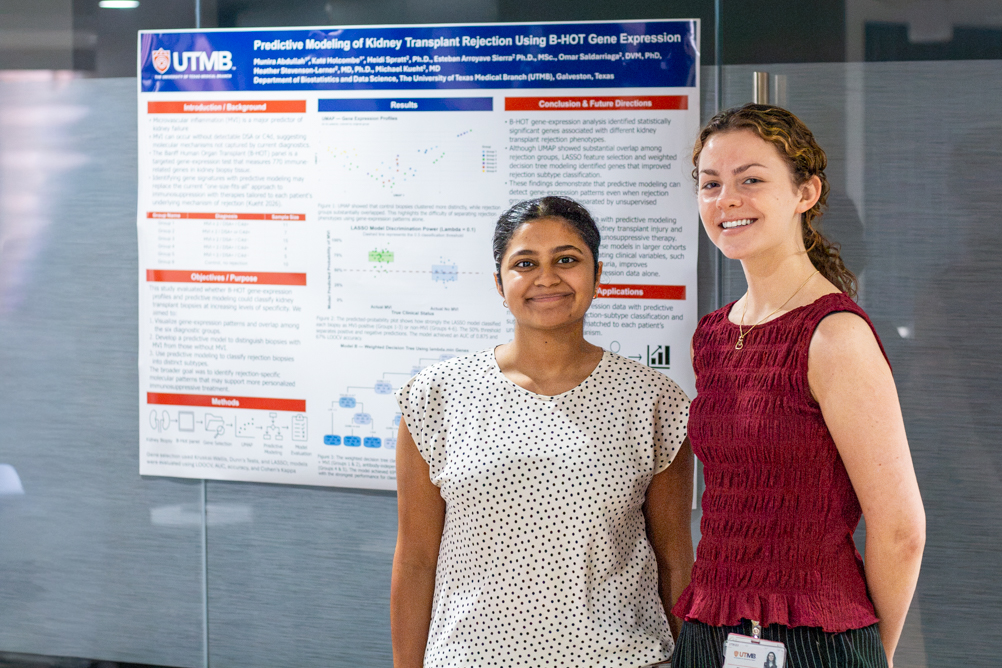
Two SIBDS students stand beside a poster titled “Predictive Modeling of Kidney Transplant Rejection Using B-HOT Gene Expression.”

Munira Abdullah and Kate Holcombe applied predictive modeling to gene-expression data from kidney transplant biopsies, testing whether molecular signatures from a 770-gene targeted panel could distinguish types of rejection and, eventually, support more personalized immunosuppression.
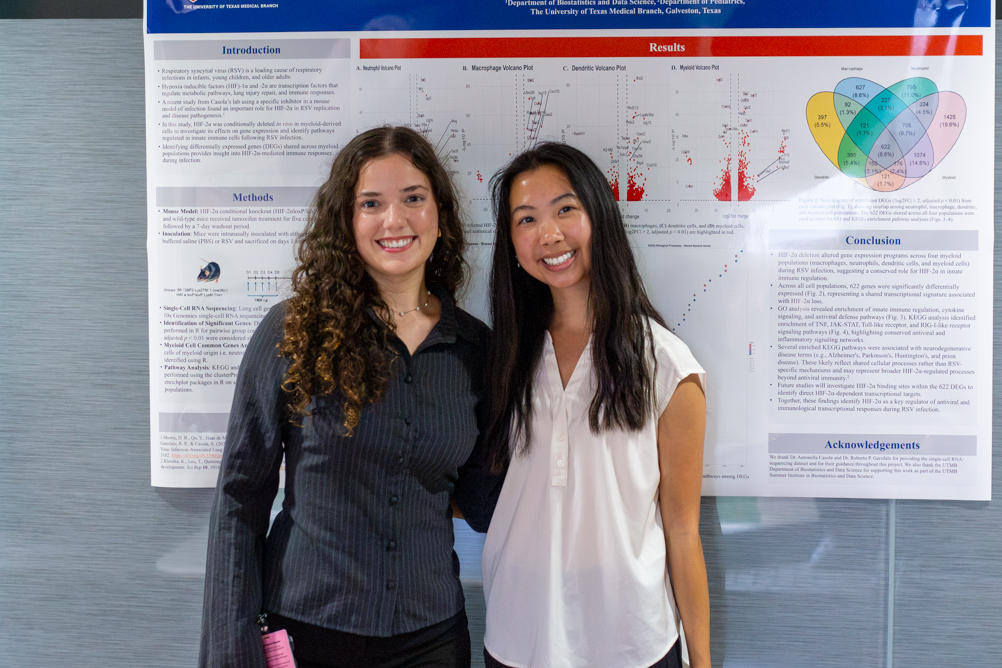


Two SIBDS students stand beside a poster about gene expression in mice infected with respiratory syncytial virus.

Danielle Barber and Jennifer Lin analyzed single-cell RNA-sequencing data to see how deleting the HIF-2α gene reshapes immune-cell gene expression during respiratory syncytial virus (RSV) infection, reporting a shared signature of hundreds of genes across several myeloid cell populations.
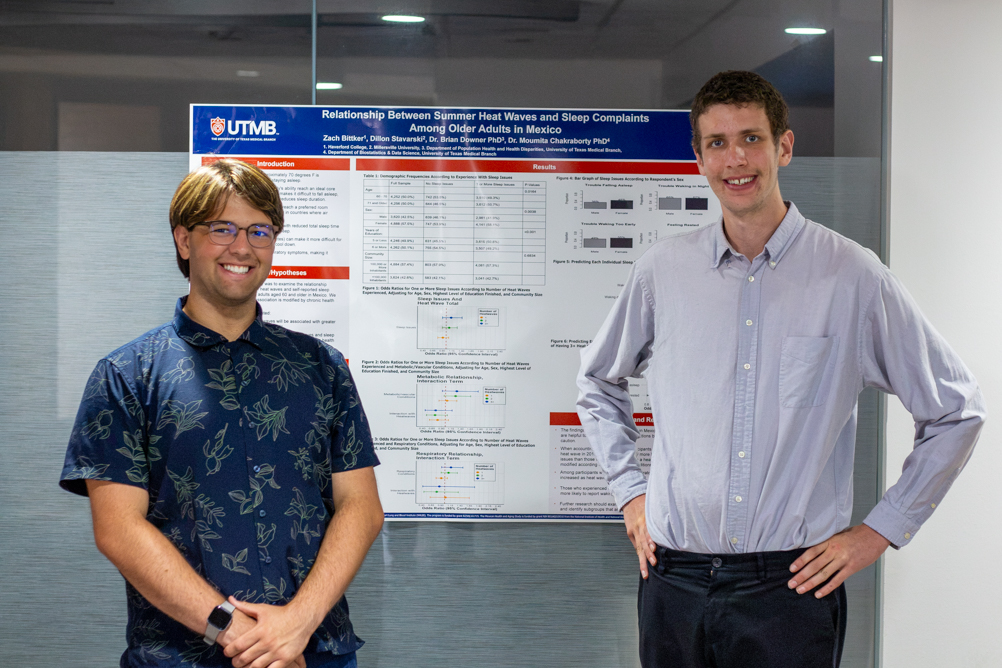


Two SIBDS students stand beside a poster titled “Relationship Between Summer Heat Waves and Sleep Complaints Among Older Adults in Mexico.”

Dillon Stavarski and Zach Bittker used the Mexican Health and Aging Study to ask whether summer heat waves were associated with sleep complaints among adults aged 60 and older, reporting that repeated heat-wave exposure, rather than a single event, was linked to waking during the night.
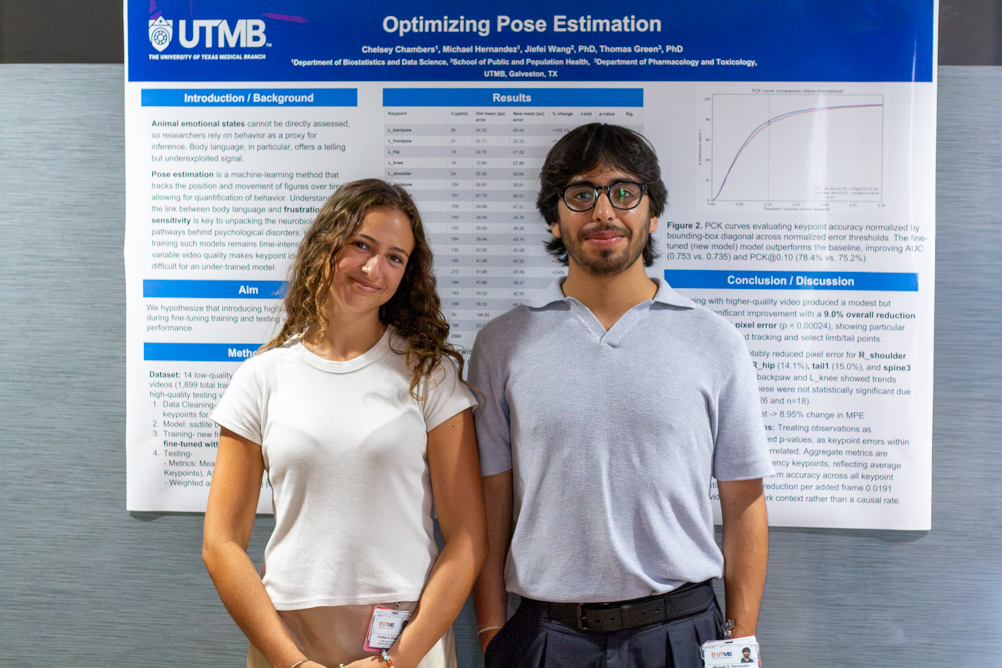


Two SIBDS students stand beside a poster titled “Optimizing Pose Estimation.”

Chelsey Chambers and Michael Hernandez worked to improve a machine-learning “pose estimation” model that tracks animal movement frame by frame, testing whether training it on higher-quality video measurably sharpened the accuracy of its predictions.
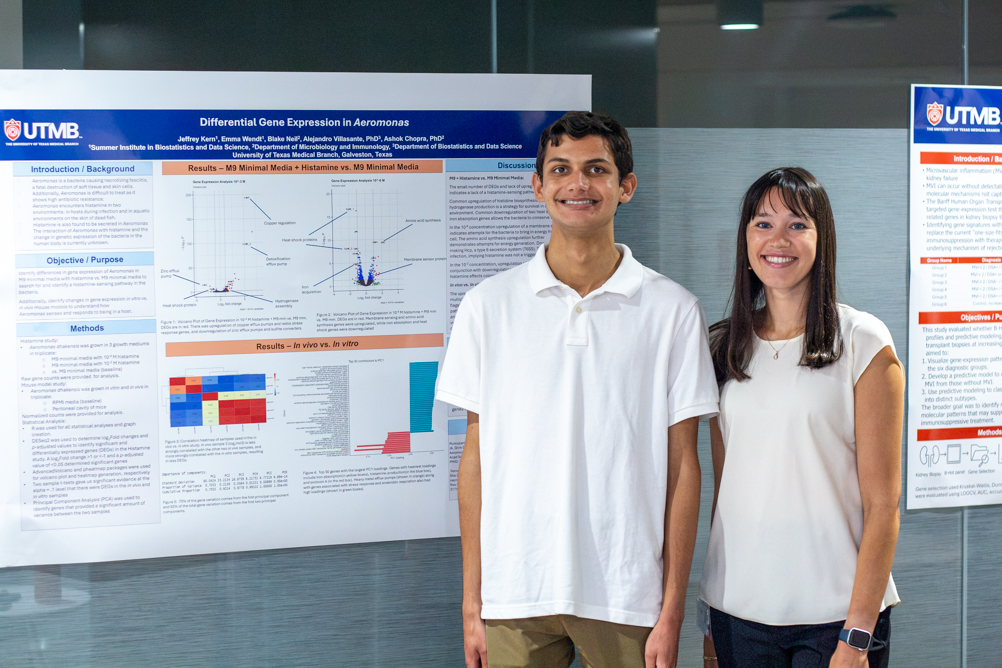


Two SIBDS students stand beside a poster titled “Differential Gene Expression in Aeromonas.”

Jeffrey Kern and Emma Wendt studied how Aeromonas, a bacterium behind flesh-destroying infections, shifts its gene expression across different environments, including in the presence of histamine and inside a host, as a way of probing how the pathogen senses and responds to its surroundings.
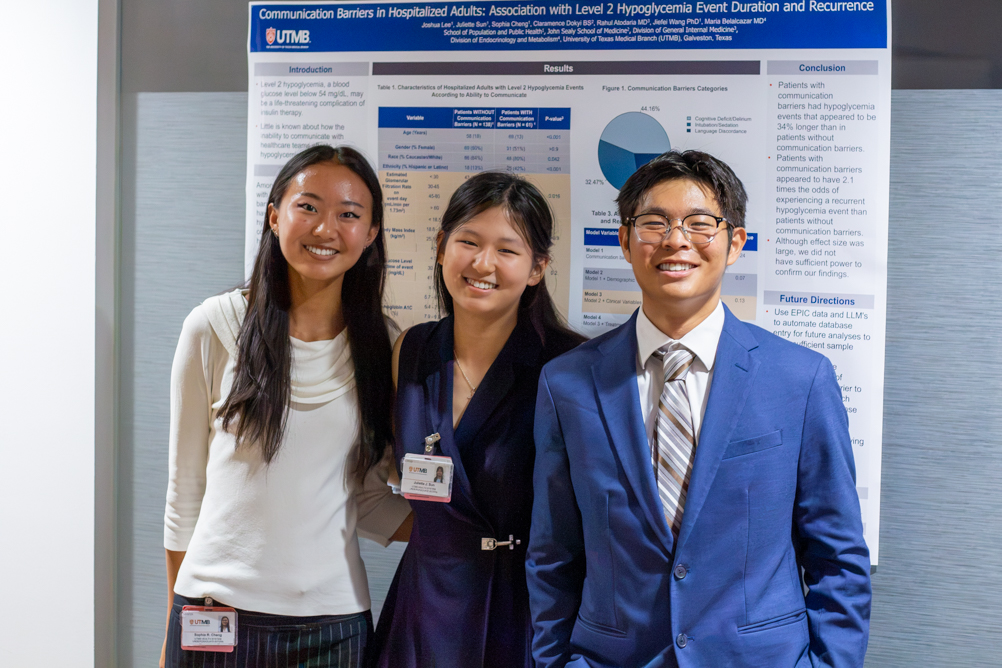


Three SIBDS students stand beside a poster about communication barriers among hospitalized adults with level 2 hypoglycemia.

Sophia Cheng, Juliette Sun, and Joshua Lee examined whether hospitalized patients who had trouble communicating with their care teams experienced longer or more frequent episodes of severe low blood sugar, reporting associations that pointed in that direction while cautioning that their sample was too small to confirm the findings.
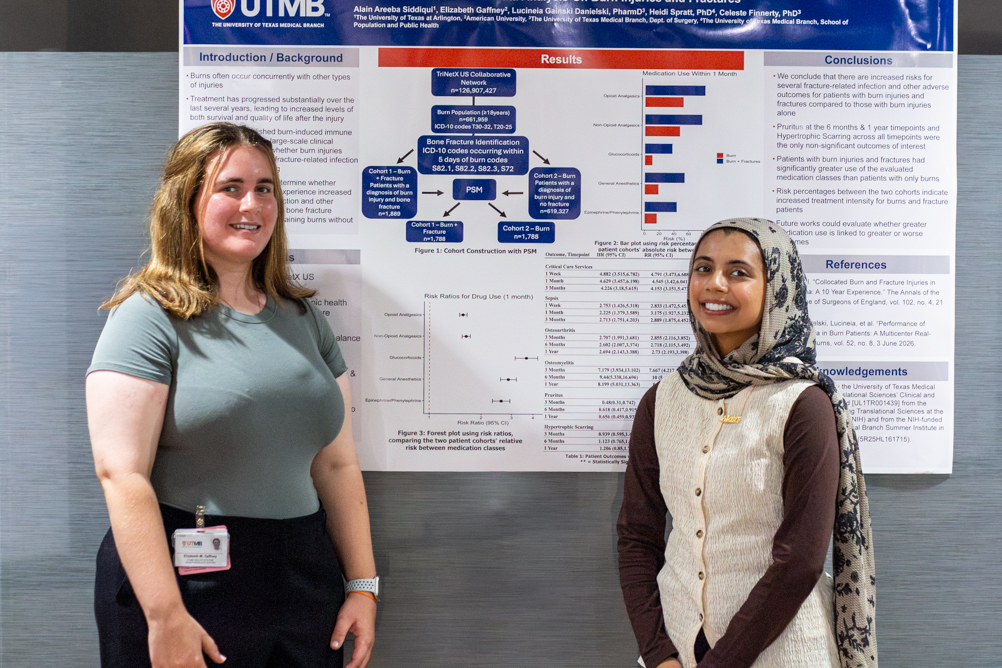


Two SIBDS students stand beside a poster comparing outcomes for patients with burn injuries and fractures.

Elizabeth Gaffney and Alain Areeba Siddiqui used a large multicenter health-records database to compare patients who had both burn injuries and fractures against those with burns alone, reporting higher risks of several adverse outcomes in the combined-injury group.

After the posters

The program’s own measure of success will play out over years, in how many of these students go on to graduate programs or careers in statistics, biostatistics and data science.

For now, the 2026 cohort has a finished poster to show for the summer and, for many, a first real sense of what a research career feels like from the inside.


The UTMB Summer Institute in Biostatistics and Data Science is a seven-week, NHLBI-funded program for undergraduates and recent graduates. Explore the Summer Institute program page.


Events

By the Numbers

Strength in numbers—driven by dedicated faculty, ambitious students, and impactful research funding shaping the future of public health.

* Approximations subject to change

4 Masters Programs

From the Seas to the Skies, We Are Public Health

Exploring health from every angle—land, sea, and sky—our diverse expertise shapes the future of public health.

Public Health Research

Advancing health through innovative, data-driven research that informs policy, improves care, and impacts communities globally.

Discover Our Research

Student Spotlight

Celebrating our students’ achievements, impact, and excellence—inside the classroom and beyond.

The 2026 SIBDS cohort and mentors pose together on the steps of a UTMB building.

Seventeen Scholars, Eight Questions at UTMB's Summer Biostatistics Poster Session

For seven weeks this summer, seventeen undergraduates traded their own classrooms for real biomedical datasets in Galveston. On Thursday morning, they stood beside their posters on the fourth floor of UTMB Health Clinics and answered questions from faculty, mentors and one another.

It was the culmination of a program that runs each summer from early June into late July, and for several of the students it was the first poster they had ever presented.

The Summer Institute in Biostatistics and Data Science (SIBDS) is, at its core, a workforce program. Sponsored by the National Heart, Lung, and Blood Institute under grant R25HL161715, it brings undergraduates and recent graduates to Galveston for a paid summer of case-based instruction, computer-lab training and mentored research.

What counts as normal

Two SIBDS students stand beside a poster titled “Establishing Baseline Biological Parameters for Cynomolgus Macaques.”

Sarah Landers and Abbly Black spent their summer on the question of what a healthy monkey looks like on paper.

Working with biostatistics mentor Moumita Chakraborty, PhD, and David Beasley, PhD, of UTMB’s Department of Microbiology and Immunology, the pair set out to rebuild the baseline biological reference ranges for the cynomolgus and rhesus macaques used in high-containment research at the Galveston National Laboratory, where scientists study pathogens such as West Nile and Ebola. Because that work cannot ethically be done in humans, it depends on primates, and each animal’s bloodwork counts as “normal” only until the day it enters a study.

Post-pandemic, the two explained, the available animals skew younger and are drawn from different colonies, which can quietly shift what “normal” means for a given lab. Sarah and Abby took each parameter across many past studies, checked whether the data were normally distributed, transformed the ones that weren’t, and built ranges from the mean plus or minus two standard deviations, then lined their results up against published literature values and older UTMB ranges to check their work.

Not everything resolved neatly. Monocyte counts, they found, behaved strangely in both species. In one, a small cluster of extreme outliers could be cleanly removed; in the other, the values were simply smeared across the whole range with no clear break. “Both of these are kind of a big question mark as to why that happened,” the students said, describing how they combed through original records and data files without landing on an explanation. It was, they noted, something specific to UTMB’s population worth flagging for whoever picks up the project next.

The two arrived at that poster by very different roads. Abby, a public health major at the University of Texas at Austin, found SIBDS through a post on a UT parent Facebook group that was forwarded to her. Sarah, a biochemistry major with a data-analytics minor at John Brown University, was pointed toward Galveston by a professor after a freshman genetics course.

For Sarah, the payoff was clarity about a career she had only glimpsed from a distance. “I’ve gotten a realistic picture of what a life in biostatistics would actually look like,” she said. “That’s always been something I’ve seen as a vague interest in the distance, but never thought could actually be a practicality.” She called Dr. Beasley and Dr. Chakraborty “incredible” guides through the summer.

Abby, who leans toward epidemiology, framed the value differently. “I’m still very epi-focused, less biostatistics,” she said, “but it’s very valuable coming from the public health side to get the numbers experience, the coding, the math.” She also appreciated the program’s rhythm, which pairs long days of analysis with room to breathe.

"You're going to work all day and learn a lot," she said, "but they're also giving you time to go out and learn to be a person, too."

Seven more questions

The rest of the cohort worked on problems that ranged from genomics to clinical medicine to population health.

Two SIBDS students stand beside a poster titled “Predictive Modeling of Kidney Transplant Rejection Using B-HOT Gene Expression.”

Munira Abdullah and Kate Holcombe applied predictive modeling to gene-expression data from kidney transplant biopsies, testing whether molecular signatures from a 770-gene targeted panel could distinguish types of rejection and, eventually, support more personalized immunosuppression.


Two SIBDS students stand beside a poster about gene expression in mice infected with respiratory syncytial virus.

Danielle Barber and Jennifer Lin analyzed single-cell RNA-sequencing data to see how deleting the HIF-2α gene reshapes immune-cell gene expression during respiratory syncytial virus (RSV) infection, reporting a shared signature of hundreds of genes across several myeloid cell populations.


Two SIBDS students stand beside a poster titled “Relationship Between Summer Heat Waves and Sleep Complaints Among Older Adults in Mexico.”

Dillon Stavarski and Zach Bittker used the Mexican Health and Aging Study to ask whether summer heat waves were associated with sleep complaints among adults aged 60 and older, reporting that repeated heat-wave exposure, rather than a single event, was linked to waking during the night.


Two SIBDS students stand beside a poster titled “Optimizing Pose Estimation.”

Chelsey Chambers and Michael Hernandez worked to improve a machine-learning “pose estimation” model that tracks animal movement frame by frame, testing whether training it on higher-quality video measurably sharpened the accuracy of its predictions.


Two SIBDS students stand beside a poster titled “Differential Gene Expression in Aeromonas.”

Jeffrey Kern and Emma Wendt studied how Aeromonas, a bacterium behind flesh-destroying infections, shifts its gene expression across different environments, including in the presence of histamine and inside a host, as a way of probing how the pathogen senses and responds to its surroundings.


Three SIBDS students stand beside a poster about communication barriers among hospitalized adults with level 2 hypoglycemia.

Sophia Cheng, Juliette Sun, and Joshua Lee examined whether hospitalized patients who had trouble communicating with their care teams experienced longer or more frequent episodes of severe low blood sugar, reporting associations that pointed in that direction while cautioning that their sample was too small to confirm the findings.


Two SIBDS students stand beside a poster comparing outcomes for patients with burn injuries and fractures.

Elizabeth Gaffney and Alain Areeba Siddiqui used a large multicenter health-records database to compare patients who had both burn injuries and fractures against those with burns alone, reporting higher risks of several adverse outcomes in the combined-injury group.

After the posters

The program’s own measure of success will play out over years, in how many of these students go on to graduate programs or careers in statistics, biostatistics and data science.

For now, the 2026 cohort has a finished poster to show for the summer and, for many, a first real sense of what a research career feels like from the inside.


The UTMB Summer Institute in Biostatistics and Data Science is a seven-week, NHLBI-funded program for undergraduates and recent graduates. Explore the Summer Institute program page.