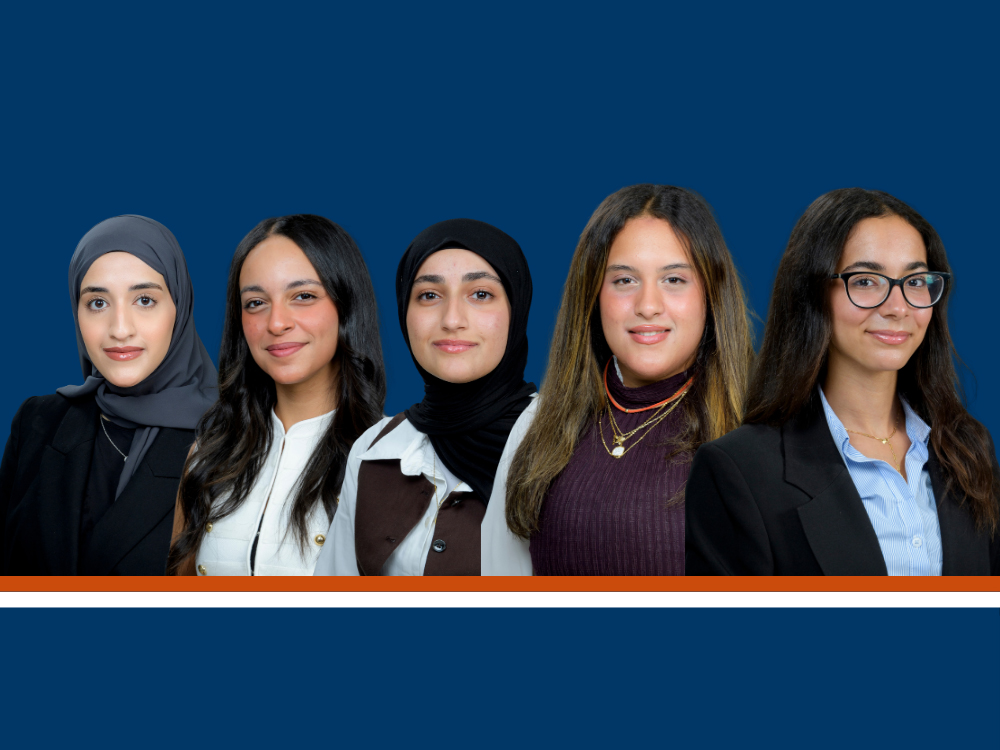
Five medical students from Badya University in Egypt spent four weeks at the UTMB Summer Program for Badya University in Galveston this August, under the Consulting and Technical Services Agreement between the two universities. Each of the five arrived with a different reason for being in medicine, and each left with a different question.
What brought each of them to medicine
Nour Nosair, a second-year medical student at Badya University, points back to childhood. “I was a very curious child, always wanting to understand how and why things worked, and that curiosity has stayed with me as I have grown,” she said. She is considering cardiology, oncology and gastroenterology, drawn to all three by how heavily their diseases weigh on the people who have them.
Salma Abdelaal, a third-year student, grew up inside the profession. Her mother, father and both older sisters are physicians, and watching her sisters work is what made her want the same path. Her own direction is still wide open. “As for my future specialty, I honestly change my mind almost every week,” she said. Ophthalmology, internal medicine and pediatrics are all live options.
Malak Ebrahim, entering her second year, is working toward general surgery, and her reasoning starts with an obligation to serve the community. She wants a career that joins technical precision with that obligation.
Malak Aboubakr, a third-year student, chose medicine for the combination of science and direct patient care. Neonatal surgery interests her most at the moment, though she said she is keeping an open mind.
Salma Elbery, a second-year student, spent the month working on a habit rather than narrowing a specialty. Being surrounded by people with more experience than her taught her to speak up when she was unsure. “You learn the most when you are willing to engage, ask when you are unsure, and take initiative,” she said.
All five entered medical school directly after secondary school, and most were already aware of the UTMB collaboration when they were deciding where to apply. It was one of the things that distinguished Badya from the other universities they were considering.
What does health mean anyway
From Aug. 2 to Aug. 28, students had a busy schedule, starting the Summer Program strong with sessions on investigating health systems that taught them how to select and prioritize topics for research, define objectives, choose an appropriate methodology and develop an operational plan.
Students then continued with sessions on Global Health Matters, including milestones of global health development, global health governance, pandemic preparedness, the Sustainable Development Goals and climate impact on health. They also took health systems tours at St. Vincent and Grace Clinics, as well as tours of the Health Education Center, Old Red and the Moody Medical Library Museum. All students worked on a protocol development project as part of their hands-on training. The Summer Program ended with sessions on public speaking, career advice, a dashboard-building workshop and a mock run of the closing presentations.
It is interesting how the experience shaped students’ views on the meaning of health. Nosair said that a patient’s health is “influenced by much more than the doctor treating them.” Climate, environment, health systems and the surrounding community all leave marks on who gets sick and who recovers. For Aboubakr, history explained the present. Health systems have adapted repeatedly in response to major events and pandemics, which left her seeing that “many of the practices and structures we rely on in healthcare are the result of lessons learned over time.”
Five versions of the same question about artificial intelligence
The group built one protocol project together, to answer a study question about how medical students and faculty in Egypt and the United States use artificial intelligence in their education. Asked individually what they most wanted it to reveal, they each gave different answers.
Aboubakr is after the practice itself, how students and faculty in both countries currently use these tools and what determines whether they use them responsibly. She hopes the answers point medical schools toward where guidance and training are thinnest. Nosair is interested in the comparison, in whether habits differ between Egypt and the United States and what each country could take from the other. Elbery wrote hers as a single sentence. “What strategies could improve the effective and appropriate use of artificial intelligence in medical education among medical students and faculty members?”
Abdelaal and Ebrahim both landed on the same tradeoff from opposite directions. Abdelaal wants to know how these tools can support learning without eroding accuracy, ethical use and critical thinking. Ebrahim is looking for a framework that lets students and faculty benefit from the assistance without losing the thinking, and she already has candidates for what stands in the way — “institutional resistance, unequal access to technology, or the fear of academic dishonesty.”
A month on the island
For several of them this was a first trip to the United States, and much of what they noticed was ordinary by design. Drivers stop for people crossing the street. The August heat carries a humidity even Egypt does not manage. Galveston struck them as a place with more history than its size suggests, and the residents struck them as unusually proud of living there.
By the end of the month, they had started counting the painted turtle sculptures scattered around the island. Nosair turned a year older in Galveston and spent the evening at The Spot with a birthday sign waiting for her, “surrounded by people who had been strangers to me just weeks before.” She came to like the city itself, where the past feels present in the streets and buildings. Abdelaal’s favorite part of the island was the turtles.
What they carry back to Egypt
Elbery intends to go after opportunities differently, describing herself as wanting to be “more proactive in seeking opportunities rather than waiting for them to come to me,” and to bring back the collaborative habits she found here. Ebrahim expects to read her coursework with less patience for memorization. “I will no longer just look at dry facts on a page,” she said, planning instead to connect the curriculum to problems that have a person on the other end of them.
Nosair wants to work with people who have prediabetes as a lifestyle coach for the Diabetes Prevention Program, using what she learned through her training to make preventive health part of how she supports the people around her. Aboubakr and Abdelaal both intend to pass along what they picked up, and to approach their own work with a more critical and open-minded eye than they brought to Galveston.
What two summers have built
This was the second consecutive summer Badya students spent in Galveston. Hani Serag, MD, MPH, associate professor in the Department of Population Health and Health Disparities, director of the Division of Global Partnerships and principal investigator on the UTMB-Badya agreement, describes the program as work that goes “beyond traditional academic exchange,” building students’ capacity to carry scholarship and evidence into how they learn and eventually practice.
The cultural side does as much in his account, giving participants from different backgrounds room to develop academic and professional connections that outlast the four weeks. Over time, what he is after is a generation of health professionals who are “globally minded, academically engaged, and better prepared to address the increasingly complex health challenges facing our communities.”
Hanaa Sallam, associate professor and co-principal investigator on the UTMB-Badya agreement in the Division of Global Partnerships, pointed to the students’ commitment to making the most of every learning opportunity. “We are proud of what these students were able to achieve on such a short visit,” she said. “I believe they were driven by a greater purpose, to serve their community by bringing and implementing the program in Egypt.”