Nearly two years ago, Kiersten Vallier purchased a copy of “The Beginner’s Guide to Running.”
“I’d see people running and be like, man, I wish that was me,” Vallier said. “That looks so fun.”
So, she bought the book. But by fall of 2024, Vallier, a teacher who had just given birth to her second son, weighed 324 pounds. She wasn’t sure she would ever be able to run again.
A lot can change in a year, though, especially with the help of Dr. Sarah Samreen, director of bariatric surgery at The University of Texas Medical Branch (UTMB Health).
Surrounded by gym patrons pursuing their fresh resolutions in January 2026, Vallier climbed on the elliptical. She ran and ran, reveling in the blend of sweat and endorphins.
Chasing better quality of life
Vallier’s weight loss journey started not with a trip to meet with Samreen at the obesity clinic, but with an orthopedic specialist.
“My classroom was upstairs, and I had to go up steep stairs every day to get there,” Vallier said. “My knees were hurting so bad, I said, ‘I need to go to the doctor.'”
Although Vallier had always struggled with her weight, she said she was metabolically healthy.
“My numbers were always okay until I hit 40, and the check engine light came on,” Vallier said.
When that doctor told her weight loss would probably resolve the knee pain, Vallier got serious.
“I decided I was going to do something—that I was going to be on a journey just for me—because I'm always doing stuff for other people,” Vallier said. “I said, ‘You know what, I'm going to get my health right and I'm going to focus on something for me.’ I’m excited I did that because it was actually the best decision I ever made.”
Vallier started her health journey by driving from her home in Port Arthur to League City to meet with Samreen to discuss bariatric surgery options.
“There's no one size fits all,” Samreen said. “It's not a cookie cutter approach. We must take every individual and decide, based on their situation, based on their metabolic health and their lifestyle, what operation would be the best option for them.”
Kicking off a year-long challenge
Vallier had surgery in December 2024.
“We did a procedure called the duodenal switch,” Samreen said. “It's one of the most effective procedures that we have for weight loss. In Kiersten's case, she did end up losing about 117 pounds, and she's now in a much healthier weight range. This happened over a year's time period. So, we are very happy with her success, but we have to remember that is just a number. Instead of the number, we need to focus on the health benefits of that weight loss.”
Samreen said the surgery is only beneficial if there are tangible improvements in quality of life.
“This weight loss may translate to taking a flight comfortably where a patient could not fly in their seat comfortably before,” Samreen said. “For some it may mean being able to take an amusement park ride with a child for the first time. For some it may mean being able to bend down and pick up things they couldn't before.”
Samreen said one common misconception is that most people put the weight back on.
“The long-term data is that more than 80 percent of patients maintain their weight loss for 20 years or more,” Samreen said. “That's a huge success rate.”
Staying on track after bariatric surgery
For Vallier, the key to success her first year after surgery was compliance with her care team’s instructions.
“I told myself from the beginning, whatever they tell me, I'm going to do it,” Vallier said. “I was really on myself about being consistent and not going through all of this for nothing. That’s been my mindset this entire year.”
Her UTMB Health care team gave her a book to guide her after surgery. This one didn’t gather dust; it became dog-eared from use.
“It said, this is what you’re supposed to eat in week one; that’s what I ate,” Vallier said. “I didn’t deviate, and if I didn’t have the book with me, I wouldn’t eat because I didn’t want to hurt.”
Although she did make some lifestyle changes like walking more and staying hydrated, her diet was the focus.
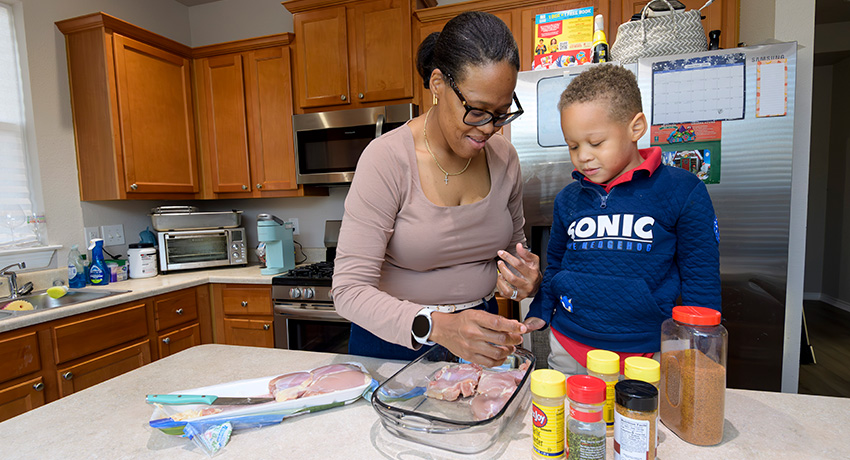
“I made sure I meal prepped,” Vallier, who had to break the habit of eating out, said. “You have to change the way you eat food and even your whole relationship with food.”
After a year, Vallier said she feels like she has the dietary changes down.
“For the next year, I’m focusing on working out and shaping up a little bit more,” Vallier said. She can already complete a 45-minute class called “Tough Tread” at the gym. It incorporates both running and weightlifting.
Maintaining marathon mentality to sustain weight loss
“We at UTMB Health don't believe in just doing the operation and then letting the patient be on their own,” Samreen said. “We have resources built into the program, such as a dietitian and a social worker who can provide nutrition counseling and mental health support after the surgery, which is so important in the long term. Once you're a UTMB Health patient and have had surgery with us, you can use those resources for life.”
For Vallier, staying focused on her “why” has been the key to staying the course.
“Find your reason why,” Vallier said. “And it can’t be just looks because you’re going to find something wrong there. I have a 19-year-old daughter and a four-year-old son who is very hyper, and I want to keep up with him. I wanted to keep going. I didn’t want to feel elderly at 40.”
She’s getting there one step at a time.
“The why keeps you going when you don’t want to drink a protein shake or have fish because you really, really want a burger,” Vallier said.
Overcoming hurdles to improved quality of life
Since about 40 percent of American adults have obesity, Samreen said it’s important to reduce barriers to care. One of those is anxiety about surgery.
“You come in the morning, get the surgery and go home the very next day,” Samreen said. “It's mostly one or at most two nights stay in the hospital and then afterwards there's consistent follow up. It's not the drastic measure that people think.”
Some patients struggle with guilt about needing medical intervention, whether in the form of medication or surgery, Samreen said. Consulting with a weight loss specialist can help.
“Some patients feel like if they’re going for surgery, maybe they have failed,” Samreen said. “That's the thought process. We don't make a cancer patient feel bad about getting surgery and getting their cancer out. Obesity is a chronic disease, just like heart disease, diabetes, or a cancer.”
Vallier, who had never had a major surgery, is glad she didn’t let fear stop her from experiencing all the long-term benefits, like shopping in stores that she never could before. Some of those benefits are not even a direct result of weight loss, but stem from prioritizing herself.
“I read more books,” Vallier said. “Before I didn't really do that. I did audio books, but I actually sit down for myself and do things that keep me in a good head space.”