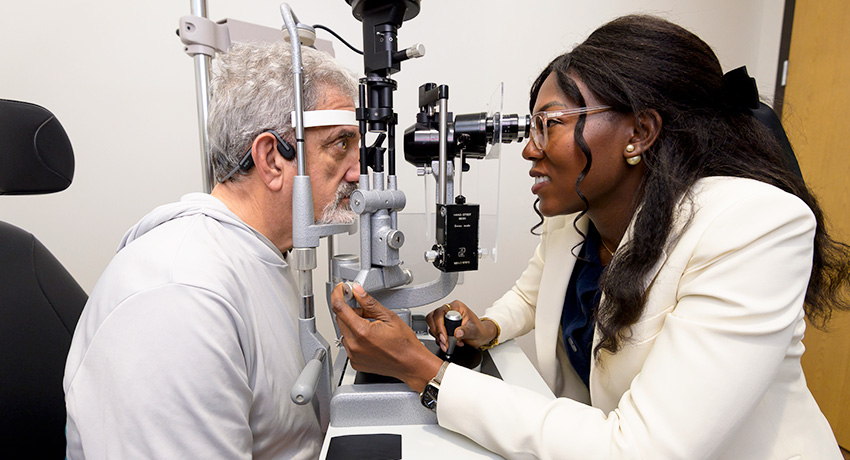
As we age, changes in our vision are common, but when they cloud our ability to see, cataracts may be the reason. Cataracts can make everyday activities like reading, driving, or recognizing faces more difficult. The good news is that cataracts are highly treatable. An eye exam and conversation with your doctor can be the first step toward clearer, brighter vision.
Understanding cataracts
Cataracts can form in one or both eyes. They occur when proteins in the eye’s natural lens begin to break down and clump together, causing the lens to become cloudy. This can cause blurred or dim vision, increased sensitivity to light, difficulty seeing at night, and faded colors.
Because cataracts develop slowly, people often do not realize how much their vision has changed until it becomes a barrier to daily life. That was the case for Susanne Kaboord, who turned to Dr. Aishat Adebayo, a UTMB ophthalmologist, for a solution.
“My eyes were getting very tired very quickly, and I was having difficulty reading,” Kaboord said. “And I just kept thinking, 'oh, I need to get my prescription updated.'”
Although aging is the most common cause, cataracts are also linked to diabetes, long-term sun exposure, smoking, certain medications, or previous eye injuries. No matter the cause, early evaluation is key.
Feeling nervous is natural
Surgery is the gold-standard method — and the only proven treatment — for removing cataracts and restoring clear vision. Because eyes are sensitive and vital to our daily living, some people are understandably anxious about any procedure on their eyes. However, cataract surgery is one of the most frequently performed surgeries in the United States and is both safe and effective.
“After surgery, many patients notice improved vision very quickly, sometimes even the same day or by the next day,” Adebayo said. “The restrictions after surgery are usually minimal, such as avoiding heavy lifting and bending over for about a week.”
When to consider cataract surgery
It may be time to talk with your doctor if you are:
- Struggling to see well enough to drive safely
- Finding it difficult to read or do close-up work
- Avoiding nighttime activities because of glare or halos
- Noticing that colors seem faded or washed out
- Feeling that your glasses prescription never seems right
Your doctor can determine whether cataracts are affecting your quality of life and surgery is needed.
What happens during cataract surgery?
Cataract surgery is typically an outpatient procedure, meaning you go home the same day. During the surgery, the cloudy lens is removed and replaced with a clear, artificial lens. Many patients notice vision improvements within days. Recovery is usually quick, and discomfort is generally minimal.
Advancements in lens technology also offer options that can reduce, and in some cases eliminate, the need for glasses after surgery. Your care team will help you choose the lens that best fits your lifestyle and vision goals.
Why you should not wait
While cataracts are not usually an emergency, delaying evaluation can allow symptoms to worsen and impact safety, independence, and overall quality of life. Seeing a doctor early helps you understand your options and decide on the best time to move forward with treatment.
Most importantly, clearer vision can help you stay active, engaged, and confident in your daily life.
For Kaboord, every day begins differently now that her cataracts are gone, and she no longer needs glasses.
“I’ve worn glasses all my life, and it took me forever to stop reaching for my glasses in the morning,” she said.
Ready to take the next step?
“Early intervention can really make a huge impact on your vision,” Adebayo said. “It is important to choose an ophthalmologist who listens to you, answers questions clearly, and makes you feel comfortable throughout the process. Our team here really is focused on giving you the best care from start to finish. We want every patient to feel that their eye care is a partnership, and that we are working together every step of the way.”