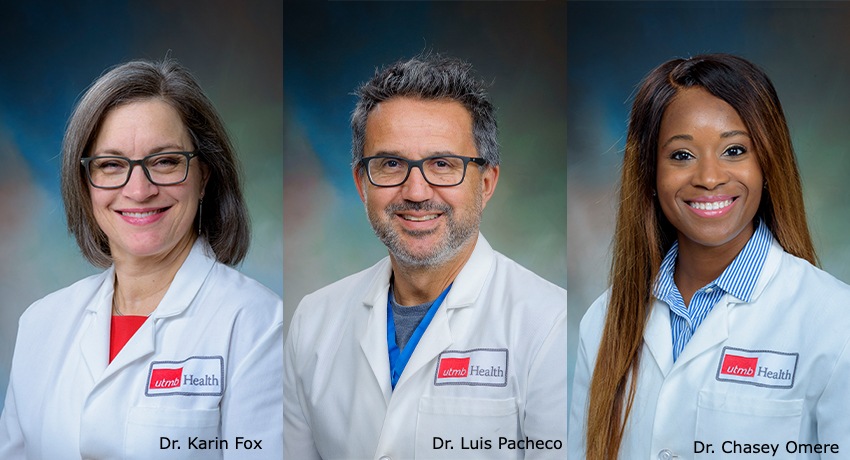
Faculty members from The University of Texas Medical Branch (UTMB) recently were featured in a landmark Cesarean Delivery Special Supplement published by The American Journal of Obstetrics and Gynecology.
Dr. Karin Fox, professor of Maternal-Fetal Medicine and director of the UTMB Placenta Accreta Spectrum Program, served as a guest editor for the supplement in addition to her role as the journal’s associate editor of Obstetrical Surgery. Based on her experience spanning two decades in complex obstetrical surgery, Fox authored the expert review “Surgical Management of Complex Cesarean Delivery.”
Fox’s article includes instructional videos produced in collaboration with UTMB OB/GYN residents Dr. Arlen Suarez Ares and Dr. Kirsten Wheeler; Maternal-Fetal Medicine fellows Dr. Rachael Hartman and Dr. Ben Spires; and Stephanie Woodby, RN, a specialist in operating room nursing for Labor & Delivery.
Cesarean deliveries are happening more often and can sometimes be quite complicated surgeries, Fox said. Having multiple prior cesareans can make later surgeries more risky because scar tissue and changes around the uterus can distort normal anatomy and increase bleeding or injury to nearby organs. Conditions like adhesions, fibroids, or uterine tearing make surgery harder and more dangerous for both mother and baby. Complex cases require highly skilled surgeons and careful planning to ensure safety.
“Doctors must understand both normal and changed anatomy, and use careful, step-by-step techniques to avoid damaging tissue and to reduce bleeding to deliver the baby and keep mothers as safe as possible,” she said. “Because many doctors today get less hands-on surgical training during residency, ongoing education and strong teamwork are especially important as these surgeries become more challenging.”
Dr. Luis Pacheco, division director of Maternal-Fetal Medicine, and Dr. Chasey Omere, assistant professor of Maternal-Fetal Medicine, co-authored the expert review “Hemostatic Resuscitation: Blood Product Replacement During Cesarean Delivery.” Their work provides essential guidance for clinicians on when, how, and why blood products should be transfused to ensure patient safety during severe bleeding events.
“Severe bleeding after childbirth is still the top cause of mothers dying worldwide,” Pacheco said. “This study concludes that survival improves when doctors avoid giving too much IV fluid and instead quickly give blood and clotting factors, while closely monitoring body temperature and key blood levels during surgery.”
“It also highlights the need for better research to determine the best way to use blood products to save lives in these emergencies,” he said.
Nearly one in three babies worldwide are born by cesarean delivery each year, making it the most commonly performed surgical procedure in modern medicine. While advances in obstetric care have significantly improved safety, cesarean deliveries remain major surgery with inherent risks.
These achievements come as UTMB was recently recognized by U.S. News & World Report as a Best Practice hospital for low-risk deliveries and maintains a Level IV Maternal Care status (highest level of care), underscoring the institution’s leadership in caring for both routine and high-risk pregnancies.