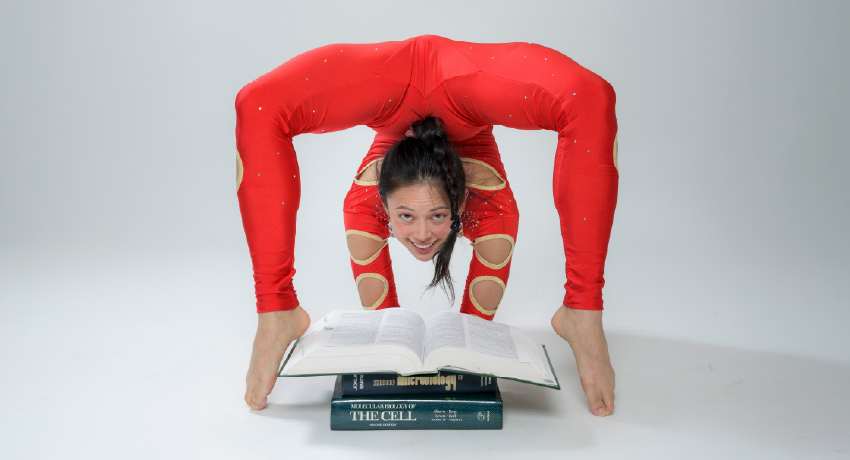
By day, Sarah Dang studies anatomy and physiology in lecture halls and from textbooks. When not studying, she bends her own body in ways that seem impossible.
A first-year medical student with a childhood fascination with backbends that grew into a talent for contortion, Dang moves between two worlds that demand precision, discipline, and a deep understanding of the human body — one shaped in the classrooms of the John Sealy School of Medicine at The University of Texas Medical Branch (UTMB), and the other through years of training and travel.
From playground curiosity to medical school
“When I was in elementary school in Houston, all my friends were in gymnastics class — but I wasn’t,” she said. “My friends taught me how to do backbends and handstands on the playground. During recess, all I would do is hang upside down and practice what they showed me. I was just obsessed with it.”
A year of ballet in middle school helped her build strength and flexibility, but she avoided sports because she wore glasses.
“I just wasn’t that physical,” she said. “After high school, I did a yoga teacher training program, and that was the first time I felt that kind of connection to my body. I began to understand how to use my body in an athletic way.”
Finding strength and connection through movement
Her interest in yoga evolved into acrobatic yoga, which requires two people.
“I thought it was fun, being thrown around with another person, but then I heard about contortion,” she said. “I just couldn’t find a teacher.”
She eventually found a group in Houston and later spent time in France, where she found formal training and began studying seriously.
“My teacher in France was Chinese, and it opened a whole new world for me,” she said. “In China, Mongolia, Russia, and other countries, contortion is considered an elegant art and an expression of Buddhist culture. As a Buddhist, I appreciated that.”
Dang later learned that many professional contortionists are from Mongolia, where formal training begins at a young age.
After completing her own training, Dang knew contortion would remain an important part of her life. For the past two years, she has continued her training and discovered that progress is possible at any age with focus and passion.
“I’m 31 years old, and I am still training my body and mind and becoming more flexible,” she said. “I train online with people from all over the world. It is a very niche community, but it is amazing to be part of it.”
Pushing past limits
She trains several times a week and performs on weekends.
“The performing aspect is such a reward,” she said. “When you are on stage, you are not just performing. You are presenting your whole self as the art. That takes courage, and that is what matters to me.”
Pushing past fear, what she calls “brain barriers,” is another part of the process.
“It’s scary, but also thrilling,” she said. “The first time I saw the backs of my knees over my head, it gave me a completely new perspective. Now it feels normal. I am still learning how far I can go and how to strengthen that mind-body connection.”
Shaping the physician she will become
Dang is considering a career in pediatrics, family medicine, or dermatology. Though currently undecided, she believes her experience in contortion will shape the kind of physician she becomes.
“I have been exposed to many different people and perspectives,” she said. “Medical school challenges my brain, and contortion challenges my body. Both push me beyond limits I didn’t know were there. I hope to inspire that same sense of possibility in my patients, especially young girls. I also value caring for families as a whole and have an interest in skin care.”
Even now, Dang said, the path she has taken still surprises her.
“I still can’t believe I do this,” she said. “I love it. I knew I was a contortionist after I came back from Mongolia. I’m always an amateur compared to them, but that just pushes me to keep going.”