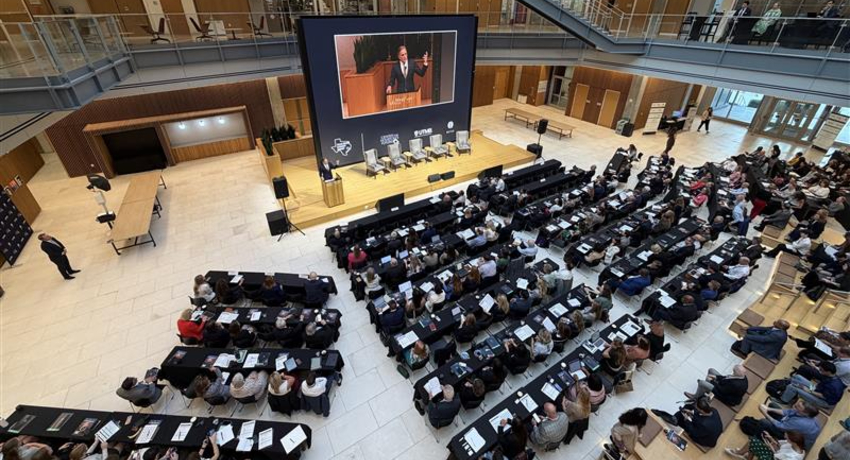
More than 500 leaders representing healthcare, business, academia, government, technology, and public policy gathered Tuesday for the opening day of the Texas Brain Economy Summit held at the Texas Medical Center.
Presented by The University of Texas Medical Branch (UTMB), the Center for Houston's Future, and Project Metis, the two-day summit brings together national and international experts to explore how investments in brain health can improve quality of life, strengthen communities, support workforce resilience, and drive economic growth.
Organized around the theme “Enabling Human Flourishing and Economic Growth,” the first day of the summit explored brain health across the lifespan — from early childhood development and workplace well-being to healthy aging and dementia prevention. Through discussions on mental health, workforce resilience, cardiovascular health, and emerging approaches to measuring cognitive well-being, speakers examined how brain health influences both quality of life and economic prosperity.
“The conversations taking place here are helping shape the future of how we think about healthy aging, cognitive well-being, workforce resilience, and the role brain health plays in our collective prosperity,” said Jochen Reiser, MD, PhD, UTMB president and CEO of the UTMB Health System. “This summit brings together leaders from multiple sectors to explore solutions that can improve lives while also strengthening the economic future of Texas and beyond.”
Throughout the day, speakers highlighted the growing body of evidence showing that brain health influences not only individual well-being but also workforce productivity, innovation, community vitality, and economic competitiveness.
Houston region: Project Metis
Among the featured discussions was one of three panels focused on geo-based initiatives and perspectives, titled “The Houston Region: Project Metis,” which examined how regional collaboration can advance brain health while supporting economic growth and community well-being.
Reiser, a founding chair of Project Metis, joined leaders from Rice University, Memorial Hermann Health System, and West Health to discuss the work of the collaborative initiative. Led by the Center for Houston’s Future, Project Metis brings together healthcare organizations, employers, academic institutions, researchers, and community stakeholders to develop practical strategies for improving brain health outcomes.
The panel explored how place-based approaches can help strengthen workforce participation, promote healthy aging and improve quality of life while positioning Houston as a leader in brain health innovation. Panelists discussed opportunities to leverage the region's strengths in healthcare, research, technology and community engagement to create measurable improvements in both public health and economic competitiveness.
The conversation reinforced one of the summit's central themes: improving brain health is not only a healthcare priority but also an economic and societal opportunity that can strengthen communities, support a healthier workforce and enhance long-term prosperity across Texas and beyond.
Project Metis has emerged as one of the region's most ambitious collaborative efforts, focused on understanding the connections among brain health, workforce performance, community well-being, and economic growth while identifying practical solutions that can improve quality of life across the Houston region.
A lifespan approach to brain health
A central theme throughout the day was the importance of protecting and strengthening brain health across every stage of life.
Sessions explored topics ranging from early brain development and cognitive health in childhood to workplace well-being, mental health, and healthy aging. Speakers emphasized that factors influencing brain health begin early in life and continue throughout adulthood, affecting educational outcomes, workforce participation, quality of life, and long-term health.
Panel discussions examined the growing importance of supporting brain health in the workplace, where employers increasingly recognize the connection among cognitive well-being, employee engagement, productivity, and organizational success.
Additional sessions focused on mental health and emerging approaches to measuring brain health and brain capital, highlighting the importance of understanding cognitive and emotional well-being as part of broader efforts to improve community health and economic competitiveness.
Throughout the day, speakers emphasized that brain health is shaped by a wide range of factors, including education, social connection, physical health, mental health, workplace environments, and community conditions, and that addressing those factors can help people live healthier, more productive lives.
Healthy aging takes center stage
Healthy aging was another major focus of the summit.
Alan Landay, PhD, vice president of Team Science and a professor in the departments of internal medicine and microbiology & immunology at UTMB, moderated a panel discussion featuring Dr. Mitchell Elkind of Columbia University, Dr. Jim Ray of UT MD Anderson Cancer Center, Dr. Joanne Pike of the Alzheimer's Association, and Dr. Andrew Nevin of The University of Texas at Dallas.
The panel examined the growing importance of brain health across the lifespan and explored opportunities to reduce dementia risk, improve quality of life, and support healthy aging through research, prevention, and public engagement.
Speakers emphasized that promoting healthy aging is essential not only for improving health outcomes but also for sustaining communities, strengthening the workforce, and supporting economic growth as populations continue to age worldwide.
The discussion highlighted the importance of translating scientific discoveries into practical interventions that help people maintain cognitive health, independence, and quality of life.
Exploring the brain-heart connection
One of the day’s keynote presentations focused on the powerful relationship between cardiovascular health and cognitive health.
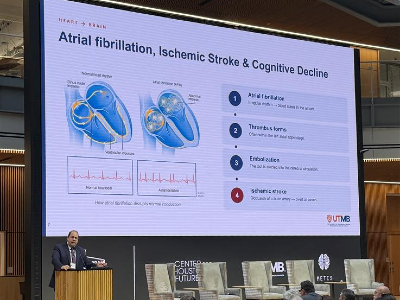
Hani Jneid, MD, director of the Sealy Heart and Vascular Institute and vice president of cardiovascular operations at UTMB, delivered a keynote address titled “Brain-Heart Connection,” highlighting decades of research demonstrating that many of the same factors that protect the heart also help preserve brain function.
“What’s good for the heart is good for the brain,” Jneid told attendees. “The same factors that protect cardiovascular health also help preserve cognitive function and reduce the risk of dementia.”
Jneid noted that nearly 45% of dementia cases are attributable to modifiable risk factors, underscoring the importance of prevention and early intervention.
“Prevention is not only possible; it is one of the most powerful tools we have,” he said.
He emphasized that lifestyle factors, including blood pressure control, physical activity, nutrition, and sleep, play a critical role in protecting both heart and brain health over time.
“These risks accumulate over a lifetime,” Jneid said. “The earlier we begin addressing blood pressure, physical activity, nutrition, sleep, and other lifestyle factors, the greater the opportunity to protect brain health as we age.”
Jneid also highlighted the American Heart Association's Life's Essential 8 framework as a practical roadmap for improving long-term health outcomes.
“Life's Essential 8 provides a roadmap not only for preventing heart disease but also for promoting long-term brain health,” he said. “The prescription for a healthier heart is often the same prescription for a healthier brain.”
Looking ahead to day two
As day 1 concluded, a common message emerged across presentations and panel discussions: Brain health is increasingly being recognized as a critical component of healthy aging, workforce resilience, community well-being, and economic prosperity.
The summit continues today with VentureX: Scaling Innovation & AI Solutions, a day focused on translating scientific discoveries into real-world impact through artificial intelligence, venture investment, technology development, and commercialization.
Sessions will explore the future of brain-health innovation, neuroscience technologies, entrepreneurship, systems transformation, and the growing role of artificial intelligence in improving cognitive health, accelerating discovery, and supporting economic growth.
By bringing together leaders from around the world, the summit seeks to accelerate partnerships and practical solutions that help people live healthier lives, maintain cognitive well-being, age with greater independence, and contribute to stronger communities and a more resilient economy.
Day two of the summit
Read more about the presentations during day two of the summit.
 |  |