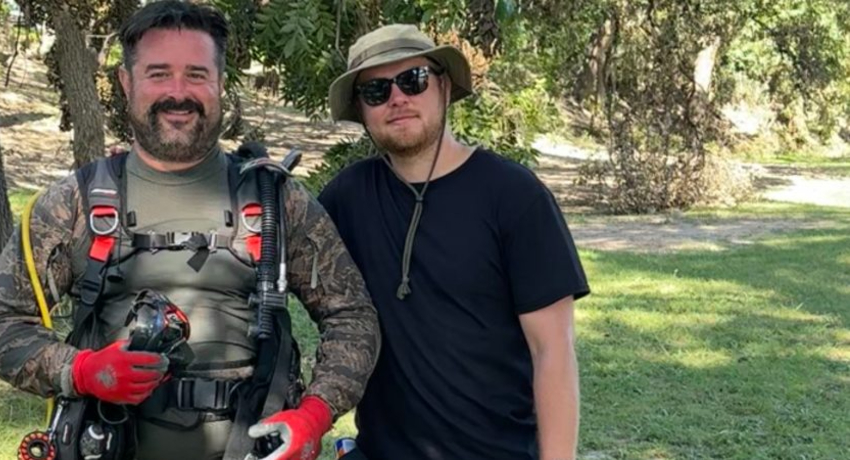
One year after catastrophic flooding along the Guadalupe River devastated Kerr County, UTMB Health colleagues Tyler Morrison and Austin Johnson reflect on their role in the response and the lessons they took away from the experience. Here's their story.
Morrison, a senior exercise physiologist at The University of Texas Medical Branch (UTMB Health), and his friend and co-worker Johnson, a physical therapist assistant, decided they had to step up the morning of the Fourth of July 2025. They listened to reports about rapidly deteriorating weather conditions along the Guadalupe River in Kerrville and immediately felt compelled to help.
Morrison and Johnson, both veterans with EMS training and search-and-rescue experience, were stunned by the magnitude of the disaster. A certified diver, Morrison connected with the United Cajun Navy, a volunteer disaster-response organization that was assisting with search-and-rescue efforts in Kerr County. He and Johnson joined the group’s rescue efforts in Center Point, an unincorporated community in Kerr County, where they were based for the next three days.
“We are Texans, and we love the water, but I never thought I would see or do something like this on the Guadalupe River, where I’ve had so much fun,” Morrison said. “When I heard that a lot of kids were involved in this, it made it more real to me. I have two kids, so I felt even more compelled to be part of the rescue effort. And because it was a water-related emergency, I knew there would be divers in the water, and I felt that was where I could contribute the most.”
The United Cajun Navy had been very active in sharing its rescue efforts on social media, Morrison said, and he knew it was the right organization to support.
“When you see a tragedy like this and know, while you’re sitting on the couch, that you have the skills to help, you have to do something,” Johnson said. “I was happy to hitch my wagon to Tyler’s and follow him out there.”
Working beneath the surface
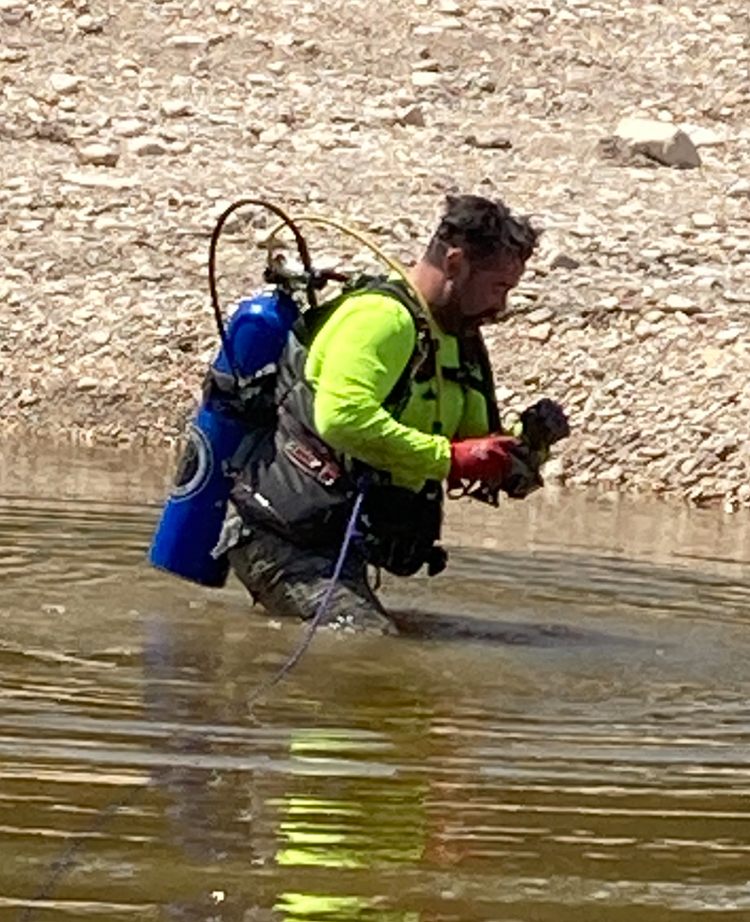
The two became part of a dive team, with Johnson serving as a tender, responsible for managing Morrison’s safety line from the riverbank, and Morrison as a diver.
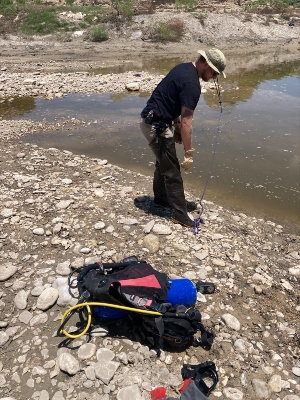
“As a tender,” Johnson explained, “I stood on the riverbank with one end of a 150-foot rope tied to me and the other end tied to Tyler. I helped ensure he was hitting every area in the search zone, every single square inch. A few times we had to go back and search the same area again. At one point, Tyler was entangled in a 10-foot branch.”
Their task was to search the rock quarries connected to the Guadalupe River, and they were part of the first team to dive in areas of the river that had not yet been covered. There was so much debris, Johnson said, but everyone worked together to get the job done.
“You get turned around in the river, and you don’t know where you’ve just searched, but we make sure we search every square inch. The topside is just as important as the diver in the water,” he said.
Searching inch by inch
Both said the near-zero visibility in the river was a major obstacle in the search-and-rescue effort.
“We spent three days there, with the first day receiving our assignments and the next two days diving,” Morrison said. “Visibility was minimal. I had to use my hands to search every area. There was so much sand, silt, and mud that you couldn’t see 2 inches in front of your face. I would dig my arms into every area to see if I could feel anything. I could feel rocks and sticks, but you can’t see anything, and you’re on the bottom, going inch by inch. It’s hard to understand the magnitude of what water can do."
Their team remained in the water for extended periods, changed tanks, and then got back in the water.
“We didn’t want to leave anything to question,” Morrison said. “I would want someone to do the same thing if it had been my kids.”
The areas they searched did not yield any victims. However, when they arrived, there were about 114 people reported missing.
“By the time we were done, that number had decreased to single digits. It was a big effort, with a lot of people doing their jobs,” Morrison said.
A lasting impact
Both said they were ready to assist if another disaster occurred.
“We’re still in contact with our dive team,” Johnson said. “There are a lot of veterans and civilians who work with them. It’s a different breed and a different mindset. Anyone who has worked in law enforcement, fire service, or military understands that hierarchy and chain of command, which is why they are so efficient. The United Cajun Navy welcomed us, and we were grateful to work with such a reputable organization.”
Overall, Morrison said, the search-and-rescue operation went as well as it could.
“We met so many people, and our dive team was top-notch,” he said. “These are people we otherwise never would have crossed paths with. We had a phenomenal team dynamic, with the United Cajun Navy serving as our main command, along with another search-and-rescue team called Woods and Water. If there’s any beauty in a tragedy, it’s that it brings so many people together.”
 .
. 
Tyler Morrison Austin Johnson
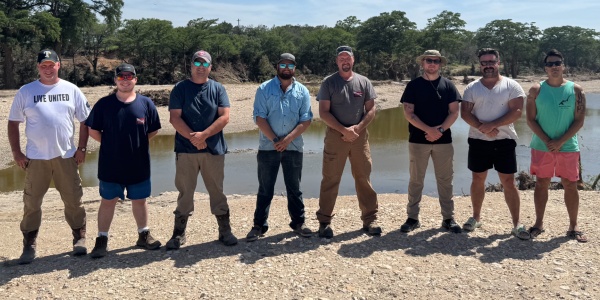
Morrison and Johnson worked alongside the United Cajun Navy in the aftermath of the flooding in Kerr County.
Photo at top of page: Tyler Morrison, left, and Austin Johnson