News

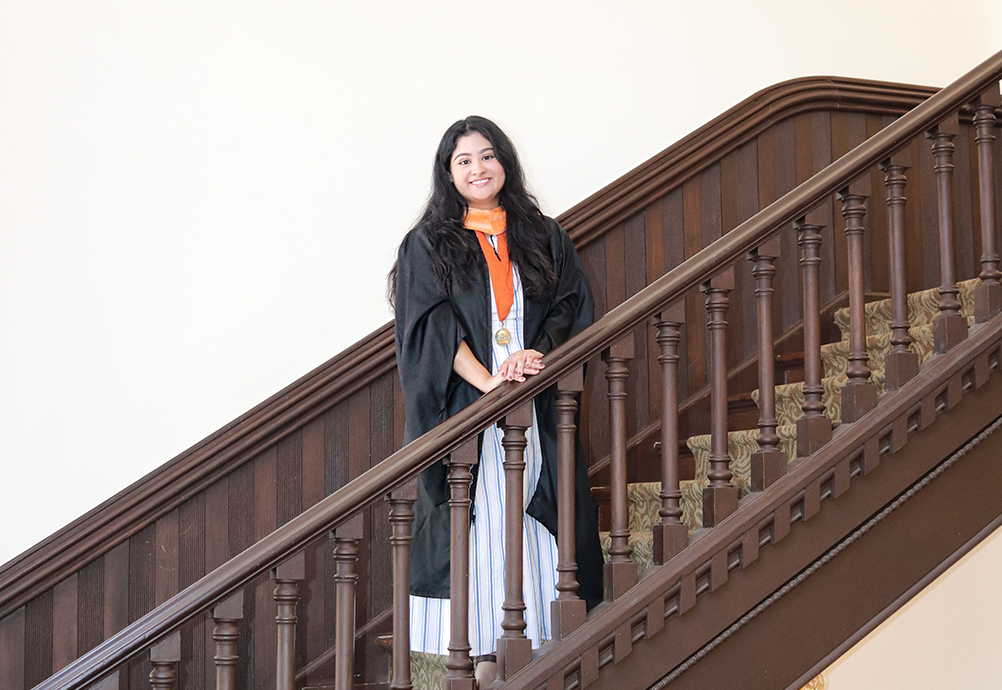
Klarisa Lopez smiles in graduation regalia and a medal while standing on a dark wooden staircase.

Klarisa Lopez on Language as Part of Patient Care

Klarisa Lopez spent two years in the Master of Public Health program at the University of Texas Medical Branch School of Public and Population Health studying something she had already lived. Her capstone work reviewed 15 studies on how interpretation services shape care for patients with limited English proficiency, then asked Spanish-speaking patients across Harris and Galveston counties what those services look like from the waiting room. The questions were never abstract to her. She had carried them as an emergency room scribe, and again as the family member interpreting for her grandmother during hospice care.

15
studies in her review
20
patients surveyed
75%
preferred in-person interpreters

What 15 studies and 20 patients told her

For her Integrative Learning Experience, Klarisa conducted a systematic review, following PRISMA guidelines across four databases and narrowing 42 candidate articles down to 15 that compared a health outcome against a specific feature of language service. The pattern held across emergency care, primary care, stroke management, diabetes care, and cancer care. In-person professional interpreters and language concordance, meaning a provider who speaks the patient's own language, were tied most consistently to better communication, higher satisfaction, and stronger outcomes.

To map why, she built a causal loop diagram that traced how governance, the health system, family support, and a patient's own circumstances feed into access, quality, and outcomes. The diagram and the review met several of the MPH program's foundational and bioethics competencies, including the ability to interpret evidence for policy and to apply a systems-thinking tool to a public health problem.

Her Applied Practice Experience took the same questions into the community. She designed a survey, approved by the UTMB Institutional Review Board, to capture how often Spanish-speaking patients were offered interpretation, what kinds they used, what they preferred, and whether language had ever kept them from seeking care.

The original plan called for group discussions. As organizations grew cautious about giving access to their members and individuals hesitated to take part even in an anonymous survey, that plan became unworkable, and Klarisa rebuilt the project as a field survey. The obstacle itself became one of her lessons.

"Working with communities who have lost trust or are cautious serves as a reminder that this work is a balancing act. We must strive to understand and respect those voices in order to continue building relationships and empower communities."

Klarisa Lopez, MPH, UTMB School of Public and Population Health

She gathered 20 participants, 10 in Harris County and 10 in Galveston County, recruiting in stores, neighborhoods, and a church and offering a small gift card for completing the survey. Klarisa learned Spanish from her family rather than as a native speaker, and she was direct about that limit. She worked with Oscar David Almaraz Aguilar, MD, a physician whose fluency helped put participants at ease and answer their questions in the moment.

Working across that gap shaped how she thinks the research should be done. "I believe it is important to center voices, especially for groups we may not be included in," she said, describing collaborators as the bridge between researchers and the communities they hope to reach. Her approach drew on what Dr. Cara Pennel teaches about how hard trust is to earn from outside a community, and her primary mentor, Dr. Dana Wiltz-Beckham, met with her regularly and helped her navigate the redesign.

Most patients who received interpretation were satisfied with it. The sharper finding was the gap between what patients wanted and what they got. Three out of four preferred in-person interpreters, yet video and staff interpreters were used far more often, a gap Klarisa attributes to the cost pressures shaping how systems deliver care. The data also split by gender. 42% of women reported always being offered interpretation, compared with 25% of men.

"Often women seek care more than men, which can drive the gap of who uses interpretation services," she said, adding that staff may read women, especially those arriving with children, as more in need of support. Her recommendation is to ask everyone, regardless of gender, and to track who actually uses interpreters so the gaps become visible.

What she noticed first as an emergency room scribe

Before the master's program, Klarisa worked as a scribe in a San Antonio emergency department from 2019 to 2021. Physicians picked up new patients from a board, and the triage note flagged when a patient spoke Spanish or another language. She watched some providers hope a colleague would take the patient, or wait until someone else signed onto the chart, even with interpretation tablets within reach.

"I was thinking that the patient's language was thought of first before their medical needs, even when translators were readily available."

Klarisa Lopez, MPH, UTMB School of Public and Population Health

She found herself wondering whether the patients in the waiting room understood that their language was shaping their care from the moment they checked in, and whether faster, easier interpretation tools would change a provider's hesitation at all. The systematic review later gave her the data behind what she had seen. Having an interpreter available is only the first condition. Whether providers reach for it is another.

Why a follow-up call counts as patient safety

When Klarisa coded the open-ended survey responses by hand into themes, the answers that stayed with her were small ones. A woman whose appointment was canceled without anyone reaching her in a language she understood. Patients who got results calls placed in English when they needed Spanish. S

he frames fixing these as the floor, not an upgrade. In clinical training, staff learn a set of patient rights meant to prevent harm before care is delivered. The first is the "Right Patient," confirming a person's full name, birth date, and other identifying details before anything else. A patient's language need, she argues, belongs in that same category of basic verification.

"It should be bare minimum to ensure whether the patient requires language services, as it is part of their identity and ensures delivery of appropriate, high-quality care."

Klarisa Lopez, MPH, UTMB School of Public and Population Health

Federal obligations to provide language assistance have existed for decades, rooted in the Civil Rights Act of 1964 and reinforced around the turn of the century. Health systems have had time to build the basic infrastructure, she points out, and the gaps that remain in access and follow-up suggest an underinvestment rather than a new or unsolved problem.

Bridging the gap inside her own family

The work connected to something closer than any study. When her grandmother entered hospice care, Klarisa stepped away from her job to become a caregiver while most of the family's adults were supporting households of their own. At appointments, she said, "we were the interpreters, transportation, and involved in her care management." She valued the role.

"I enjoyed bridging that gap because I could speak to my grandmother about her values and decision-making."

Klarisa Lopez, MPH, UTMB School of Public and Population Health

The hardest stretch came when she could no longer do it. "The most difficult part of navigating this experience was not being able to speak with my grandmother to relay her decisions to the provider," she said. The experience left her with a conviction that runs through her research. Communication is part of the care itself, and so are the families who often carry it.

What she carries into medicine

As she prepares to apply to medical school, Klarisa plans to earn certification as a Spanish medical interpreter. She draws a firm line between speaking a language and being qualified to interpret in a clinical setting, where a mistranslation can change a decision.

"Health, in itself, is another language that requires the patient to receive accurate, timely, and confidential communication with the provider."

Klarisa Lopez, MPH, UTMB School of Public and Population Health

Her bioethics training taught her to weigh every party in the encounter at once, the patient, the family, the provider, the interpreter, and the system around them. "Understanding the values of all parties creates a greater impact than purely looking through a data-focused or clinical view," she said. That habit shapes how she would change the field.

She would retire the practice of labeling a person "limited English proficient" and replace it with questions that put the patient first. She suggests asking, "What is your preferred language when receiving care? Would you like an interpreter for this visit?"

The destination is a clinical career, but the lens stays public health. As a physician, she wants to keep noticing the patients who get moved to the back of the line because their care takes an extra step. "I aspire to create awareness and seek change in closing the gaps of our health system that negatively impact how care is delivered," she said.


Klarisa earned her MPH in the bioethics concentration at SPPH, where students take public health questions into Texas communities and bring back evidence that can change practice. Learn more about the MPH program and its concentrations.


Events

By the Numbers

Strength in numbers—driven by dedicated faculty, ambitious students, and impactful research funding shaping the future of public health.

* Approximations subject to change

4 Masters Programs

From the Seas to the Skies, We Are Public Health

Exploring health from every angle—land, sea, and sky—our diverse expertise shapes the future of public health.

Public Health Research

Advancing health through innovative, data-driven research that informs policy, improves care, and impacts communities globally.

Discover Our Research

Student Spotlight

Celebrating our students’ achievements, impact, and excellence—inside the classroom and beyond.

Klarisa Lopez smiles in graduation regalia and a medal while standing on a dark wooden staircase.

Klarisa Lopez on Language as Part of Patient Care

Klarisa Lopez spent two years in the Master of Public Health program at the University of Texas Medical Branch School of Public and Population Health studying something she had already lived. Her capstone work reviewed 15 studies on how interpretation services shape care for patients with limited English proficiency, then asked Spanish-speaking patients across Harris and Galveston counties what those services look like from the waiting room. The questions were never abstract to her. She had carried them as an emergency room scribe, and again as the family member interpreting for her grandmother during hospice care.

15
studies in her review
20
patients surveyed
75%
preferred in-person interpreters

What 15 studies and 20 patients told her

For her Integrative Learning Experience, Klarisa conducted a systematic review, following PRISMA guidelines across four databases and narrowing 42 candidate articles down to 15 that compared a health outcome against a specific feature of language service. The pattern held across emergency care, primary care, stroke management, diabetes care, and cancer care. In-person professional interpreters and language concordance, meaning a provider who speaks the patient's own language, were tied most consistently to better communication, higher satisfaction, and stronger outcomes.

To map why, she built a causal loop diagram that traced how governance, the health system, family support, and a patient's own circumstances feed into access, quality, and outcomes. The diagram and the review met several of the MPH program's foundational and bioethics competencies, including the ability to interpret evidence for policy and to apply a systems-thinking tool to a public health problem.

Her Applied Practice Experience took the same questions into the community. She designed a survey, approved by the UTMB Institutional Review Board, to capture how often Spanish-speaking patients were offered interpretation, what kinds they used, what they preferred, and whether language had ever kept them from seeking care.

The original plan called for group discussions. As organizations grew cautious about giving access to their members and individuals hesitated to take part even in an anonymous survey, that plan became unworkable, and Klarisa rebuilt the project as a field survey. The obstacle itself became one of her lessons.

"Working with communities who have lost trust or are cautious serves as a reminder that this work is a balancing act. We must strive to understand and respect those voices in order to continue building relationships and empower communities."

Klarisa Lopez, MPH, UTMB School of Public and Population Health

She gathered 20 participants, 10 in Harris County and 10 in Galveston County, recruiting in stores, neighborhoods, and a church and offering a small gift card for completing the survey. Klarisa learned Spanish from her family rather than as a native speaker, and she was direct about that limit. She worked with Oscar David Almaraz Aguilar, MD, a physician whose fluency helped put participants at ease and answer their questions in the moment.

Working across that gap shaped how she thinks the research should be done. "I believe it is important to center voices, especially for groups we may not be included in," she said, describing collaborators as the bridge between researchers and the communities they hope to reach. Her approach drew on what Dr. Cara Pennel teaches about how hard trust is to earn from outside a community, and her primary mentor, Dr. Dana Wiltz-Beckham, met with her regularly and helped her navigate the redesign.

Most patients who received interpretation were satisfied with it. The sharper finding was the gap between what patients wanted and what they got. Three out of four preferred in-person interpreters, yet video and staff interpreters were used far more often, a gap Klarisa attributes to the cost pressures shaping how systems deliver care. The data also split by gender. 42% of women reported always being offered interpretation, compared with 25% of men.

"Often women seek care more than men, which can drive the gap of who uses interpretation services," she said, adding that staff may read women, especially those arriving with children, as more in need of support. Her recommendation is to ask everyone, regardless of gender, and to track who actually uses interpreters so the gaps become visible.

What she noticed first as an emergency room scribe

Before the master's program, Klarisa worked as a scribe in a San Antonio emergency department from 2019 to 2021. Physicians picked up new patients from a board, and the triage note flagged when a patient spoke Spanish or another language. She watched some providers hope a colleague would take the patient, or wait until someone else signed onto the chart, even with interpretation tablets within reach.

"I was thinking that the patient's language was thought of first before their medical needs, even when translators were readily available."

Klarisa Lopez, MPH, UTMB School of Public and Population Health

She found herself wondering whether the patients in the waiting room understood that their language was shaping their care from the moment they checked in, and whether faster, easier interpretation tools would change a provider's hesitation at all. The systematic review later gave her the data behind what she had seen. Having an interpreter available is only the first condition. Whether providers reach for it is another.

Why a follow-up call counts as patient safety

When Klarisa coded the open-ended survey responses by hand into themes, the answers that stayed with her were small ones. A woman whose appointment was canceled without anyone reaching her in a language she understood. Patients who got results calls placed in English when they needed Spanish. S

he frames fixing these as the floor, not an upgrade. In clinical training, staff learn a set of patient rights meant to prevent harm before care is delivered. The first is the "Right Patient," confirming a person's full name, birth date, and other identifying details before anything else. A patient's language need, she argues, belongs in that same category of basic verification.

"It should be bare minimum to ensure whether the patient requires language services, as it is part of their identity and ensures delivery of appropriate, high-quality care."

Klarisa Lopez, MPH, UTMB School of Public and Population Health

Federal obligations to provide language assistance have existed for decades, rooted in the Civil Rights Act of 1964 and reinforced around the turn of the century. Health systems have had time to build the basic infrastructure, she points out, and the gaps that remain in access and follow-up suggest an underinvestment rather than a new or unsolved problem.

Bridging the gap inside her own family

The work connected to something closer than any study. When her grandmother entered hospice care, Klarisa stepped away from her job to become a caregiver while most of the family's adults were supporting households of their own. At appointments, she said, "we were the interpreters, transportation, and involved in her care management." She valued the role.

"I enjoyed bridging that gap because I could speak to my grandmother about her values and decision-making."

Klarisa Lopez, MPH, UTMB School of Public and Population Health

The hardest stretch came when she could no longer do it. "The most difficult part of navigating this experience was not being able to speak with my grandmother to relay her decisions to the provider," she said. The experience left her with a conviction that runs through her research. Communication is part of the care itself, and so are the families who often carry it.

What she carries into medicine

As she prepares to apply to medical school, Klarisa plans to earn certification as a Spanish medical interpreter. She draws a firm line between speaking a language and being qualified to interpret in a clinical setting, where a mistranslation can change a decision.

"Health, in itself, is another language that requires the patient to receive accurate, timely, and confidential communication with the provider."

Klarisa Lopez, MPH, UTMB School of Public and Population Health

Her bioethics training taught her to weigh every party in the encounter at once, the patient, the family, the provider, the interpreter, and the system around them. "Understanding the values of all parties creates a greater impact than purely looking through a data-focused or clinical view," she said. That habit shapes how she would change the field.

She would retire the practice of labeling a person "limited English proficient" and replace it with questions that put the patient first. She suggests asking, "What is your preferred language when receiving care? Would you like an interpreter for this visit?"

The destination is a clinical career, but the lens stays public health. As a physician, she wants to keep noticing the patients who get moved to the back of the line because their care takes an extra step. "I aspire to create awareness and seek change in closing the gaps of our health system that negatively impact how care is delivered," she said.


Klarisa earned her MPH in the bioethics concentration at SPPH, where students take public health questions into Texas communities and bring back evidence that can change practice. Learn more about the MPH program and its concentrations.