News

Professor Bhavnani and CEO Kumar Sign Translational AI Agreement

"Unwritten in our agreement is a shared belief: translation must be grounded in alleviating human suffering informed by our own personal stories.”

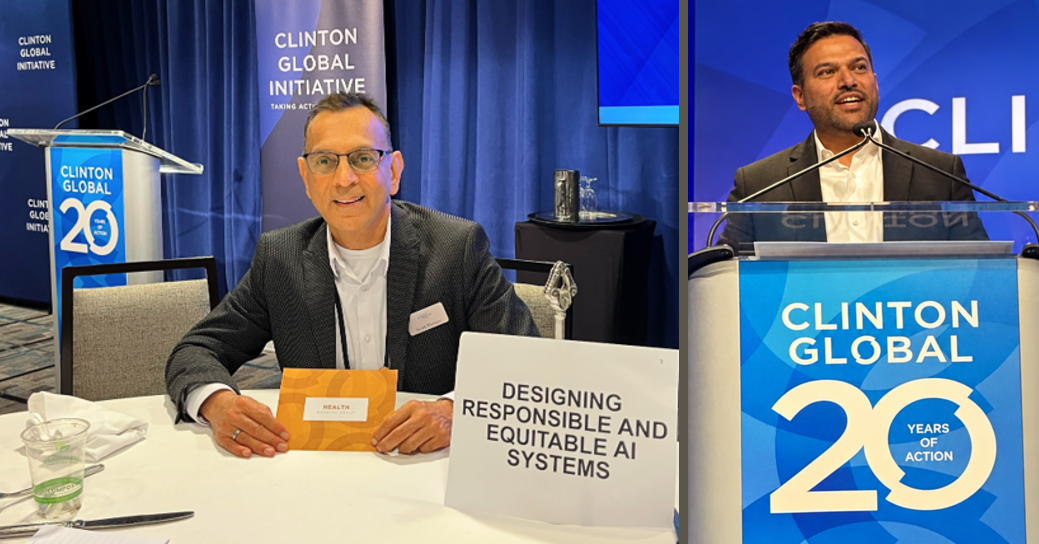
Prof. Bhavnani, from the School of Public and Population Health at UTMB, and CEO Kumar, from Deep Impact AI, recently signed a collaborative agreement to co-develop an AI application to help Houston residents navigate the safety net. Both have recently been in the national spotlight: Prof. Bhavnani’s NIH-funded research was nationally highlighted for its novel AI-to-policy translational path, and CEO Kumar was selected by the Clinton Global Initiative (CGI) as a “commitment maker" for their success in deploying AI applications in the Global South. We asked them about their meeting, handshake, and vision for a long-term public-private partnership.

The Meeting: A Presidential Connection

Both of you walk on different paths, one in academia, the other in industry. How did your paths cross?

Prof. Bhavnani: When I was a Presidential Leadership Scholar, I was honored to meet President Clinton, and briefly discussed with him my project on AI and precision policies. He enthusiastically invited me to attend the Clinton Global Initiative (CGI) Annual Meeting, a summit of global leaders involved in social impact. During the summit, I presented my work on precision policies at an invited-only working group on health equity. The same day, CEO Kumar was selected as a “commitment maker,” a prestigious honor given by CGI to those showing promise in implementing social impact projects. When I ran into him in the lobby, I briefly showed him a video of the application our group had designed called Resource and Access Precision Policy (RAPP) in collaboration with the Houston Health Department. The meeting was short but consequential.

CEO Kumar: Yes, our meeting was brief, but easily one of the best I’ve had at CGI. Few academic projects have a solid empirical foundation, deep stakeholder engagement, and clear commercial potential—RAPP had all three, packaged in a user interface with a public-facing video. I instantly saw how RAPP could help improve the lives of many Americans beyond Houston. Our paths were different, but they crossed through President Clinton.

The Handshake: From Personal Tragedies to Translational AI

Prof. Bhavnani, you have previously noted that “Translation is not a finish line; it is a frequent handshake.” How did both of you arrive at a handshake leading to this collaborative agreement, and what hurdles did you face?

CEO Kumar: The agreement was straightforward: Deep Impact AI will build a prototype or what’s called a minimum viable product of RAPP, and Prof. Bhavnani will provide expertise on the algorithm, and interface informed by user feedback throughout the process. We both hoped to translate RAPP into an enterprise-level solution for the Houston Health Department with the goal of attracting future funding to scale it up for other agencies beyond Houston. The hurdles were mainly to clarify the ownership of the jointly developed software, which our two legal teams iteratively resolved.

Prof. Bhavnani: I agree—we both had excellent legal teams. But unwritten in our agreement is a shared belief: translation must be grounded in alleviating human suffering informed by our own personal stories. Both our fathers had shortened lives struck down by chronic conditions, providing first-hand knowledge of family trauma and the complexities of navigating healthcare systems. Our handshake therefore represents more than a development effort; it is grounded in our personal experiences with a shared commitment to use AI for improving the health of communities in the US and beyond.

The Vision: Navigating the Last Mile

The last mile in translation is known to be the most difficult due to real-world complexities difficult to predict during prototyping. What is your strategy to overcome such hurdles?

Prof. Bhavnani: We both have industry experience addressing such hurdles, and our development strategy carefully balances functionality, workflows, and effort, despite a dynamic sociopolitical landscape. Through deep engagement with our stakeholders, we aim to use AI methods to solve social problems while at the same time making more efficient use of limited resources. RAPP does exactly that by helping Americans navigate the safety net while making more efficient use of available resources. We see an opportunity in the public health arena to complement the extensive development efforts in the clinical arena. But both ultimately should be grounded in alleviating human suffering.

CEO Kumar: Yes, while we are fully tuned into the polarizing discussions about AI, our goal is to produce empirically grounded, real-world human-centered AI solutions that improve the lives of people, starting right here at home.

Community and Institutional Perspectives

"I am delighted that Bhavnani and Kumar have reached this important collaborative agreement. RAPP can help our clients get the combination of services they need to make effective use of available resources."

— Dr. Deborah Banerjee, Bureau Chief, Houston Health Department

"The Bhavnani-Kumar partnership is exactly the kind of public-private collaboration that can lead to sustainable social impact."

— Dr. Vineet Gupta, Vice President for Innovation, Technology Development and Transfer, UTMB

"The collaboration between a UTMB Lab, a private AI company, and a public health department is an exciting example of how Translational AI can bridge different disciplines and organizations for the common good."

— Dr. Randall Urban, Director of the Institute for Translational Science, and PI of the UTMB CTSA

Acknowledgments

Prof. Bhavnani and CEO Kumar extend their sincere thanks to Sundeep Mattamana, PhD, MBA, Executive Director for Technology Development and Transfer, and Frances Streeter, JD, Associate Vice President for Intellectual Property Legal Affairs at UTMB for their invaluable expertise in drafting this collaborative agreement; and to Joshua Chang, PhD, from Deep Impact AI for contributing his extensive knowledge of implementing real-world AI systems. The research was funded by NIH AIM-AHEAD and the UTMB CTSA. The views and reflections expressed in this article are those of the authors and do not necessarily represent the official positions or policies of NIH or UTMB.


Events

By the Numbers

Strength in numbers—driven by dedicated faculty, ambitious students, and impactful research funding shaping the future of public health.

* Approximations subject to change

From the Seas to the Skies, We Are Public Health

Exploring health from every angle—land, sea, and sky—our diverse expertise shapes the future of public health.

SPPH Research

Advancing health through innovative, data-driven research that informs policy, improves care, and impacts communities globally.

 Discover Our Research

Student Spotlights

Celebrating our students’ achievements, impact, and excellence—inside the classroom and beyond.

Professor Bhavnani and CEO Kumar Sign Translational AI Agreement

"Unwritten in our agreement is a shared belief: translation must be grounded in alleviating human suffering informed by our own personal stories.”

Prof. Bhavnani, from the School of Public and Population Health at UTMB, and CEO Kumar, from Deep Impact AI, recently signed a collaborative agreement to co-develop an AI application to help Houston residents navigate the safety net. Both have recently been in the national spotlight: Prof. Bhavnani’s NIH-funded research was nationally highlighted for its novel AI-to-policy translational path, and CEO Kumar was selected by the Clinton Global Initiative (CGI) as a “commitment maker" for their success in deploying AI applications in the Global South. We asked them about their meeting, handshake, and vision for a long-term public-private partnership.

The Meeting: A Presidential Connection

Both of you walk on different paths, one in academia, the other in industry. How did your paths cross?

Prof. Bhavnani: When I was a Presidential Leadership Scholar, I was honored to meet President Clinton, and briefly discussed with him my project on AI and precision policies. He enthusiastically invited me to attend the Clinton Global Initiative (CGI) Annual Meeting, a summit of global leaders involved in social impact. During the summit, I presented my work on precision policies at an invited-only working group on health equity. The same day, CEO Kumar was selected as a “commitment maker,” a prestigious honor given by CGI to those showing promise in implementing social impact projects. When I ran into him in the lobby, I briefly showed him a video of the application our group had designed called Resource and Access Precision Policy (RAPP) in collaboration with the Houston Health Department. The meeting was short but consequential.

CEO Kumar: Yes, our meeting was brief, but easily one of the best I’ve had at CGI. Few academic projects have a solid empirical foundation, deep stakeholder engagement, and clear commercial potential—RAPP had all three, packaged in a user interface with a public-facing video. I instantly saw how RAPP could help improve the lives of many Americans beyond Houston. Our paths were different, but they crossed through President Clinton.

The Handshake: From Personal Tragedies to Translational AI

Prof. Bhavnani, you have previously noted that “Translation is not a finish line; it is a frequent handshake.” How did both of you arrive at a handshake leading to this collaborative agreement, and what hurdles did you face?

CEO Kumar: The agreement was straightforward: Deep Impact AI will build a prototype or what’s called a minimum viable product of RAPP, and Prof. Bhavnani will provide expertise on the algorithm, and interface informed by user feedback throughout the process. We both hoped to translate RAPP into an enterprise-level solution for the Houston Health Department with the goal of attracting future funding to scale it up for other agencies beyond Houston. The hurdles were mainly to clarify the ownership of the jointly developed software, which our two legal teams iteratively resolved.

Prof. Bhavnani: I agree—we both had excellent legal teams. But unwritten in our agreement is a shared belief: translation must be grounded in alleviating human suffering informed by our own personal stories. Both our fathers had shortened lives struck down by chronic conditions, providing first-hand knowledge of family trauma and the complexities of navigating healthcare systems. Our handshake therefore represents more than a development effort; it is grounded in our personal experiences with a shared commitment to use AI for improving the health of communities in the US and beyond.

The Vision: Navigating the Last Mile

The last mile in translation is known to be the most difficult due to real-world complexities difficult to predict during prototyping. What is your strategy to overcome such hurdles?

Prof. Bhavnani: We both have industry experience addressing such hurdles, and our development strategy carefully balances functionality, workflows, and effort, despite a dynamic sociopolitical landscape. Through deep engagement with our stakeholders, we aim to use AI methods to solve social problems while at the same time making more efficient use of limited resources. RAPP does exactly that by helping Americans navigate the safety net while making more efficient use of available resources. We see an opportunity in the public health arena to complement the extensive development efforts in the clinical arena. But both ultimately should be grounded in alleviating human suffering.

CEO Kumar: Yes, while we are fully tuned into the polarizing discussions about AI, our goal is to produce empirically grounded, real-world human-centered AI solutions that improve the lives of people, starting right here at home.

Community and Institutional Perspectives

"I am delighted that Bhavnani and Kumar have reached this important collaborative agreement. RAPP can help our clients get the combination of services they need to make effective use of available resources."

— Dr. Deborah Banerjee, Bureau Chief, Houston Health Department

"The Bhavnani-Kumar partnership is exactly the kind of public-private collaboration that can lead to sustainable social impact."

— Dr. Vineet Gupta, Vice President for Innovation, Technology Development and Transfer, UTMB

"The collaboration between a UTMB Lab, a private AI company, and a public health department is an exciting example of how Translational AI can bridge different disciplines and organizations for the common good."

— Dr. Randall Urban, Director of the Institute for Translational Science, and PI of the UTMB CTSA

Acknowledgments

Prof. Bhavnani and CEO Kumar extend their sincere thanks to Sundeep Mattamana, PhD, MBA, Executive Director for Technology Development and Transfer, and Frances Streeter, JD, Associate Vice President for Intellectual Property Legal Affairs at UTMB for their invaluable expertise in drafting this collaborative agreement; and to Joshua Chang, PhD, from Deep Impact AI for contributing his extensive knowledge of implementing real-world AI systems. The research was funded by NIH AIM-AHEAD and the UTMB CTSA. The views and reflections expressed in this article are those of the authors and do not necessarily represent the official positions or policies of NIH or UTMB.