News

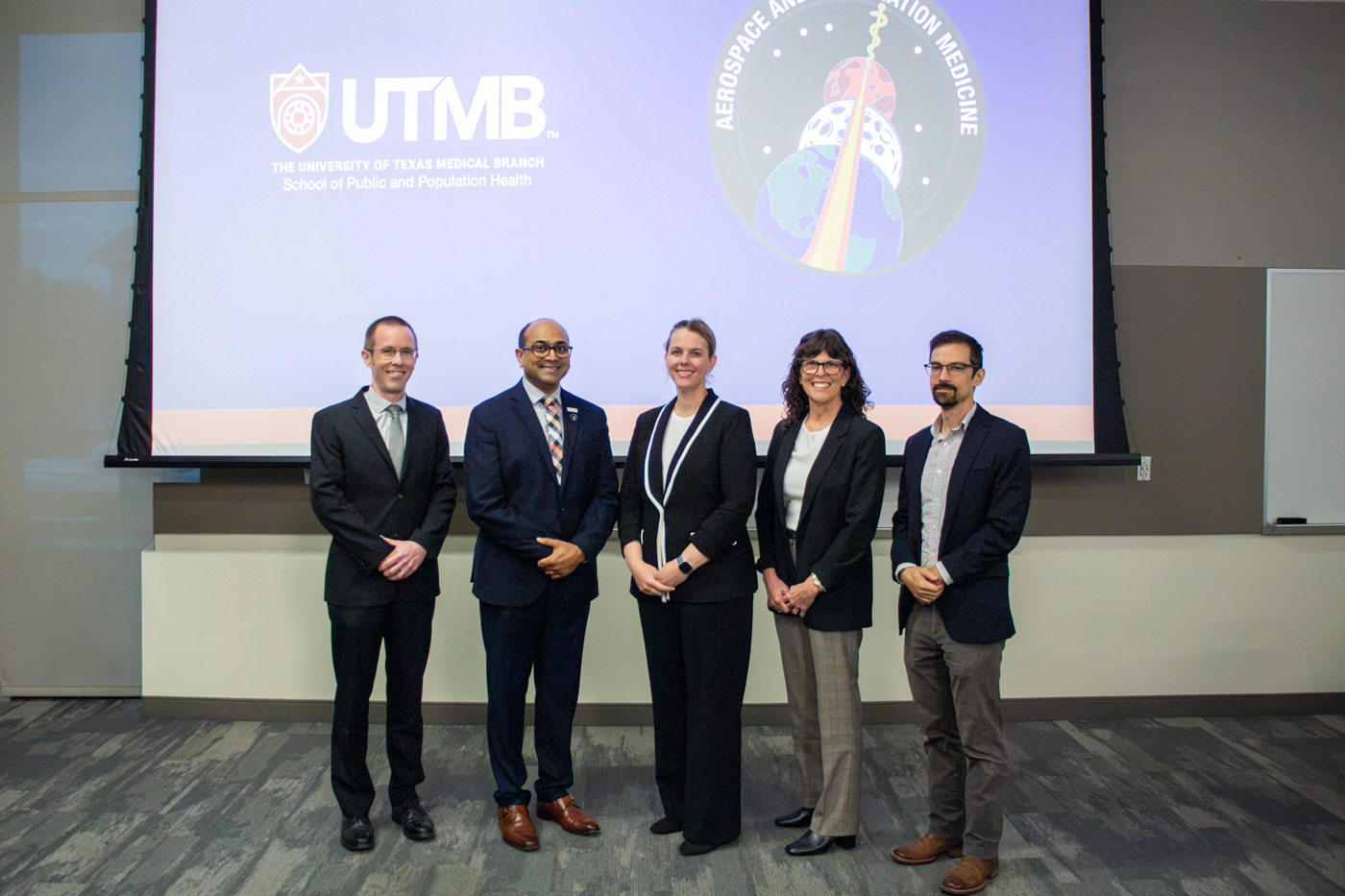
From left, Drs. Matthew Makowski, Ronak Shah, Amy Kreykes, Mary Van Baalen, and John Marshall stand beneath the Aerospace and Exploration Medicine patch on a screen.

UTMB opens Department of Aerospace and Exploration Medicine

The University of Texas Medical Branch (UTMB) School of Public and Population Health opened its Department of Aerospace and Exploration Medicine on Oct. 27, elevating one of the nation's longest-standing civilian aerospace medicine programs into a full academic department.

The opening was marked with a Provost's Lecture by J.D. Polk, DO, NASA's chief health and medical officer and a product of the university's own aerospace medicine training, followed by a ribbon cutting with university leaders, faculty, residents, alumni, partners from NASA and the commercial space industry, and representatives of state and federal lawmakers.

Ronak V. Shah, DO, MBA, MPH, the department's inaugural chair, said UTMB is the first civilian institution to create a department of aerospace and exploration medicine, and that no other institution in the world does what its program does.

A legacy that predates the department

The department is new, but UTMB's role in aerospace medicine dates to the dawn of human spaceflight. In the 1960s, UTMB faculty member Charles Berry, MD, helped select the Mercury Seven astronauts and bring the Apollo 13 crew home safely.

That history took formal shape in the 1990s, when the university and NASA partnered to create the Residency in Aerospace Medicine to meet the needs of the nation's space program. The residency has since produced nearly 80 graduates who have gone on to serve in government, academia, and senior military roles — Polk among them.

Even with that record, Shah said, the program has never been content to rest on its past. What began as a single residency grew into a division and is now a department, with three training pathways in place and a fourth on the way.

Those pathways include the residency and a Master of Science in Aerospace Medicine, and UTMB is launching an Undersea and Hyperbaric Medicine Fellowship in 2027.

UTMB Provost Susan Chubinskaya, PhD, MS, and M. Kristen Peek, PhD, dean of the School of Public and Population Health, announced the department in September.

Why "exploration"

Shah said the question he hears most often is where the word "exploration" came from.

The answer lies in why the faculty do this work at all — the late nights, the weekends, the sacrifices — and in a lineage that runs from Lewis and Clark to the explorers who reached the ocean floor, the tallest peaks, and the stars.

That innate drive to explore defines who the department's people are and why they do the work, which made the word a natural fit.

Where the field is headed
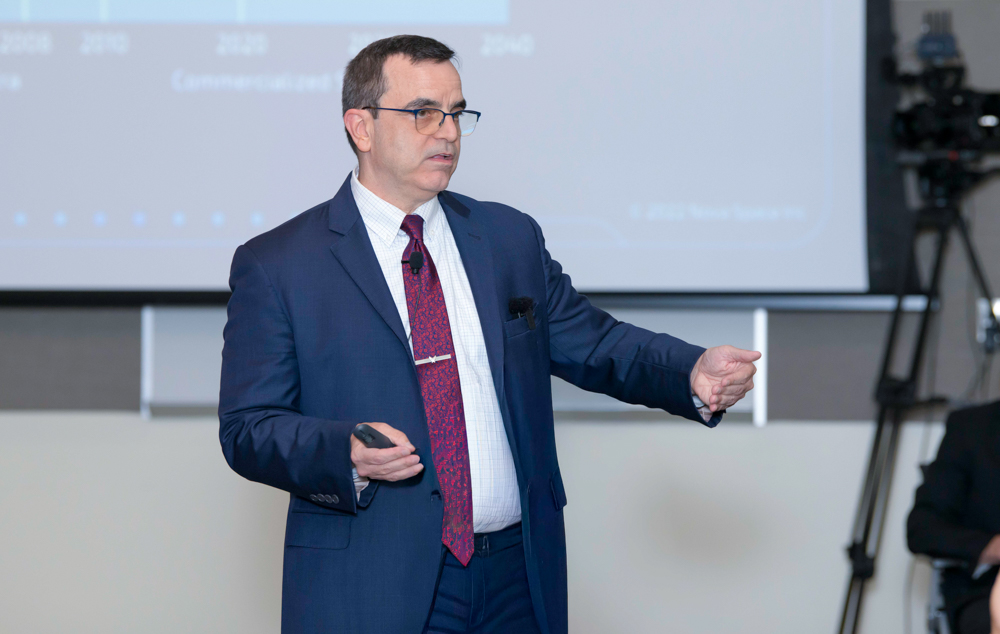
J.D. Polk gestures while delivering a talk on the future of space medicine

In his lecture, Polk, who completed his aerospace medicine training at the university before rising to lead health and medical programs across NASA, said the field is being reshaped by a fast-growing commercial space economy.

He pointed to a workforce gap, with the industry expanding faster than education and training can keep pace, and to commercial flyers who bring a wider range of health conditions to orbit with no Federal Aviation Administration medical standards yet in place for them.

As a result, the discipline is broadening from the care of career astronauts toward "medicine in space," drawing on pharmacology, tissue engineering, artificial intelligence, precision medicine, and occupational health.

Shah credited the faculty, staff, and university leadership who made the department possible, along with Polk's years of mentorship. Shah said the department's continued growth depends on its partners in commercial space, academia, and the military, all working to serve the nation's needs.


See All News & Events 

By the Numbers

Strength in numbers—driven by dedicated faculty, ambitious students, and impactful research funding shaping the future of public health.

* Approximations subject to change

From the Seas to the Skies, We Are Public Health

Exploring health from every angle—land, sea, and sky—our diverse expertise shapes the future of public health.

SPPH Research

Advancing health through innovative, data-driven research that informs policy, improves care, and impacts communities globally.

 Discover Our Research

Student Spotlights

Celebrating our students’ achievements, impact, and excellence—inside the classroom and beyond.

From left, Drs. Matthew Makowski, Ronak Shah, Amy Kreykes, Mary Van Baalen, and John Marshall stand beneath the Aerospace and Exploration Medicine patch on a screen.

UTMB opens Department of Aerospace and Exploration Medicine

The University of Texas Medical Branch (UTMB) School of Public and Population Health opened its Department of Aerospace and Exploration Medicine on Oct. 27, elevating one of the nation's longest-standing civilian aerospace medicine programs into a full academic department.

The opening was marked with a Provost's Lecture by J.D. Polk, DO, NASA's chief health and medical officer and a product of the university's own aerospace medicine training, followed by a ribbon cutting with university leaders, faculty, residents, alumni, partners from NASA and the commercial space industry, and representatives of state and federal lawmakers.

Ronak V. Shah, DO, MBA, MPH, the department's inaugural chair, said UTMB is the first civilian institution to create a department of aerospace and exploration medicine, and that no other institution in the world does what its program does.

A legacy that predates the department

The department is new, but UTMB's role in aerospace medicine dates to the dawn of human spaceflight. In the 1960s, UTMB faculty member Charles Berry, MD, helped select the Mercury Seven astronauts and bring the Apollo 13 crew home safely.

That history took formal shape in the 1990s, when the university and NASA partnered to create the Residency in Aerospace Medicine to meet the needs of the nation's space program. The residency has since produced nearly 80 graduates who have gone on to serve in government, academia, and senior military roles — Polk among them.

Even with that record, Shah said, the program has never been content to rest on its past. What began as a single residency grew into a division and is now a department, with three training pathways in place and a fourth on the way.

Those pathways include the residency and a Master of Science in Aerospace Medicine, and UTMB is launching an Undersea and Hyperbaric Medicine Fellowship in 2027.

UTMB Provost Susan Chubinskaya, PhD, MS, and M. Kristen Peek, PhD, dean of the School of Public and Population Health, announced the department in September.

Why "exploration"

Shah said the question he hears most often is where the word "exploration" came from.

The answer lies in why the faculty do this work at all — the late nights, the weekends, the sacrifices — and in a lineage that runs from Lewis and Clark to the explorers who reached the ocean floor, the tallest peaks, and the stars.

That innate drive to explore defines who the department's people are and why they do the work, which made the word a natural fit.

Where the field is headed

J.D. Polk gestures while delivering a talk on the future of space medicine

In his lecture, Polk, who completed his aerospace medicine training at the university before rising to lead health and medical programs across NASA, said the field is being reshaped by a fast-growing commercial space economy.

He pointed to a workforce gap, with the industry expanding faster than education and training can keep pace, and to commercial flyers who bring a wider range of health conditions to orbit with no Federal Aviation Administration medical standards yet in place for them.

As a result, the discipline is broadening from the care of career astronauts toward "medicine in space," drawing on pharmacology, tissue engineering, artificial intelligence, precision medicine, and occupational health.

Shah credited the faculty, staff, and university leadership who made the department possible, along with Polk's years of mentorship. Shah said the department's continued growth depends on its partners in commercial space, academia, and the military, all working to serve the nation's needs.