Once a year, the people who keep pilots and astronauts healthy gather at the Aerospace Medical Association's scientific meeting — flight surgeons and researchers from the military services, NASA, industry, and a small number of university programs. This year's meeting ran May 17 through 21 in Denver, and UTMB Aerospace Medicine was present at nearly every level of the field at once. Current residents earned the meeting's training awards and its top quiz-bowl trophy, faculty chaired the sessions and committees that set the specialty's standards, and alumni collected several of its career and lifetime honors.
11 Awards earned | 8 Podium presentations |
4 Societies served | 82% Top RAM Bowl score |
A memorial lecture on motion sickness in spaceflight
Dr. Amy Kreykes, who directs UTMB's aerospace medicine residency, and Rebecca Blue, a program alumna and former faculty member, delivered the Eugene Reinartz Memorial Lecture. They presented the management of spaceflight-associated motion sickness using the Spaceflight Health Aggregated Research Evidence Database, or SHARED, which pools study results to guide how flight surgeons handle a problem that affects many crew members in the first days of a mission.
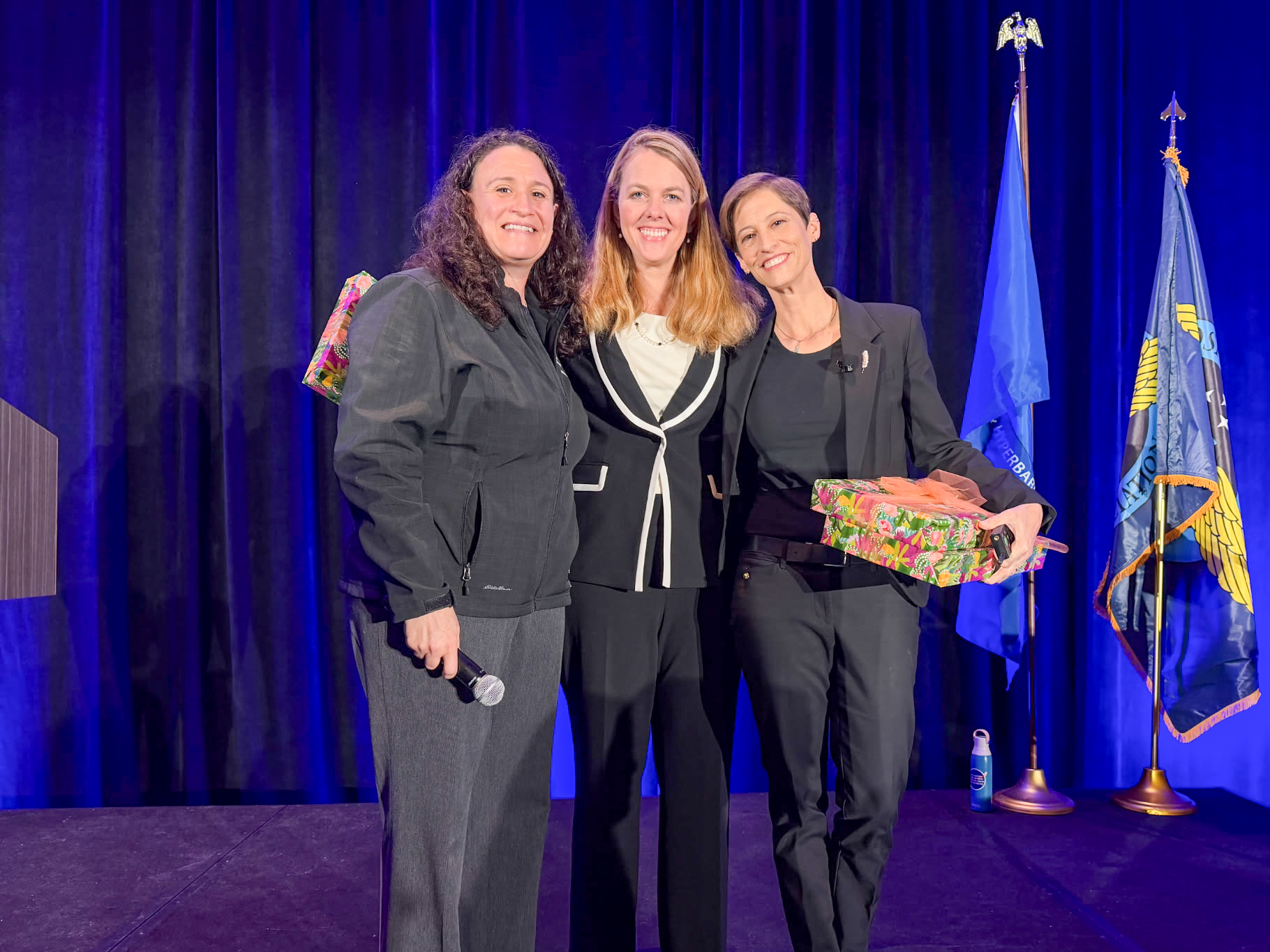
Joining them on the panel were Serena Auñón-Chancellor and Tom Marshburn, both NASA astronauts with ties to the program. Auñón-Chancellor is a former faculty member, and Marshburn is an alumnus of the residency.
RAM Bowl champions again
The RAM Bowl is the meeting's annual quiz competition, a test of how well residents know the full range of aerospace medicine, from the physics of the flight environment to clinical care, accident investigation, and aviation regulation. Teams from the Air Force, Navy, Army, Mayo Clinic, and a group of hyperbaric medicine fellows compete for the Louis H. Bauer Trophy. UTMB is one of four residency programs accredited to train aerospace medicine physicians in the United States, and the only one based at a university rather than a branch of the military. Its residents took the trophy again this year, outscoring the three military programs for a title the program has held many times before.
Sam Stephenson was named the competition's most valuable player as the top individual scorer across every team, answering an average of 82 percent of his questions correctly.
Early-career honors for residents
Four UTMB residents earned individual awards. Vasilis Mavratsas received the Julian E. Ward Memorial Award, given each year for outstanding achievement during aerospace medicine residency. The award is named for the first member of the Society of U.S. Air Force Flight Surgeons to die in an aircraft accident, and it honors flight surgeons lost in the practice of the field. Andrew Lam received the Society of NASA Flight Surgeons Outstanding Student Award. Clare McNerlin received the Anita Mantri, PhD Memorial Award from the Aerospace Medicine Student and Resident Organization. Daniel Cox was awarded the Stanley R. Mohler Aerospace Medicine Endowed Scholarship from the AsMA Foundation, a training grant for students and residents early in their aerospace medicine careers.
Eight presentations across operational and space medicine
UTMB faculty, residents, and incoming residents delivered eight podium presentations. Several came from residents working through hypothetical astronaut cases, the kind of return-to-flight decisions a flight surgeon faces when a crew member develops a medical problem in orbit.
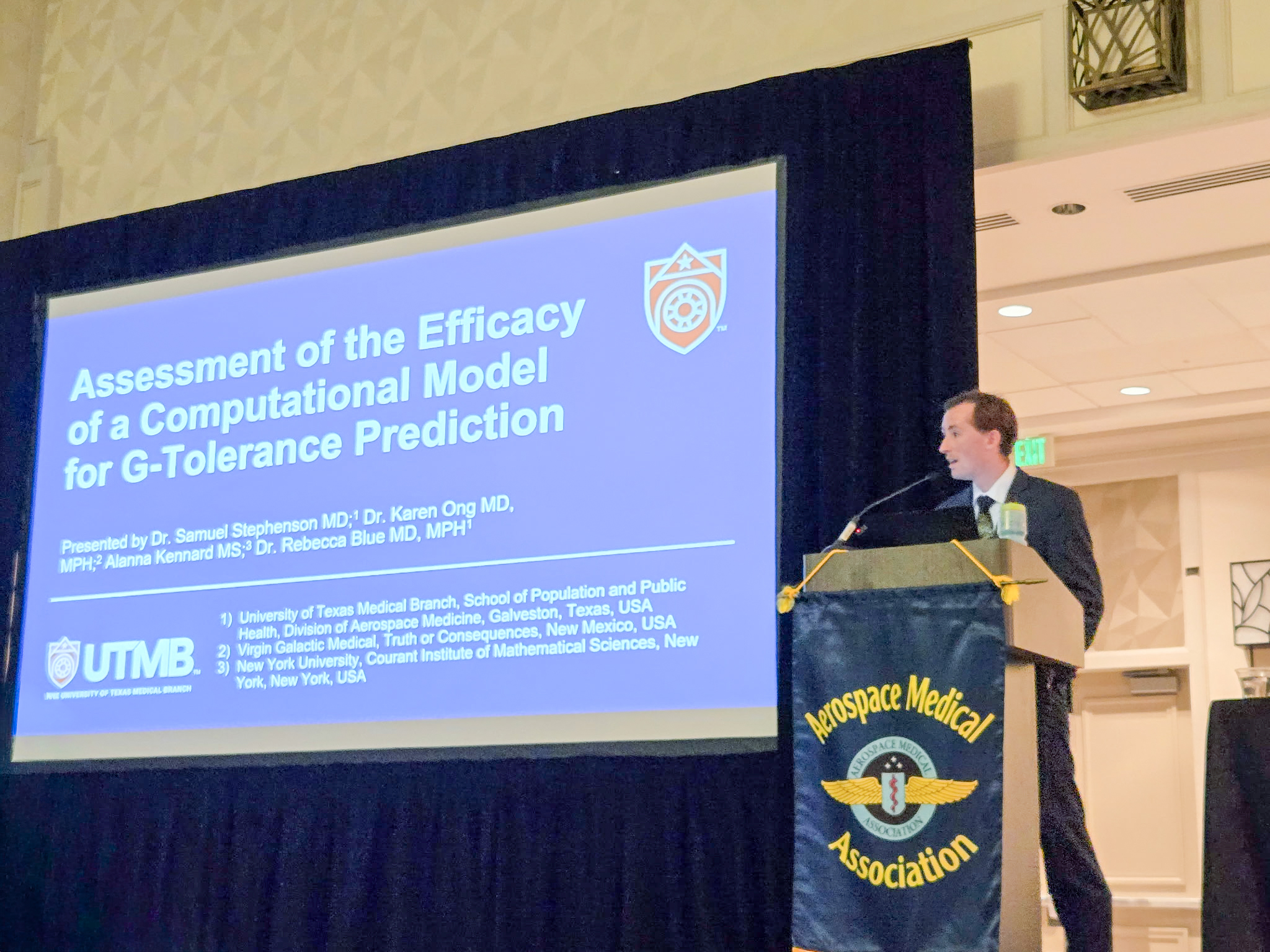
One case worked through the aeromedical questions raised by a pituitary tumor. Another followed a collection of fluid under the retina that appeared during a six-month mission and resolved after the crew member returned to Earth. Others examined how to certify a crew member for flight after hernia repair and how to weigh kidney-stone risk before a long-duration mission.
Dr. Kreykes also gave a rapid review of spatial disorientation, the loss of orientation in flight that remains a leading cause of fatal aviation accidents, during the specialty's board-exam review session.
Alumni collect the field's career awards
The meeting also recognized a generation of UTMB-trained physicians now working at NASA, in the military, at Mayo Clinic, and across industry. Joseph Dervay, a longtime NASA flight surgeon, received the Space Medicine Association's Lifetime Achievement Award for sustained contributions to space medicine. Benjamin Johansen received the Harry G. Moseley Award for contributions to flight safety, and at the same meeting chaired a panel on the joint medical framework that NASA, the Canadian Space Agency, and the U.S. military are building to recover Artemis crews after splashdown. Alejandro Garbino, who received the Sidney D. Leverett Jr. Environmental Science Award for work in environmental medicine, presented findings on the decompression-sickness risk of back-to-back lunar spacewalks, a question that will shape how often Artemis crews can work outside on the Moon.
One alumni-led team reported the first complete intravenous fluid infusion performed aboard the International Space Station, a procedure carried out during on-orbit medical training that had not been done in the station's twenty-five years.
| Award | Recipient |
|---|
| Space Medicine Association Lifetime Achievement Award | Joseph Dervay |
|---|
| John Paul Stapp Award | James Pattarini |
|---|
| Harry G. Moseley Award | Benjamin Johansen |
|---|
| Theodore C. Lyster Award | Jan Stepanek |
|---|
| Sidney D. Leverett Jr. Environmental Science Award | Alejandro Garbino |
|---|
| Boothby-Edwards Award | Charles “Chuck” Mathers |
|---|
| Space Medicine Association Award for Journal Publication | Samantha King |
|---|
All recipients are UTMB Aerospace Medicine alumni.
Leading the organizations that shape the specialty
Beyond the awards, UTMB faculty and alumni hold elected and appointed positions across four of the field's professional societies.
| Dr. Amy Kreykes chairs the Education and Training Committee of the American Society of Aerospace Medicine Specialists, the body that represents the field's specialists within AsMA. |
| Dr. Amy Kreykes and Ethan Stephens serve on the Aerospace Medical Association's Education and Training Committee. |
| Dr. Natacha Chough was elected First Vice President of the Society of NASA Flight Surgeons. |
| Dr. Tarah Castleberry and Craig Kutz were elected Members at Large of the Space Medicine Association for 2026 through 2029. |
At the meeting itself, Dr. Kreykes chaired the board-exam review session that the four accredited residencies run together for physicians preparing for certification, and co-chaired a clinical-case session during Grand Rounds. Faculty took part in all three of the meeting's speed-mentoring sessions, meeting prospective applicants at a point when the program has opened its master's degree to professionals working outside the residency.
The week in Denver reflected a program present at every stage of a career in the field — the newest residents, the faculty who set its standards, and the alumni who have spent decades advancing it. For thirty years, UTMB Aerospace Medicine has trained the flight surgeons and researchers who do this work.
Explore UTMB Aerospace Medicine