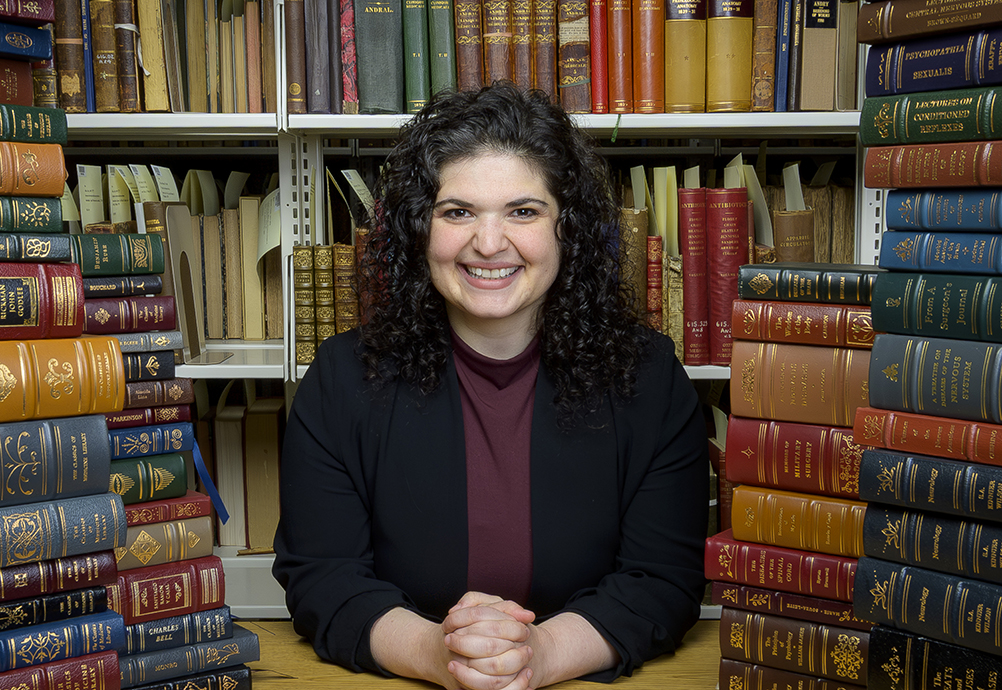
In July, Columbia University Press will publish Monstrous Conceptions, the first book by Dr. Miriam Rich, the James Wade Rockwell Assistant Professor of Philosophy of Medicine at UTMB’s Institute for Bioethics and Health Humanities. The book traces the history of “monstrosity” as a formal category in American medicine, examining how nineteenth-century practitioners turned the bodies of infants born with major anatomical differences into objects of scientific study, and how that scientific work shaped enduring ideas about race, sex, and disability.
Discovering ‘monster’ in a medical manual
Dr. Rich’s interest in this history began with a passage in a nineteenth-century medical jurisprudence manual, a guide intended to counsel physicians on serving as expert witnesses in court. The manual was self-consciously professional in tone, working hard to present medicine as scientific and forward-looking. It also contained a section advising physicians on what issues might arise around the birth of “monsters.” That matter-of-fact use of a word that today reads as jarring became the entry point for the project.
To nineteenth-century practitioners, there was no incongruity. The category of “monstrosity” was a formal scientific designation, embedded in the rising profession of medicine, and it continued to appear in some mainstream medical journals into the late twentieth century.
“Today, it would rightly be considered shocking and outrageous for a medical professional to classify a human being as a ‘monster,’” said Dr. Rich. “Yet practitioners routinely used the word in this way for generations.”
The historical category, she argues, both reflected and facilitated profoundly stigmatizing conceptions of human difference and disability, “contributing to ideas about ‘deviant’ and ‘defective’ bodies that we still grapple with today.”
Monstrosity as a medical category
In 1832, the French scientist Isidore Geoffroy Saint-Hilaire defined teratology as “the modern scientific study of monsters.” American medical practitioners readily engaged with the field, applying the term “monstrous birth” to infants born with conditions such as anencephaly. They studied these infants as specimens, presented them at professional society meetings, dissected them, and added preserved bodies and organs to anatomical museum collections.
In Monstrous Conceptions, Dr. Rich argues that this scientific work was not neutral. The category of monstrosity gave form to pervasive ideas about racial difference and human variation, and it helped lay the groundwork for the American eugenics movement. Some of those ideas continue to shape how bodies marked as different are understood today, even after the formal medical category fell out of use.
“None of the infants discussed in this book were inherently ‘monstrous.’ Their bodies were configured and presented as ‘monsters’ through specific historical practices. By narrating, interacting with, preparing, displaying, visualizing, and classifying newborn bodies as ‘teratological monsters,’ historical practitioners constructed the medical category of monstrosity.”
Dr. Miriam Rich
Reading patient and family voices through medical archives
Much of the book’s source material consists of nineteenth-century medical case reports, illustrations, photography, and organizational records of hospitals and research institutes. Dr. Rich also drew on surviving anatomical collections, including one preserved at UTMB. Her argument turns on what these sources reveal when read against the dominant narrative they were authored to support.
Some history of medicine focuses almost exclusively on physicians, but they’re not the only relevant ones, she notes. The book centers not only physicians but also the lived experiences of childbearing women and their families, showing how everyday women participated in the production of medical meaning even as practitioners were claiming singular authority over reproduction.
To recover those voices, Dr. Rich draws on what scholars call reading against the grain. When they wrote case reports, nineteenth-century physicians did not explicitly intend to convey information about things like the emotional dimensions of medical practice, broader cultural attitudes toward human difference, or the social contexts of their patients’ lives. However, careful attention to how they described and recorded their interactions with patients, infants, and families opens a window onto matters the texts were not intentionally designed to document.
“In my book, I approach medical meaning making as a historical process that involved multiple different kinds of people, practices, sites, and sensory modalities,” said Dr. Rich. “To do this, I turned to creative methods drawn from a variety of academic disciplines.”
To understand the emotional and cultural meanings that physicians attached to “monstrosity,” she examined descriptions of how liveborn infants with anencephaly were touched and cared for in the postpartum period, and analyzed the visual details of such infants’ portrayals in medical illustrations. To reconstruct the experiences of laywomen who were largely excluded from nineteenth-century medical archives, she searched for, contextualized, and reassembled fragmentary details about them found in physician-authored reports.
Teaching at the medical school and in graduate seminars
Dr. Rich completed her PhD in history of science at Harvard, and before joining UTMB she held a position at Yale University’s School of Medicine. The Institute for Bioethics and Health Humanities (BHH), where she now teaches, is part of UTMB’s School of Public and Population Health (SPPH). Her teaching also reaches the John Sealy School of Medicine (JSSOM). She leads several of the foundational ethics and humanities sessions in the medical school’s Doctoring and Clinical Skills course for first- and second-year students, covering topics such as the history and ethics of human subjects research, the ethics of end-of-life care, and the historical relationship between law and medicine. At the graduate level, she teaches seminar courses primarily for BHH PhD students, with master’s students across SPPH welcome to enroll.
She also serves as the inaugural director of a new Bioethics and Health Humanities scholarly concentration for medical students. The concentration will allow medical students to earn a certificate in Bioethics and Health Humanities alongside their MD by completing block segments in BHH graduate courses, participating in the department’s weekly seminar and other events, and conducting mentored scholarly research on topics in bioethics and health humanities. The first cohort will begin small and grow gradually after the initial rollout.
Publication and campus events
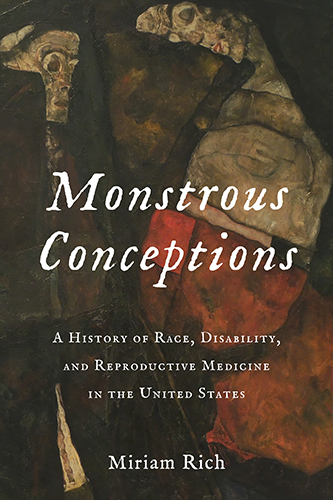
Monstrous Conceptions will be published by Columbia University Press in July 2026. The book is available for pre-order online through Columbia University Press or Barnes & Noble.
A campus book launch event is planned for Friday, September 4, from 3–5 p.m. at the Open Gates Conference Center, with additional details to be shared closer to the event. Dr. Rich will also give book talks at several universities during the fall.
Learn more about Monstrous Conceptions from Columbia University Press.