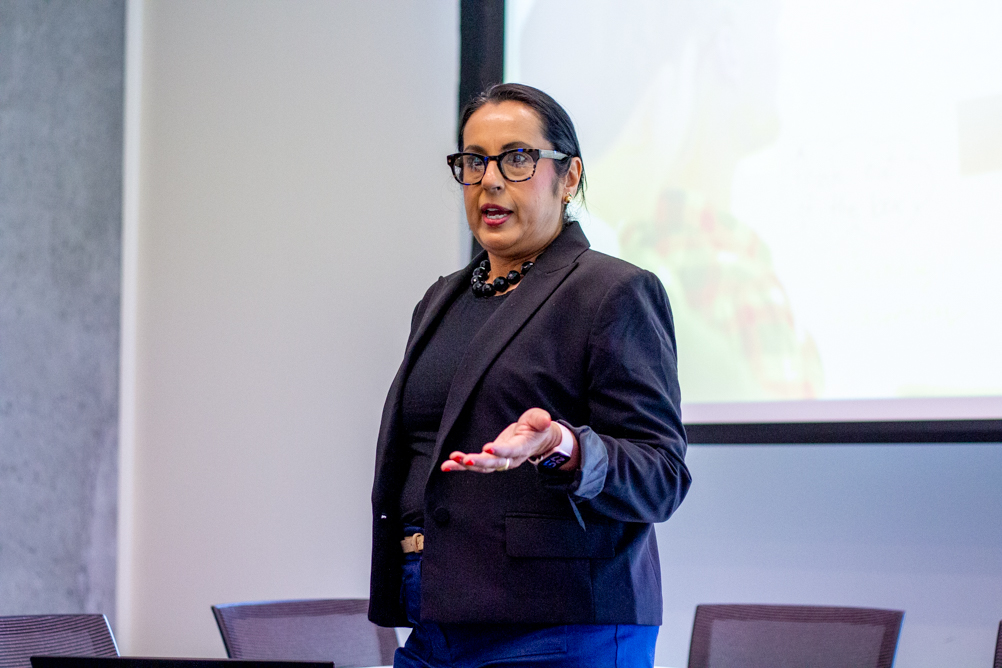
Monisha Arya, MD, MPH walked through what makes a health campaign land with its audience and what makes it miss. The Master Class, co-hosted by the Department of Population Health and Health Disparities and the School of Public and Population Health, drew on Dr. Arya's award-winning campaign work in HIV prevention, hepatitis screening, and HPV vaccination.
Dr. Arya framed the afternoon around a premise familiar to anyone who lived through the first years of COVID-19. The pandemic was the one health story every American was exposed to, and many of the campaigns that came out of it left people more confused than informed.
The same gaps that sometimes produced contradictory mask guidance and abstract social-distancing slogans show up in the rest of public health work too. Clinical trial flyers full of jargon that no patient uses. Blood pressure ads scrolled past at nine at night on Instagram, where the audience is winding down rather than taking in health advice.
The Master Class was about closing those gaps with the strategies marketers use every day to move people toward action.
The BACMEE framework for health campaign design
Dr. Arya's working acronym, expanded from an existing health communication framework, lays out the six components every campaign has to account for.
B | Budget Real campaigns cost real money. Formative research, production, implementation, evaluation, and consultants all draw from the same line. Even flyers around campus add up. |
A | Audience Demographics are a starting point. Geographic context, cultural norms, values, mood at the moment of exposure, and where the audience sits in the stages of behavior change all shape what will land. The narrower you can describe your audience, the more the rest of the framework starts to design itself. |
C | Channel Where does the audience actually spend time, and in what frame of mind when they are there? The right channel could be traditional media, social media, an interpersonal conversation, or a multi-channel mix. The audience profile determines the answer. |
M | Message Audience and channel determine what the message looks like. Words and images should evoke emotion in the half-second before conscious thought catches up, and a clear call to action tells the audience what to do next. |
E | Exposure Right place, right time. Repeated messages reach people at different stages of readiness, and a single channel is rarely enough to move a behavior on its own. |
E | Evaluation Did the campaign change behavior, or only awareness? Public health and marketing measure success differently, and surveys are not the only tool. The strongest evaluation plans are designed before the campaign launches. |
Of the six components, audience was the one Dr. Arya kept circling back to. She walked through campaign after campaign where audience-first thinking either rescued or sank the work.
The Indian Health Service used the length of a canoe to define six feet of social distance, because canoes were a familiar reference point for the tribal communities the campaign was meant to reach.
Whole Foods placed footprint stickers six feet apart on the floor of the checkout line, meeting a bored shopper exactly where she was already standing.
By contrast, a CDC sign on the beach that told already-out-of-the-house beachgoers to stay home reached the wrong audience at the wrong moment, in the wrong mood.
The framework is most useful as a sequence, and the sequence starts with knowing exactly who you are talking to.
With the framework in hand, the room split into two teams for the closing design challenge. Each team had 30 minutes, an unlimited fictional budget, and a slip of paper with their audience on it. The prompt was the same for both groups. Design a skin cancer prevention campaign for whoever you have been given.
Team one builds a softball campaign for 15-year-old girls
The first team drew "15-year-old girls" as their audience and immediately ran into the central problem of teen-targeted health messaging. Teens do not worry about cancer, because they do not believe it will happen to them. The framework forced the team off cancer prevention as the headline and toward a product the audience would choose for themselves. They landed on a body lotion with SPF, marketed as athletic skincare rather than as a medical intervention.
The team segmented further, narrowing the audience to softball-oriented 15-year-old girls. Galveston context made the choice credible, and athletes already think about their future selves in a way that the average teen does not. With a tightly defined audience, the rest of the framework fell into place. Their channel was functional swag. Branded water bottles, carabiners, and music-playing clip-ons that would hang off softball gear and play a snippet when pressed. Their messenger was Billie Eilish, whose song "My Future" anchored the campaign emotionally around self-love and forward-looking confidence. Their tagline, "protect your skin game," translated SPF into the language of athletic identity. Skin cancer prevention itself appeared only in the fine print, where the parents and the public health statisticians could find it.
Exposure ran through championship sponsorships, retail partnerships with Academy and Dick's Sporting Goods, and product placement at a Billie Eilish concert. Dr. Arya pushed back with questions. Are you sure Billie Eilish maps to this audience? Are these urban or rural softball players? Each question pointed back to the same lesson she had been working through all afternoon.
The narrower the audience definition, the sharper every other decision becomes.
Team two pitches a hat to balding fishermen
The second team had 60-year-old men as their starting audience and worked down through the same kind of segmentation Team one had used. Galveston and the Gulf Coast narrowed the geography. Fishing narrowed the lifestyle. From there, the team focused on balding fishermen specifically.
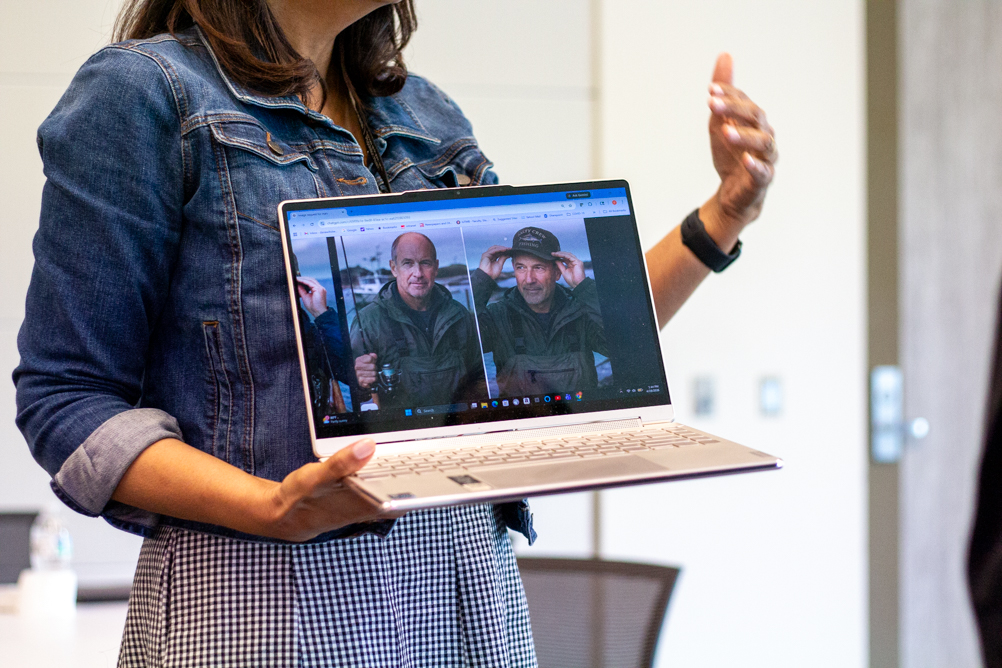
The team wanted the image at the center of the campaign to show a before-and-after graphic of a balding 60-year-old wearing a hat and looking sexy in it, so the visual sold the outcome before the tagline asked anyone to want it. The tagline: "Look Sexy and Prevent Skin Cancer".
Channel selection followed the audience. Bass Pro Shops, smaller bay shops, fishing expos, and the bass tournaments that draw fishermen from across the region all put the campaign in front of the audience in the mood it wanted to reach. In-store billboards and repeat monitors at point of sale would catch a fisherman as he was already shopping for gear. A commercial cut for the broadcast of a bass tournament would catch him at home, in the middle of an event he chose to spend his afternoon watching. The team also wanted vinyl decals of the sexy-fisherman image to live on the back of boats, so every fisherman who picked up a hat carried a piece of the campaign with him every time he towed his boat through town.
Both pitches were unfinished by design. Half an hour is not enough to build a real campaign. It is enough, Dr. Arya argued, to walk the framework end to end and feel where each decision pulls on the next.

Dr. Monisha Arya is Assistant Professor of Medicine in the Section of Infectious Diseases at Baylor College of Medicine and Director of Marketing for the Houston AIDS Education and Training Center. She is the founder of Arya Communications, the healthcare marketing consultancy she launched in 2019. Her award-winning campaign work, recognized by the CDC, NIH, and the Society for Health Communication, has focused on HIV prevention, hepatitis screening, and HPV vaccination, including NIH-funded research on patient and provider barriers to routine HIV testing in safety-net health systems.