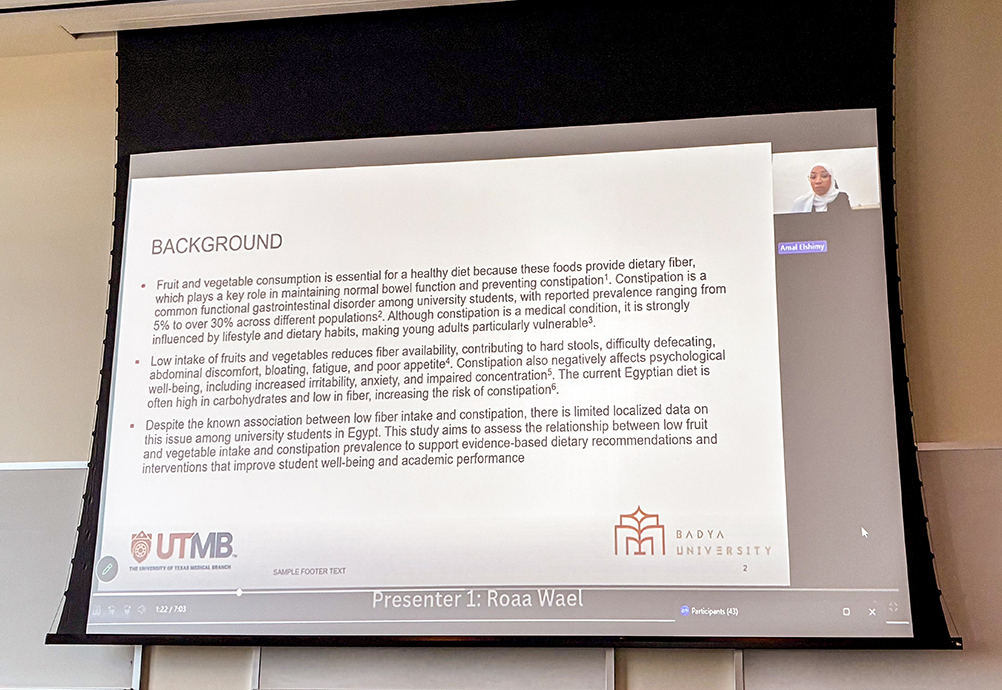
Six second-year medical students from Badya University in Cairo, Egypt, presented original research at UTMB's Public Health Symposium on Wednesday, marking the first time the university's students have shared their work at an international scientific forum. The e-poster session, held during National Public Health Week 2026, drew questions and feedback from senior UTMB faculty and leadership across multiple schools.
The session opened with remarks from SPPH Dean Dr. Kristen Peek, who called the presentations a celebration of student achievement and potential. She acknowledged the Badya University leadership and faculty for their role in building the collaboration and encouraged the students to continue asking difficult questions and building connections that will shape their careers.

Badya University leadership joined via video to express appreciation for the partnership and to recognize the faculty mentors and UTMB partners who guided the students through the research process. The students' ability to translate basic science learning into applied public health scholarship during their second year of medical school was described as a point of institutional pride for both universities.
Student-Led Research on Lifestyle and Digestive Health
All six studies examined the relationship between common lifestyle factors and gastrointestinal health among university students in Egypt. The research teams used cross-sectional survey designs to collect data from Egyptian university populations, with faculty mentorship from both Badya University and UTMB. Their topics spanned dietary habits, sleep patterns, academic stress, and digestive outcomes.
One study surveyed 241 students about fruit and vegetable intake and found a wide gap between knowledge and behavior. While 68% of respondents said they understood fiber's role in digestive health, only 28% consumed enough fruit and only 31% consumed enough vegetables. The most commonly reported barrier was academic schedules leading to skipped meals and reliance on fast food. Students who consumed fewer than two servings of fruits and vegetables per day were more likely to report constipation during exam periods.
A second study of 229 students found that roughly a quarter skipped breakfast almost every day, with 40% citing being in a rush as the primary reason. The most common symptom among breakfast skippers was stomach cramps, reported by 34% of respondents. Nearly 72% of participants said their GI symptoms improved when they ate breakfast regularly.
Other studies in the session examined how fast food consumption relates to GI symptoms and body composition changes, the association between sleep disturbances and bowel habits, the effects of late-night snacking on digestive health, and the dose-response relationship between exam-related academic stress and gastrointestinal symptoms. Across all six studies, the students found that preventable lifestyle factors were closely linked to digestive discomfort that affected academic performance and well-being.
UTMB Faculty Pushed the Students Further
The live Q&A sessions drew pointed, constructive questions from UTMB faculty across disciplines. Karen Szauter, MD, a professor of internal medicine and assistant dean for educational affairs at the John Sealy School of Medicine, asked the constipation study team about an apparent contradiction in their data.
Students reported perceiving their diets as high in fiber while simultaneously consuming fewer than two servings of fruits and vegetables per day. Dr. Szauter asked whether students might be counting alternative fiber sources, and whether fluid intake had been considered as a variable, since fiber depends on hydration to support bowel function.
The presenting student explained that the gap became visible as survey questions grew more specific, suggesting the issue was less about awareness and more about students' limited understanding of recommended daily intake amounts.

During the breakfast study presentation, Alan Landay, PhD, UTMB's Vice President for Team Science and a professor in the Department of Internal Medicine, asked how skipping breakfast might affect students' ability to perform on exams, noting that the cognitive and mental health effects of missed meals could be just as significant as the gastrointestinal symptoms the study measured.
Charles P. Mouton, MD, MS, MBA, Vice President and Executive Dean for the John Sealy School of Medicine and Senior Advisor to the President, recommended the team go beyond binary measures of whether students ate or skipped and instead examine the actual caloric and macronutrient composition of what was consumed, particularly how protein, carbohydrate, and fat ratios relate to symptom relief.
What Comes Next for the Partnership
The UTMB-Badya University collaboration began in 2023 and focuses on training Egypt's next generation of health professionals through student-centered and active learning approaches while building integrated academic and clinical systems. Faculty mentors from both institutions co-supervised all six studies presented at the symposium.
For more on the partnership's scope and history, read the full profile of the UTMB-Badya collaboration.
Poster Presentations
Association Between Low Fruit and Vegetable Intake and Constipation Among University Students in Egypt
Roaa Wael, Mustafa Alkameli, Reem Ahmed, Farida Khamees, Ebrahim Elkolaly, Neveen Mohammed, Darin Abdelaziz, Hind Ahmad, Dareen Ameen, Reem Sayed, Maryam Badran, Ahmed Fathy, Nagy Ahmed, Youssef Ahmed, Mohamed Yasser, Zeyad Attala, Amar Mohamed, Ahmed Ramy, Moaz Alsayed, Adham Youssef, Yassin Mahmoud, Bassem Reda, Malak Ashraf, Seba Mohamed, Abdelrahman Mahmood, Abdullah Kortam, Layan Khalid, Nadine Ibrahim, Mohammed Atrees, Naira Mohamad, Hoda K. Hassan, Elham Adel Heikal, Amal Elshimy, Hend Samy, Hanaa S. Sallam
School of Medicine, Badya University, Egypt | School of Public and Population Health, The University of Texas Medical Branch | School of Medicine, Cairo University, Egypt | School of Medicine, Al Azhar University, Egypt
This survey looked at how fruit and vegetable intake relates to constipation among university students in Egypt. The central pattern was straightforward. Students reported understanding the value of fiber, yet many still fell short on day-to-day intake, and constipation symptoms were especially common during periods of academic stress.
241 Students surveyed | 53.8% From medical schools | 39% Reported abdominal bloating |
Why the study matters
Fruits and vegetables provide dietary fiber that helps maintain normal bowel function and lower constipation risk. The study also notes that constipation can affect concentration, irritability, and daily comfort, which makes the issue relevant to student well-being and academic performance.
The authors focused on university students in Egypt because local data on this topic remain limited, even though busy schedules, low-fiber convenience foods, and high-carbohydrate diets may all shape bowel health.
What the survey set out to measure
- Knowledge, habits, and barriers related to fruit and vegetable intake
- Prevalence of constipation symptoms and stress-related bowel changes
- Associations between low intake and constipation indicators
How the survey was conducted
Design Cross-sectional descriptive and analytical study
Participants 241 students enrolled in Egyptian universities, ages 17 to 32, able to provide informed consent
Data collection Anonymous online self-administered questionnaire
Analysis Descriptive statistics and cross-tabulations with row percentages
Constipation symptoms reported
| Abdominal bloating | | 39% |
| Hard or lumpy stools | | 39% |
| Symptoms affect life and academics | | 27% |
| Incomplete emptying | | 26% |
| Laxative use | | 23% |
| Straining | | 22% |
n = 241
Knowledge and eating habits
| Diet includes high-fiber foods | | 94% |
| Understand fiber's role | | 68% |
| Consume enough vegetables | | 31% |
| Consume enough fruit | | 28% |
The gap between knowledge and practice is one of the clearest patterns in the poster.
Barriers to regular fruit and vegetable intake
| Delay meals or skip breakfast | | 55% |
| Forget to include them | | 43% |
| Choose snacks instead | | 42% |
| Eat the same limited foods | | 38% |
| Rely on fast food | | 38% |
| Prefer fast food | | 30% |
| Not regularly available | | 26% |
| Less convenient | | 23% |
Selected associations in the data
| Comparison | Reported percentage |
|---|
| Consume fewer than two vegetable servings per day and report constipation during exam periods | 41% |
| Consume more than two servings and report constipation during exam periods | 26% |
| Do not include high-fiber foods daily and report straining | 25% |
| Include high-fiber foods daily and report straining | 19% |
What the findings suggest
The poster argues that low fruit and vegetable intake is common among students and is associated with constipation and worsening gastrointestinal symptoms during stressful periods. It also points to a knowledge-behavior gap. Students may know fiber matters, yet convenience, routine, and food access still shape what they eat.
The authors recommend campus-based nutrition education, stronger access to healthier food options, and support for better eating habits during high-stress academic periods.
Selected references
WHO. Increasing fruit and vegetable consumption. 2023.
Suares NC, Ford AC. Systematic review of fiber in chronic idiopathic constipation. Aliment Pharmacol Ther. 2011.
Hardeman W, et al. Intention-behavior gaps in healthy eating. Br J Health Psychol. 2002.
Impact of Skipping Breakfast on Digestive Comfort and Distress Among Late Teenage Students Across Different Countries
Samar M. Nouman, Omar Salem Fawzy, Shams Ayman, Moataz A. Fouad, Cady ElGamal, Ibrahem O. Saied, Hoda K. Hassan, Sara Kamal Mattout, Amal Elshimy, Hend Samy, Hanaa S. Sallam
On behalf of Badya University School of Medicine Undergraduate Research Group E2, Year 2 medical students | The University of Texas Medical Branch | School of Medicine, Badya University | School of Medicine, Cairo University
This poster examined how often students skip breakfast, why they do it, and whether that pattern relates to gastrointestinal discomfort. Across the survey, breakfast skipping was common. A large share of students also reported that their digestive symptoms improved when they did eat breakfast.
229 Students surveyed | 86.6% From Egypt | 71.7% Reported better GI comfort when eating breakfast |
Why the study matters
Breakfast provides energy and nutrients after an overnight fast, yet students often skip it because of rushed schedules, academic pressure, and shifting daily routines.
The study focused on digestive comfort and distress, including stomach cramps, bloating, constipation, and heartburn, to better understand how irregular meal timing may affect student well-being.
What the survey set out to measure
- How frequently students skip breakfast
- What first-meal patterns look like among students who skip it
- Which gastrointestinal symptoms are associated with breakfast skipping
- Whether students perceive digestive improvement when they eat breakfast
How the survey was conducted
Design Cross-sectional study
Participants 229 university students ages 16 to 25 from Egypt and other countries in the Middle East and Far East
Data collection Face-to-face recruitment and an online questionnaire during the 2025 to 2026 academic year
Analysis Descriptive statistics and cross-tabulations
Who responded to the survey
| Group | Category | Reported percentage |
|---|
| Age | 19 to 21 years | 56.7% |
| Age | 22 to 25 years | 23.7% |
| School | Medicine | 31.6% |
| School | Dentistry | 14.7% |
| Country | Egypt | 86.6% |
| Country | Other countries in the Middle East and Far East | 36.0% |
How often students skipped breakfast
| Almost every day | | 25.0% |
| 1 to 2 days per week | | 22.1% |
| 3 to 4 days per week | | 22.0% |
| Never skip breakfast | | 10.9% |
Main reasons for skipping breakfast
| In a rush | | 40.3% |
| Not hungry | | 19.9% |
| No appetite | | 16.8% |
| Prefer coffee or tea | | 11.9% |
| Other reasons | | 11.1% |
GI symptoms reported when skipping breakfast
| Stomach cramps | | 34.1% |
| No discomfort | | 19.2% |
| Other combination | | 17.9% |
| Bloating | | 10.9% |
| Constipation | | 9.2% |
| Heartburn | | 8.7% |
What the findings suggest
The discussion connects breakfast skipping with increased self-reported gastrointestinal discomfort, especially bloating, abdominal discomfort, and irregular bowel habits.
The poster also notes limits in the design. It used convenience sampling, relied on self-reported data, and cannot establish causality. Even so, the authors argue that accessible healthy breakfast options and practical education around regular meal patterns could help students.
Impact of Fast Food Consumption on Gastrointestinal Symptoms and Body Weight Changes Among University Students
Faris Ahmed Badawi, Nour Sherif Ibrahim, Bassam Bashar Akram, Malak Badr, Aseel Sherif, Maryam El-Saqa, Habiba Ehab, Nourhan Hany, Hoda K. Hassan, Amal Elshimy, Elham Adel Heikal, Hend Samy, Hanaa S. Sallam
School of Medicine, Badya University, Egypt | School of Public and Population Health, The University of Texas Medical Branch | School of Medicine, Cairo University | School of Medicine, Al Azhar University
This poster focused on how often university students eat fast food, what drives those choices, and how those habits relate to gastrointestinal symptoms and body-weight changes. The survey suggests that taste and convenience remain the strongest drivers, while digestive discomfort is common across multiple intake patterns.
114 Students surveyed | 39.5% Eat fast food 2 to 3 times per week | 33% Reported overweight or obesity |
Why the study matters
Fast food is often quick, easy to access, and low effort, which makes it attractive to students managing time pressure and irregular schedules.
The poster frames the issue as a public health concern because diets that are high in fat, salt, and calories and low in fiber may affect both digestive health and body composition.
What the survey set out to measure
- Dietary habits and fast-food consumption patterns
- Factors influencing fast-food choices
- Prevalence of gastrointestinal symptoms
- Perceived changes in body weight and body composition
- Relationships among intake frequency, GI symptoms, and weight status
How the survey was conducted
Design Cross-sectional study
Participants 114 university students
Data collection Questionnaire on dietary habits, fast-food intake, gastrointestinal symptoms, and self-reported body-weight changes
Analysis Descriptive statistics and cross-tabulations
Reasons students chose fast food
| Taste | | 35.6% |
| Ease of access | | 32.2% |
| Speed | | 18.9% |
| Cost | | 11.3% |
How often students ate fast food
| 2 to 3 times per week | | 39.5% |
| 1 time per week | | 32.5% |
| 2 to 3 times per month | | 17.6% |
| Daily | | 6.1% |
| Never | | 4.4% |
GI symptoms reported in the survey
| Bloating | | 28 |
| Pain or discomfort | | 22 |
| Diarrhea | | 14 |
| Constipation | | 10 |
| Nausea | | 9 |
Values shown here are counts reported in the poster.
Consumption frequency and reported health outcomes
| Fast-food frequency | Reported fat gain | Reported overweight or obesity | Reported any GI symptom |
|---|
| Daily n = 6 | 50.0% | 33.3% | 66.7% |
| 2 to 3 times per week n = 33 | 36.4% | 33.3% | 75.8% |
| 1 time per week n = 21 | 14.3% | 33.3% | 76.2% |
| 2 to 3 times per month n = 13 | 15.4% | 30.8% | 84.6% |
| Never n = 5 | 0.0% | 20.0% | 60.0% |
What the findings suggest
The discussion emphasizes that taste, convenience, and social settings shape fast-food habits among students. It also points to a clear overlap between these habits and reported digestive discomfort.
The poster recommends more awareness of the health risks tied to frequent fast-food intake, along with stronger support for healthier food choices and more mindful eating.
The Impact of Sleep Disturbances on Bowel Habits Among University Students
Zeyad Amr Salah, Habiba M. Abed, Mahy M. Ibrahim, Mohamed Basem Sokar, Adham A. Abdelsabour, Hoda K. Hassan, Sara Kamal Mattout, Amal Elshimy, Hend Samy, Hanaa S. Sallam
On behalf of Badya University School of Medicine Undergraduate Research, Year 2 medical students | The University of Texas Medical Branch | School of Medicine, Badya University | School of Medicine, Cairo University
This study examined sleep duration, sleep quality, and bowel habits among university students. The poster argues that poor sleep and gastrointestinal symptoms may be linked, with constipation appearing more often among students who reported disrupted sleep patterns.
147 Students surveyed | 64% Reported insufficient sleep | 38% Reported constipation |
Why the study matters
Young adults generally need seven to nine hours of sleep, but university life often disrupts that routine. Stress, irregular schedules, and poor sleep quality may also affect gastrointestinal health.
The study focused on whether sleep patterns and bowel symptoms move together in ways that could matter for student well-being and academic performance.
What the survey set out to measure
- Sleep duration, quality, consistency, and use of sleep aids
- Prevalence and frequency of digestive problems
- Associations between sleep quality and digestive symptoms
How the survey was conducted
Design Cross-sectional study
Participants 147 undergraduate students ages 17 to 25 recruited through convenience sampling across multiple public and private universities
Data collection Self-administered questionnaire reviewed by faculty mentors for clarity and relevance
Analysis Descriptive statistics and cross-tabulations
Sleep-related problems reported in the survey
| Insufficient sleep | | 64% |
| Non-restorative sleep | | 30% |
| Difficulty falling asleep | | 24% |
| Night awakenings | | 24% |
| Use of sleep aids | | 14% |
Bowel habit disturbances reported in the survey
| Diarrhea | | 40% |
| Constipation | | 38% |
| Irregular bowel movements | | 30% |
| Use of sleep aids | | 21% |
Sleep duration and constipation severity
| Sleep duration | No constipation | Mild | Moderate | High |
|---|
| Less than 7 hours | 15% | 30% | 35% | 20% |
| 7 to 8 hours | 10% | 30% | 35% | 25% |
| More than 8 hours | 15% | 35% | 40% | 20% |
What the findings suggest
The poster interprets the data as a sign that sleep disturbances and bowel habit problems often appear together in student populations. Students who reported shorter sleep duration, poor sleep quality, difficulty falling asleep, or use of sleep aids also showed higher constipation rates.
The authors recommend promoting sleep hygiene and healthy sleep habits as part of broader student wellness efforts, while noting that the cross-sectional design cannot establish causality.
Selected references
Brinkman JE, et al. Physiology of sleep. StatPearls. 2025.
Ye S, et al. Association between GI disorders and sleep-related problems. BMC Gastroenterol. 2025.
Orr WC, Fass R. Sleep and the GI tract. Neurogastroenterol Motil. 2010.
The Effects of Late-Night Snacking on Gastrointestinal Health Among University Students
Hend Samy, Malak Suliman, Hagar ElBatran, Abduallah Wael, Mariam E. Mekkawy, Basel A. Elnamly, Karim M. Mohamed, Salma T. Abdelaal, Ahmed L. Mekawy, Judy M. Ibrahim, Abdallah M. Abdallah, Mohamed Ezat, Hesham A. Abu-Hussein, Jomana K. Tawfeek, Mohamed S. Hamido, Aliaa A. Housin, Sara Z. Elrefaey, Sohaila Salah, Fares A. Aboubakr, Alaa Y. Said, Raghad I. Hegazy, Bassel A-M Fetouh-AlOusta, Hager Y. Sabra, Malak T. Farag, Habiba A. Mohamed, Mazen A. Hamdy, Saif Abdelazim, Mahmoud Magdy, Hoda K. Hassan, Riham M. Karkeet, Amal ElShimy, Hanaa S. Sallam
School of Medicine, Badya University, Egypt | School of Medicine, Cairo University, Egypt | School of Public and Population Health, The University of Texas Medical Branch
This poster examined how late-night snacking relates to gastrointestinal discomfort among university students. The strongest pattern in the presentation was the combination of food type and timing. Students who ate spicy, fried, sweet, or salty foods close to bedtime were more likely to report symptoms.
204 Students surveyed | 6 Egyptian universities | High prevalence Late-night snacking reported across the sample |
Why the study matters
Late-night snacking is common among students because of academic stress, late studying, and irregular routines. The poster notes that eating close to bedtime may interfere with digestion and sleep, which can contribute to indigestion, bloating, and heartburn.
The study also matters because there is still limited research on these patterns among university students in Middle Eastern populations.
What the survey set out to measure
- Common late-night snack types and how often students consumed them
- The interval between eating and sleep
- Food types that worsen GI symptoms
- Common GI symptoms reported by students
How the survey was conducted
Design Cross-sectional observational study
Setting Students enrolled in six Egyptian universities
Participants Convenience sample of 204 students
Data collection Online questionnaire with 25 questions on late-night snacking habits and GI symptoms
Analysis Descriptive statistics and cross-tabulations using PivotTables
Late-night snacking on spicy, fried, sweet, or salty foods significantly increased the risk of gastrointestinal issues among students.
Key patterns highlighted in the poster
- Spicy food was identified as the most common symptom trigger
- Sleeping soon after eating appeared to worsen symptoms
- The frequency and type of snacking both influenced symptom severity
- The timing of food intake relative to bedtime remained a central factor
What the findings suggest
The discussion argues that late-night snacking is common and closely related to gastrointestinal discomfort. It places particular weight on spicy and fried foods eaten close to bedtime.
The recommendations are practical. Students are encouraged to eat earlier and lighter evening meals, increase the interval between eating and sleep, and avoid known trigger foods before bed. Universities are encouraged to promote healthier late-night options and student education on eating habits.
The Impact of Academic Stress on Gastrointestinal Symptoms Among University Students
Poster presented at the UTMB Public Health Symposium in Galveston on April 8, 2026
Hend Samy, Maysoun Dahy, Omar Alnusiry, Rodaina Hussam Eldeen, Farida Mahmoud, Dima Ahmed, Ahmed Mohamed, Lina Gamal, Mohamed Amr, Kariman Elfouly, Mariam Ahmed, Mariam Dahy, Yasmin Mostafa Abdelrahman, Mostafa Elshazly, Jowairia Gamal, Youssef Yasser, Mostafa Sonbaty, Tarek Nail, Alhassan Tawfiq, Jumana Mohamed, Rahma Ramadan, Mostafa Samir, Amr Khalid, Abdullah Elmanly, Kirollous Samir, Omar Ahmed, Ahmed Radi, Mohamed Mazhr, Mohamed Hani, Mohamed Maher, Hana Mostafa, Shahd Sami, Jana Mostafa, Yehia Osama, Peirre Sameh, Hoda K. Hassan, Amal ElShimy, Riham M. Karkeet, Hanaa S. Sallam
Poster presented at the UTMB Public Health Symposium in Galveston on April 8, 2026
This poster focused on exam-related stress and its relationship to gastrointestinal symptoms among university students. The presentation describes a clear pattern in which higher stress levels were associated with more frequent GI complaints, with abdominal pain and loss of appetite standing out among the most common problems.
281 Students surveyed | Higher risk Females and medical students | Fear of failure Predominant academic stressor |
Why the study matters
Exam-related stress is a routine part of student life, but the poster emphasizes the close relationship between stress and the gastrointestinal system through the brain-gut axis.
Stress-related GI symptoms can affect daily activity, concentration, and academic performance, which is why the study treats the issue as both a wellness and education concern.
What the survey set out to measure
- Stress levels during examination periods
- Presence and frequency of GI symptoms under exam-related stress
- Relationships between stress levels and GI symptoms
- Practical wellness recommendations based on the findings
How the survey was conducted
Design Cross-sectional descriptive study
Participants 281 undergraduate medical and non-medical students during the 2025 to 2026 academic year
Data collection Structured self-administered questionnaire covering demographics, stress levels, GI symptoms, and caffeine intake
Analysis Descriptive statistics and cross-tabulations
The poster reports a dose-response pattern. As stress levels increased, gastrointestinal symptoms also increased.
Key findings highlighted in the poster
- Exam-related stress was highly prevalent, especially among females and medical students
- Abdominal pain and loss of appetite were the most common GI complaints during exams
- Students living alone appeared to be at higher risk for both stress and GI symptoms
- Fear of failure was the most prominent academic stressor in the survey
What the findings suggest
The discussion connects the survey results to the brain-gut axis and argues that academic stress should be treated as a meaningful factor in student digestive health.
The poster recommends stress-management programs, targeted support for higher-risk student groups, better awareness of the stress-GI connection, and practical student habits such as healthy sleep, regular meals, moderate caffeine use, and early intervention when symptoms appear.
Study limitations
- Cross-sectional design limits causal interpretation
- Convenience sampling may not represent all university students
- Self-reported data may reflect recall and social desirability bias
- The survey focused on examination periods rather than non-exam periods