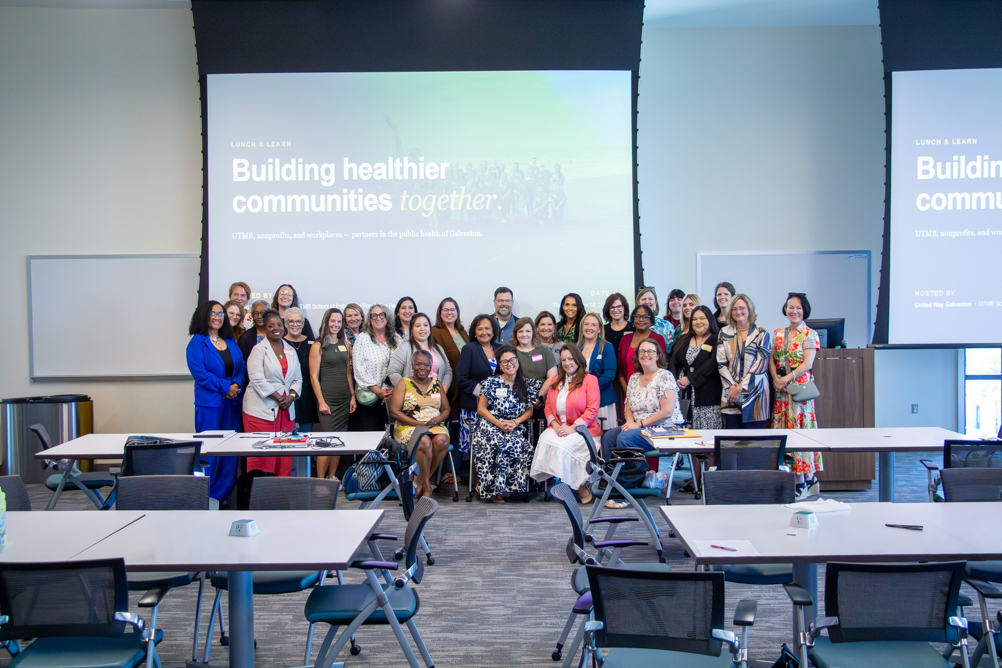
Galveston nonprofit leaders, advocates, and program staff gathered at UTMB's Health Education Center on May 14 for the United Way of Galveston Nonprofit Lunch and Learn, hosted this month by the School of Public and Population Health (SPPH). The session opened a longer conversation about where SPPH and the people carrying Galveston's day-to-day public health work might do more together.
The premise that opened the session is one Dr. Kristen Peek, PhD, Senior Vice President and Inaugural Dean of SPPH, returns to often. Public health is shaped by housing, food, safety, transportation, education, work, and the environments people move through every day. Almost every nonprofit in the room was already doing public health by another name, and naming the work that way changes how a school of public health sees the people sitting across the table. They are practitioners in their own right.
Every workplace, every nonprofit, every place people live and gather is part of public health. That framing changes who counts as a partner.
A school built on practice and partnership
Public health at UTMB is older than most of its visible programs. The earliest medical curriculum, in 1891, included hygiene and disease prevention. A formal Department of Preventive Medicine was established in 1912, and UTMB faculty contributed to plague investigation and control on the island in 1920.
That long arc of community-facing work continued through the establishment of a Master of Public Health program in the early 2000s, full accreditation from the Council on Education for Public Health, and the launch of SPPH as UTMB's fifth school in 2021.
Practice and partnership are one of three pillars of the school's work, alongside education and research.
Dr. Cara Pennel, DrPH, MPH and Leslie Stalnaker, MPH, walked the room through what that pillar looks like today. Every Master of Public Health student completes a project with a community partner. Faculty and students have worked with St. Vincent's House, the Galveston County Health District, the Family Service Center, and the Young Gardeners Program at Groundswell. Partners have brought needs around evaluation, training, survey work, workforce development, and program design. The range is wide because the field is wide.
What the working session surfaced
After the presentations, faculty and staff joined community partners at each table for a structured brainstorm. The conversations kept returning to the same set of themes.
Mental health came up repeatedly as an unmet need, often paired with the question of how people get to the care that exists. One table sketched out what the group called a red tape analysis — a student-led project that would walk through the experience of trying to access mental health resources and identify where the bottlenecks live. The output would be a piece of work that could inform policy, service providers, and the people moving through the system on their own behalf.
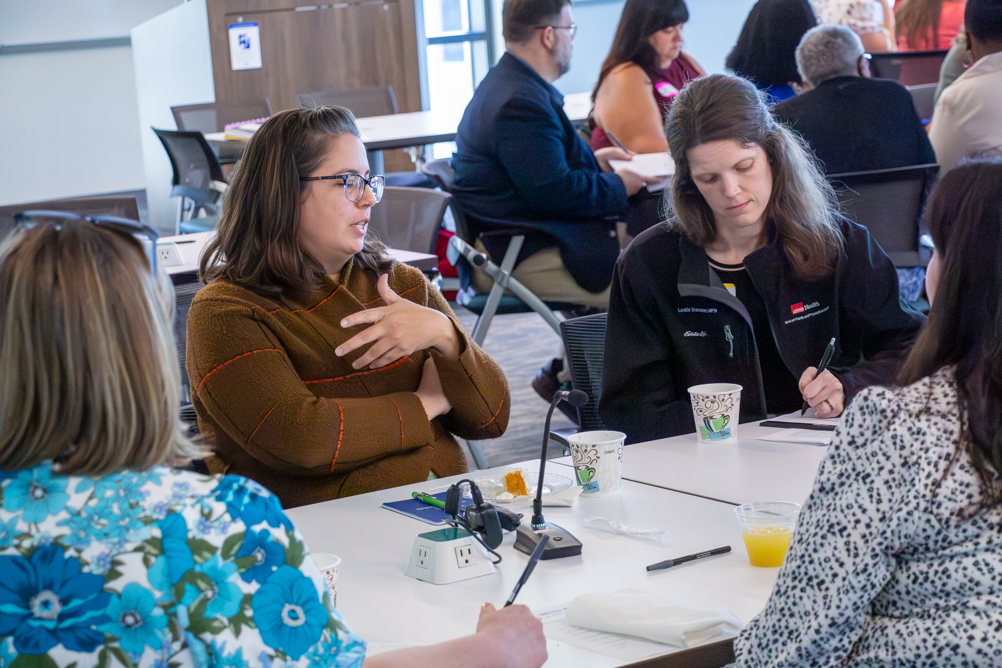
Resource navigation came up at another table as a related challenge. Organizations maintain their own referral lists, but no single place pulls those resources together with the eligibility criteria, paperwork requirements, and waitlists attached to each. A consolidated map of what is available, and what it takes to access it, is the kind of project a student team could take on with a faculty mentor.
Early childhood ran underneath several conversations as a prevention frame. A nonprofit leader at one table made the case that quality early development shapes much of what shows up later as adult mental health needs, special education demand, and trauma-related care. Investments at that stage reduce the downstream cost other systems are built to absorb. Strengthening the early childhood sector is itself public health practice, and the room agreed it would benefit from a longer-term faculty partnership.
Blue Zones at a community scale
Dr. Peek also opened the floor for questions about the Blue Zones Project, which UTMB launched in Galveston in March. The initiative translates research on long-lived communities into local work on policy, the built environment, food access, and social connection. SPPH sits inside the partnership because the work is public health, and because a place-based initiative depends on the evaluation expertise schools of public health are built for. Hiring for the local team is underway, with steering committee formation, focus groups, and the community blueprint expected through summer and fall.
Where the work goes from here
The afternoon's working notes will be consolidated and returned to participants for review. Many of the ideas surfaced need a longer conversation, a faculty match, or a student project window before they take shape, and SPPH will follow up with organizations that named specific interests. The most useful public health work tends to start with a question from someone closer to the ground than a faculty office.
Galveston's public health practice belongs to the people doing it every day. If your organization is thinking about a project, a student collaboration, or a possible partnership, SPPH wants to hear from you. Reach out through the SPPH public health practice page to start the conversation.