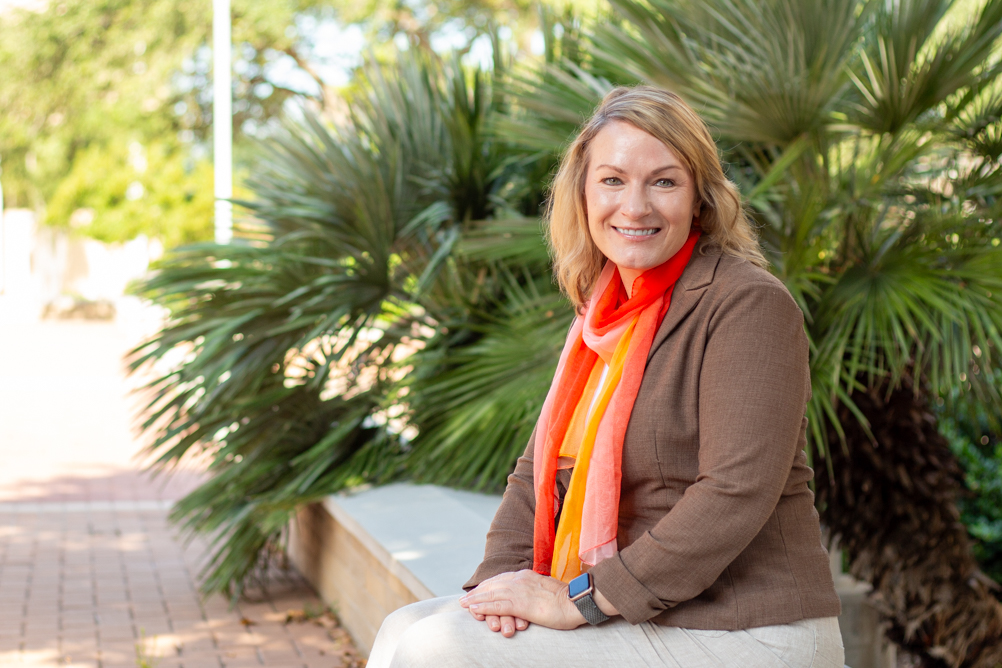
Dr. Cara Pennel came to public health by way of workplace exposure sampling and ergonomic assessments, a technical corner of occupational health she left because she wanted to work with people rather than equipment. More than twenty years later, she is the Associate Dean for Academic and Student Affairs at the UTMB School of Public and Population Health (SPPH), the faculty member who led the school through its accreditation, and, in 2025, an inductee into the University of Texas System's Kenneth I. Shine, MD, Academy of Health Science Education.
Her path ran through occupational health first
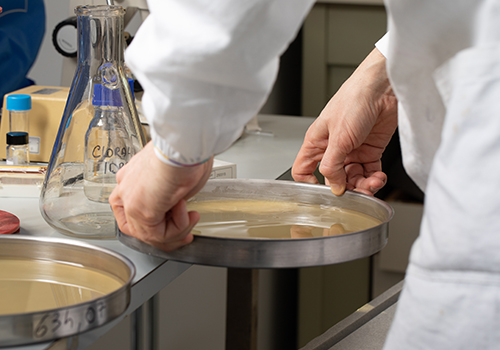
Before public health, Dr. Pennel worked in occupational health and safety consulting in Dallas. She sampled what workers were exposed to on the job, ran ergonomic assessments, and checked indoor air quality at sites that ranged from corporate offices to an East Texas foundry where crews manufactured pipes inside metal warehouses with no air conditioning. The work was technical and the travel was constant. What she kept noticing was that she cared more about the people than the equipment.
She went back to school for a Master of Public Health at Texas A&M, treating the degree as a deliberate career change. A Doctor of Public Health came later, earned while she worked full time, because she wanted to lead her own projects. Public health, she found, matched principles she already held.
"I'd always cared about fairness and about getting at the root causes of problems," she said. "When I found public health, it felt like a field that gave language and purpose to principles I'd held for a long time." Much of the work happens at a remove from the immediate results of clinical care, since the goal is to prevent problems before they start or to move a community's health a little at a time.
"Even small improvements at the population level can affect a large number of people. That ability to improve health beyond individual patients is what makes public health really meaningful to me."
Dr. Cara Pennel, Associate Dean for Academic and Student Affairs
The course she has taught for a decade
Administration has pulled Dr. Pennel further from day-to-day teaching than she once was, but she has held onto one course she has taught for the past ten years, Assessment, Planning, and Evaluation. Students work in teams across a semester, identify a community health priority, and build a plan grounded in existing evidence and frameworks rather than starting from scratch. What stays with her are the messages from graduates who tell her the work still shows up in their jobs, whether they are developing a logic model, writing an evaluation plan, or preparing a budget and its justification.
"That connection between what we teach in the classroom and what students carry into practice makes teaching especially rewarding for me," she said. Her teaching has been recognized at UTMB, including through the Suzanne Brown Logan Distinguished Professorship in Teaching Excellence.
"Few people represent the mission of public health as completely as Dr. Cara Pennel. She is a thoughtful leader, dedicated educator, and trusted partner who has spent her career creating opportunities for students, strengthening communities, and advancing the practice of public health. What makes Cara exceptional is her ability to bring people together around a shared purpose while never losing sight of the individuals whose lives are affected by the work."
Dr. Kristen Peek, Inaugural Dean, School of Public and Population Health
Building a school with accreditation in view
When SPPH became an independent school, Dr. Pennel took on academic affairs, the curriculum, the teaching assignments, and the accreditation process overseen by the Council on Education for Public Health (CEPH). She led that process, and the school earned its accreditation in 2023. A site visitor later told the team it was clear they had kept the accreditation criteria in front of them as they built, which was the point. Practice expectations, for instance, were written into the school's promotion and tenure guidelines from the start, and two faculty members have since been promoted on that basis. She also helped develop the school's four-year MD/MPH dual degree.
One of the larger pieces of that work was a redesign of the MPH core. The team reorganized the required curriculum into four integrated courses that spread the field's foundational competencies evenly across them, cut the required core from roughly twenty-one credit hours to fourteen, and gave students room to take electives while still meeting accreditation standards. Dr. Pennel and several colleagues published their analysis of how MPH core curricula are changing in Public Health Reports in 2024.
Dr. Pennel is also trained as a CEPH site visitor and now serves as a site visit chair, which means she evaluates peer schools as an outside reviewer. The experience has made her more appreciative of SPPH, not less.
"I come home from every site visit having learned something new," she said. "Not everything I learn would work for SPPH, but I find it really interesting how different schools and their unique contexts inform how they implement the criteria."
Recognition across the UT System and the field
In 2024 and 2025, Dr. Pennel was one of twenty-five people selected nationally for the Academic Public Health Leadership Institute, a yearlong program run through the Association of Schools and Programs of Public Health. The institute leaned heavily on self-assessment, and one exercise on polarities, the idea that two things which seem opposed can both be necessary over time, made its way into a course she teaches. The cohort spent a week together in person and still keeps in touch at conferences.
In 2025 she was inducted into the University of Texas System's Kenneth I. Shine, MD, Academy of Health Science Education, a recognition she counts among the most meaningful of her career. The academy draws educators from across the UT System's health institutions, most of them in clinical fields. By her count, only a couple of its members since 2005 have represented schools of public health, which is part of what makes the honor stand out to her.
Practice partnerships across Galveston County
Much of Dr. Pennel's work happens alongside community organizations in Galveston. In the spring of 2024, Paula Tobon, executive director of St. Vincent's House, invited her to help run focus groups with residents. The groups started from a single question, some version of "if you could wave a magic wand, what is one thing that would make your life easier or better today?" SPPH students sat in to take notes. That listening fed into the Sandpiper Cove Development Committee, led by Jessica Randle at St. Vincent's, which has gone on to offer residents services and programs shaped around what they actually asked for, including art therapy and soul food sessions. The committee's work has been supported in part by a Moody Foundation grant to St. Vincent's House.
A recurring need she hears from community partners is how to show the impact of their work. SPPH has run evaluation workshops and helped organizations such as Groundswell and St. Vincent's House build data collection tools and analyze what they gather. The project she is most excited about extends that idea. Coffee & Quality, a program created by United Way of Greater Houston to build nonprofits' evaluation capacity, is coming to Galveston.
What began as a few conversations among United Way Galveston, local foundations, and Dr. Kelly Grace, a UTMB colleague, grew into something larger. United Way Galveston, led by Lindsey White, received a grant from Houston Endowment to adapt and launch the program locally, and the inaugural Galveston Fellows cohort began in 2026. Dr. Pennel describes her role as one contributor among many, which is how she likes it.
"It's really a privilege to work alongside these incredible organizations that are improving the health and quality of life of Galveston County residents while helping build a stronger, more connected community," she said.
Reimagining academic public health
Dr. Pennel sees both public health and higher education at a turning point, pressed by funding, workforce needs, technology, and shifting expectations of what an education should provide. Her answer is to think past traditional models. That means tightening the link between education and practice, building more flexible ways to learn, giving students experiences alongside communities, and preparing them for careers that may look little like those of the generation before them.
It also means teaching more than the science of the field.
"I want students to learn the art of public health alongside the science. That is building trust, communicating across different audiences, facilitating respectful dialogue, navigating complex systems, and leading multi-sector collaborations."
Dr. Cara Pennel, Associate Dean for Academic and Student Affairs
The pressures are real, she acknowledges, but she reads them as an opening to rethink how the next generation of public health leaders is trained.