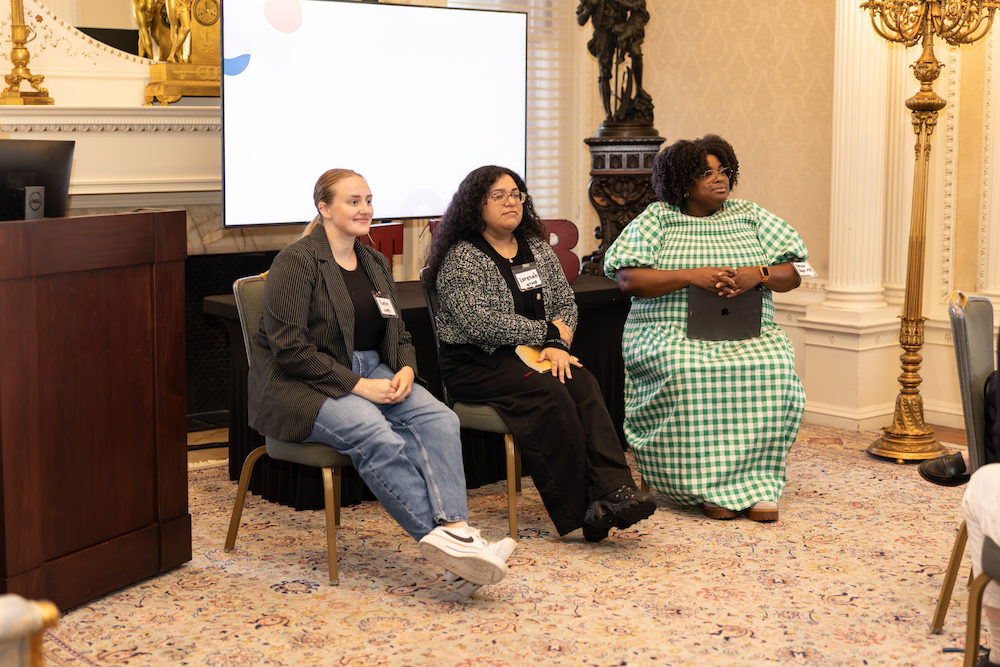
Doctoral students Lorenah Vasquez, Peyton Swanson and Carmen Haynes in the Department of Bioethics & Health Humanities presented research on August 27 at the Gulf Coast Bioethics Research and Professional Development Symposium, held at Open Gates in Galveston. Together, their presentations raised a related question about what happens when a category developed for research, policy, or recruitment becomes a frame for understanding health. The symposium, formerly the UTMB Bioethics and Health Humanities Unconference, was organized by Stephen Molldrem, PhD, Xiang Yu, PhD, and Alberto Aparicio, PhD.
Farm labor as a form of identity
The Labor Identity: How the Labor Aspect of Farmworkers’ Identities Shapes Their Health Experiences
Vasquez examined farm work as a part of one’s identity rather than only an occupation, considering what that approach might add to accounts centered on social and structural determinants of health.
She traced that identity through a century of Mexican agricultural labor in the United States, from the Immigration Act of 1917 and the repatriation campaigns of the early 1930s through the Bracero Program of 1942 to 1964, and the 1954 deportation drive the federal government called “Operation Wetback.”
Bracero recruitment screened men for physical evidence that they could do field work, then issued the documentation and identification cards and ran the medical processing, including DDT spraying, that defined an ideal worker from the outside.
Workers reworked that imposed designation into something of their own, showing up for one another inside and outside the fields, watching over each other’s pay, and organizing strikes.
Asked about the risk of binding a person’s sense of self to their labor, particularly where that labor is already entangled with legal status, Vasquez intends to ask what this means for farmworkers themselves, asking whether and how much weight the work actually carries in how they see their health.
What enrollment does not guarantee
Re-Recognizing the Rural: Recognizing When Inclusion Falls Short
Swanson, presenting the closing chapter of her dissertation on health research in rural settings, defined “rural” by self-identification rather than by geography, occupation or population count.
Federal policy has pressed for more representative enrollment since the NIH Revitalization Act of 1993, and the All of Us Research Program treats rural participation as a condition of building a representative genomic resource, yet roughly 3 percent of its participants are rural against about 20 percent of the US population.
Swanson took up the principle of fair inclusion and argued that enrolling rural participants does not on its own mean rural people can use what the research produces.
Predictable downstream barriers decide that—among them distance and isolation from research institutions, thin local clinical and technological infrastructure, and the cost of an intervention once it exists.
She asked researchers to weigh those barriers at the design stage rather than treat them as someone else’s problem once results are in.
Responding to an audience question about the changing funding landscape, Swanson used the federal Rural Health Transformation Program to illustrate her concern that technology-focused investments may not address weaknesses in existing local infrastructure.
When a disaster becomes a biological marker
Researching Adversity and Reproducing Inequity: A Bioethical Perspective of Epigenetics, Trauma, and Environmental Disasters
Haynes, presenting work developed with Swanson, examined what happens when a disaster is converted into a living laboratory, so that a bounded event becomes an identifiable exposure, the exposure becomes a biological sample, and the sample becomes a marker linked to an outcome.
Hurricane Katrina is the case, and among the post-Katrina research discussed was the RISK Project, which developed from a study begun in 2003 with low-income parents enrolled at two New Orleans community colleges.
The mechanism at issue was DNA methylation, the transformation of chemical groups to DNA that can influence gene expression without changing the underlying sequence.
Her concern is that attaching potentially persistent molecular changes to a population experiencing a disaster risks rebuilding a biologically legible category out of a social one—the move by which social categories have historically been recast as biology.
She set that argument alongside Katrina Babies, Edward Buckles Jr.’s documentary assembled from the accounts of survivors who were children in 2005 and who made the term their own.
In discussion, Haynes and Swanson questioned what affected communities receive when studies connect disaster exposure with biological or mental-health outcomes, arguing that survivors’ accounts should inform how those findings are interpreted.
Imposed from outside or claimed from within
Whether the categories in their work are imposed from outside or claimed from within drew the one question put to all three.
Their answers turned on who does the naming and for what purpose, since a term a community builds for itself carries the experience behind it, while one applied from outside more often serves the aims of whoever is asking.
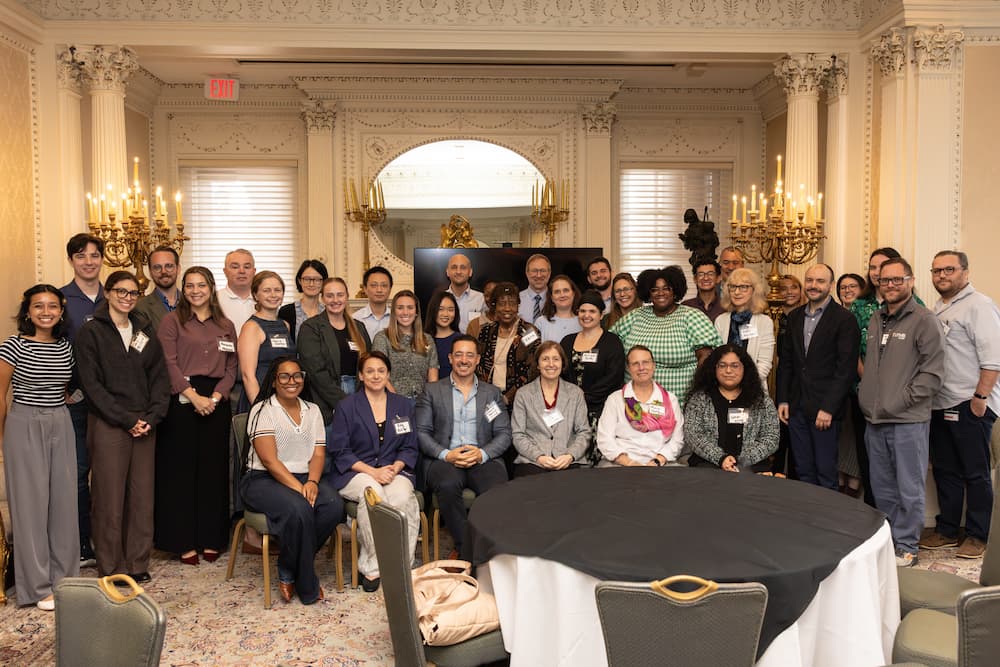
Attendees of the Gulf Coast Bioethics Research and Professional Development Symposium at Open Gates in Galveston, August 27, 2026.
Doctoral students in the department work across philosophy, history, literature, law and the social sciences to examine medicine and health, and more on that training is on the Bioethics and Health Humanities PhD program page.