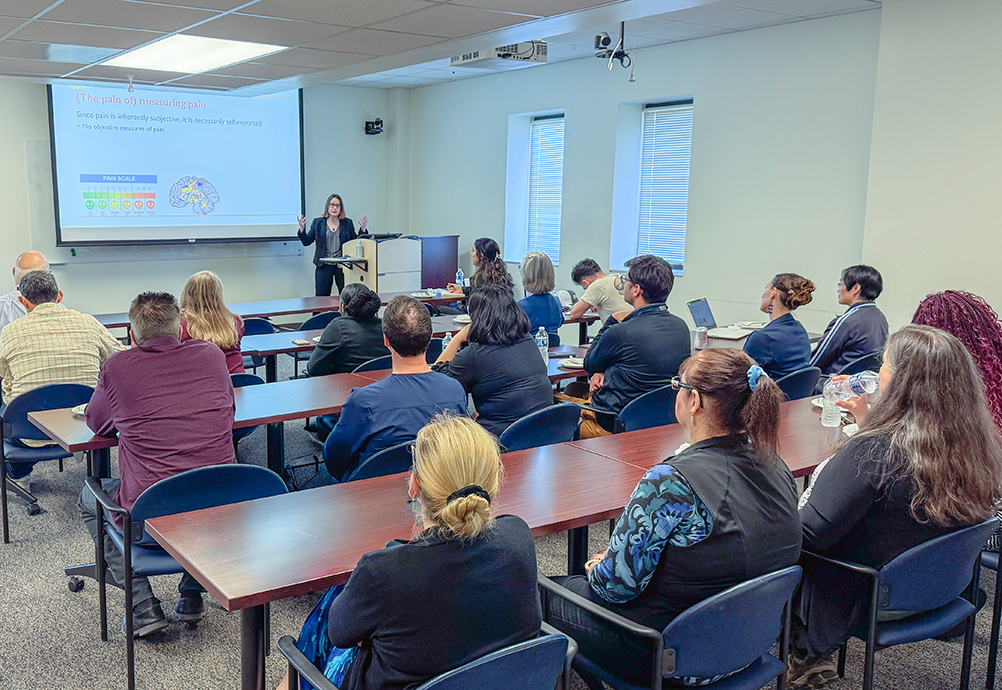
Faculty, staff, and trainees gathered at The University of Texas Medical Branch (UTMB) on April 15 for a special lecture co-organized by the Sealy Center on Aging and the Department of Epidemiology in UTMB’s School of Public and Population Health.
Anna Zajacova, PhD, professor of sociology at Western University, used the hour to move chronic pain out of a narrow clinical frame and into a broader population health one.
The message: pain is deeply personal, but its distribution is shaped by social conditions.
A public health view of pain
Dr. Zajacova opened by grounding the discussion in lived experience. Before any charts or prevalence estimates, she drew attention to the language people use to describe pain itself, words like burning, throbbing, exhausting, and unbearable. It was a useful starting point because the lecture treated pain as something people live with, report, negotiate, and often struggle to have recognized.
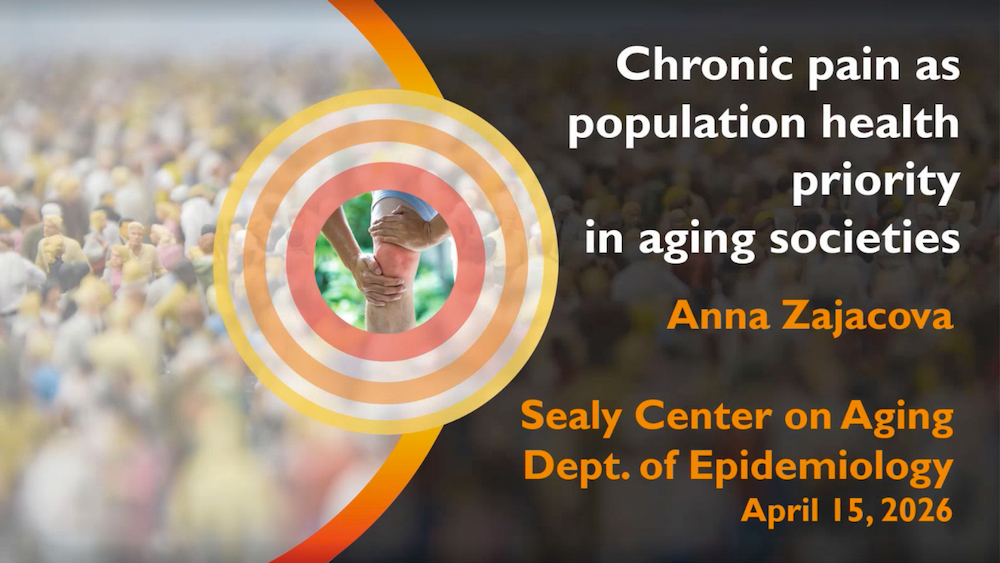
Chronic pain is not simply acute pain that lasts longer. It behaves differently, is measured differently, and often resists the tidy logic of injury followed by healing. That creates a challenge for clinicians and researchers alike. Pain is subjective. It is often invisible. It still depends heavily on self-report. Dr. Zajacova noted that even as research has advanced, there is still no single objective measure that can fully capture chronic pain across populations.
That subjectivity, she suggested, helps explain why chronic pain has not always received the same attention in population health research that it has in biomedical and clinical fields. Yet the condition is far too common, costly, and consequential to sit at the margins. If population health is concerned with disability, quality of life, access to care, and the social patterning of illness, then chronic pain belongs squarely in that conversation.
What the data reveal
One of the clearest takeaways from the lecture was scale. Dr. Zajacova said the old shorthand that chronic pain affects about one in five adults may no longer be enough. Based on more recent trends, she said the figure now appears closer to one in four. That alone reframes the issue. Chronic pain is not a niche concern or a condition limited to a small clinical subgroup. It is widespread, and its effects spill into work, mobility, mental health, and daily functioning.
She also showed how unevenly pain is distributed. Comparisons between the United States and Canada pointed to higher levels of chronic pain in the U.S., with economic hardship helping explain part of that difference. Within the United States, geographic hot spots remained even after accounting for many individual factors. That finding pushed the discussion toward the role of place, policy, and structural conditions.
Education offered another example. The lecture showed a familiar gradient, with lower educational attainment generally associated with higher pain. At the same time, Dr. Zajacova highlighted patterns that were less expected. Adults with some college or an associate degree showed higher pain levels than adults whose education stopped at high school. That kind of result complicates any simple story and points to the need for more careful work on mechanism. Social influences on pain are real, but they do not always operate in the ways researchers first assume.
Pain can function as both an outcome and an explanatory factor. In some of the work Dr. Zajacova discussed, chronic pain accounted for a meaningful share of educational disparities in later health outcomes. Leave pain out of the model, and part of the picture goes missing.
Questions that point to future work
The discussion after the lecture carried the topic from description into application. Audience questions turned to physical activity, physical therapy, and the practical realities of treatment. Dr. Zajacova acknowledged what many clinicians already know. Movement is a first-line approach for many forms of chronic pain. Still, knowing that does not erase the barriers patients face. Time, cost, transportation, competing responsibilities, local access to multimodal care, and the difficulty of beginning movement when pain is already severe all shape what treatment is actually possible.
At UTMB, the conversation naturally touched aging, rehabilitation, epidemiology, and clinical care at once. It also sharpened one of the lecture’s central implications for aging research. Pain tends to increase with age, but it should not be written off as an inevitable or unimportant feature of growing older. Dr. Zajacova argued that pain is too often left in the background of larger discussions about disability, mortality, and life course change even though it is central to how many people experience those outcomes.
The concluding invitation was:
- Study pain earlier
- Measure it better in population data
- Connect it more directly to disability, mobility, mental health, and quality of life

Dr. Anna Zajacova is a Professor of Sociology at Western University. Trained as a demographer and sociologist at Princeton University, she studies chronic pain as a population phenomenon, asking how social conditions shape its distribution in the US and Canada. She has published over 90 peer-reviewed articles in leading journals including PAIN, Demography, and the Journal of Health and Social Behavior. Her work, supported by the NIH and the Social Sciences and Humanities Research Council of Canada, positions chronic pain as a critical dimension of population health.