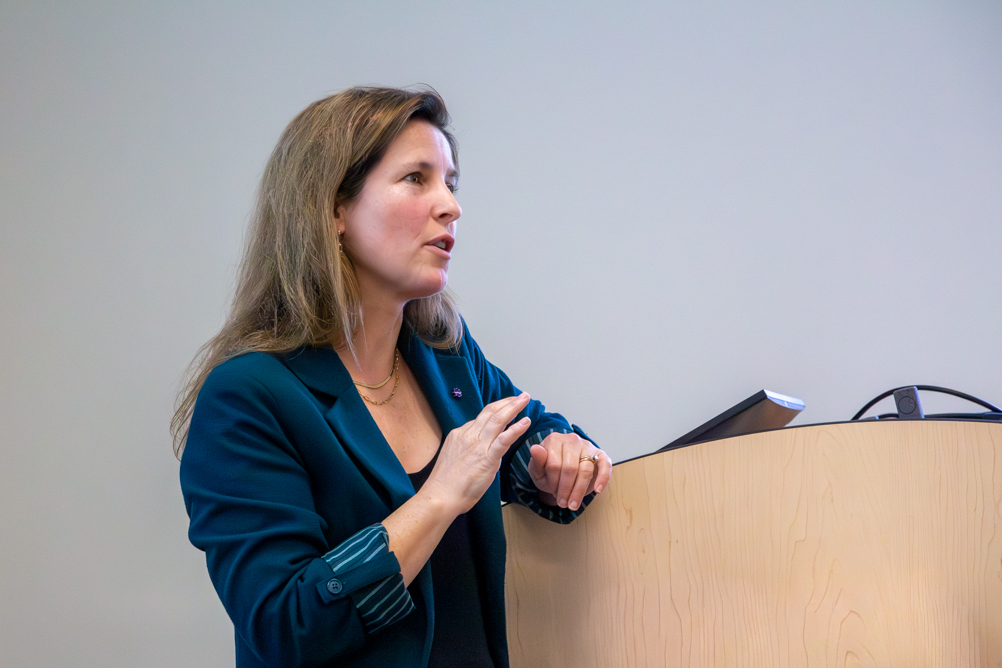
Norrina Allen, PhD, of Northwestern University's Feinberg School of Medicine, recently delivered the keynote address for UTMB's Center for Health and Clinical Outcomes Research (H-COR), co-sponsored by the Claude D. Pepper Older Americans Independence Center. Dementia, she argued, develops across the life course, and early-adult vascular risk factors shape later-life dementia risk more strongly than late-life ones do.
Dr. Allen came to dementia research from cardiovascular epidemiology, and the overlap between the two fields is substantial. Up to 80 percent of cardiovascular disease and stroke cases, and up to 40 percent of dementia cases, share the same set of modifiable risk factors — hypertension, obesity, physical inactivity, smoking, diabetes, poor diet, poor sleep, and low educational attainment. Those factors cluster within individuals and within communities, and their effects compound over decades.
The American Heart Association's Life's Essential 8 score, built around that same cluster, has shown a dose-response relationship with dementia in the Atherosclerosis Risk in Communities (ARIC) cohort that Dr. Allen described as unusually clean for an outcome this complex. Each one-point improvement in the score corresponds to roughly a 6 percent reduction in dementia risk.
Dementia has a preclinical phase estimated to begin roughly 20 years before symptoms appear. The intervention window opens well before the clinical one.
How vascular risk factors compound over a lifetime
The data vehicle for much of Dr. Allen's work is the Dementia Risk Prediction Pooling Project (DRPP), a 13-cohort consortium she helps lead. The synthetic cohort assembled through DRPP spans ages 18 through over 100, with roughly 50,000 participants, around 6,000 incident dementia cases, and 14 years of average follow-up. The pattern it reveals is consistent across body mass index, cholesterol, and fasting glucose. Risk-factor burden accumulated in early and middle adulthood is strongly associated with dementia incidence later in life.
The same risk factors measured in older adulthood often show weaker associations. In some cases they can even appear protective, with high blood pressure the most frequently discussed example. Part of that late-life inversion reflects survival bias and part reflects the age at which a given risk factor first emerged. The implication is that dementia prevention needs to target the onset of vascular risk well before the age at which current dementia trials typically recruit.
The US POINTER trial, published last year in JAMA, illustrated the point from the other direction. A structured, higher-intensity multi-domain lifestyle intervention produced a modest improvement in cognitive decline among older adults at risk. The effect was real. A suggestion in the data, not statistically significant but visible, was that younger participants may have benefited more. Very few dementia prevention trials recruit middle-aged adults, and that absence tracks closely with what the life-course data show about when prevention is most effective.
Where harmonization stops working
Harmonization drew extended discussion. Combining data from different studies so they can be analyzed together is central to DRPP's design, but Dr. Allen's main caution was that pooling mismatched data produces large sample sizes and misleading results. The harder judgment, she said, is usually whether two sources are comparable enough to combine at all, not how to align particular variables.
One example that surfaced during discussion illustrates the point. When a dementia risk tool developed in one population is applied to an aging cohort with markedly lower educational attainment, education thresholds have to be shifted before the model produces sensible estimates. The accuracy loss in that kind of cross-population application is real.
She also pointed to age-period-cohort effects as a structural limit on the field. The education literature that underpins most dementia risk models draws on cohorts born several generations ago. Those cohorts grew up under schooling systems, nutrition, chronic-disease treatment, and media environments that bear little resemblance to the ones shaping current children.
Obesity is a similar case. The field's ability to infer when and how to intervene, based on cohorts that took fifty years to accrue, is a real constraint, and Dr. Allen pointed toward statistical and synthetic-data approaches as a way to test hypotheses in current populations without waiting another half-century for the observational data to arrive.
The generation problem in risk prediction
Generational change was another point of discussion. A 75-year-old patient today is clinically a different person from a 75-year-old twenty years ago, given shifts in pharmacological treatment, early-life exposures, and health behaviors. The question Dr. Allen's group wrestles with is how to incorporate those shifts into risk modeling without waiting a generation for new cohort data.
Her group's first move is to separate prevalence from association. Even when obesity prevalence differs substantially across populations or time periods, the association between obesity and a downstream health outcome tends to remain relatively stable. That stability lets current prevalence data be combined with cohort-derived effect estimates to produce population-attributable risk figures that reflect today's risk landscape rather than the one of fifty years ago, provided good real-time surveillance exists.
Translational speed is the related concern. The typical lag from a scientific finding to clinical practice runs around 17 years. Electronic medical records and health information exchanges open the possibility of updating risk estimators closer to real time, provided the security and informatics questions can be worked through.
Dr. Allen framed that as the goal. Continuous surveillance, continuous model updates, and clinical decision support would all reflect the current population rather than one accrued over a generation.

Dr. Norrina Allen is the Quentin D. Young Professor of Health Policy in the Department of Preventive Medicine and Professor of Epidemiology, Medical Social Sciences, and Pediatrics at Northwestern University's Feinberg School of Medicine. She is the Director of the Institute for Public Health and Medicine (IPHAM) Center for Health Services and Outcomes Research and Co-Director of the Data Science Hub of the Institute for Innovations in Developmental Sciences (DevSci). Dr. Allen is a leader in many of the vascular and aging prospective cohorts, including MESA and CARDIA, as well as large pooled consortia such as the Dementia Risk Prediction Pooling Project. Her research takes a life-course approach to understanding the development of aging-related diseases, particularly in examining blood pressure as a major risk factor for cardiovascular disease and dementia.