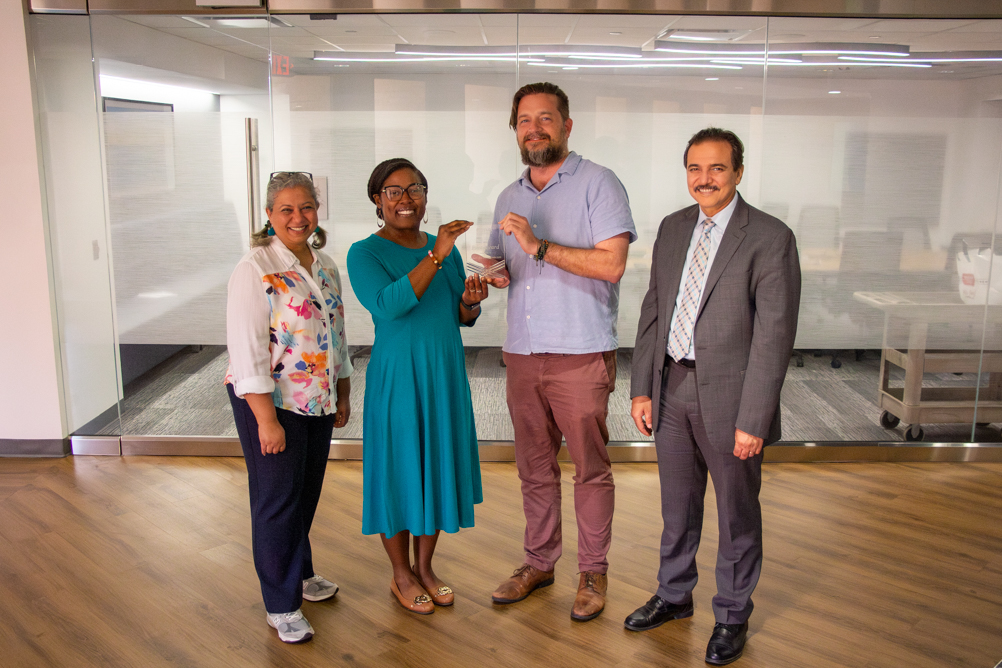
The Department of Population Health and Health Disparities has awarded its first-ever pilot grant, selecting Dr. Michael Goodman's proposal on AI-enabled community health tools from a competitive field of applications. The award reflects a deliberate investment in the faculty research that will define the department's future.
An Award Built Through Competition
The Inaugural Population Health and Health Disparities Pilot Award was open to full-time faculty across the department. Multiple investigators submitted proposals, which were scored and vetted by a review committee. Dr. Goodman's application received the highest score, earning him the inaugural award.
The $15,000 grant supports a single project and is designed to generate preliminary data for larger extramural funding applications.
A UTMB Department That Champions Its Faculty
For Dr. Mandy Hill, inaugural chair of the Department of Population Health and Health Disparities, the pilot award represents something larger than a single grant. It is an expression of the kind of department she is building. The department's core of identity, as she describes it, is improving the health of populations. That work depends on faculty who have the support and resources to develop their ideas into funded programs.
"I am committed to growth and committed to growing the people in this department," Dr. Hill said. "When we invest in our faculty's ideas, we are telling them that what they are working on has value and that this department is going to champion their work. That is the culture I want us to have."
As a relatively new department within a young school, PHHD is still establishing its research portfolio. Dr. Hill sees the pilot award as one mechanism for accelerating that process, giving faculty the seed funding they need to build competitive applications to the National Institutes of Health, the Patient-Centered Outcomes Research Institute, and other major funders. In the current funding climate, where federal research priorities are shifting and grant language is under increased scrutiny, that internal investment carries additional weight.
"We have to figure out how to keep the work moving forward," Dr. Hill said. "This award is one way we do that. We create the conditions for our faculty to do the work, and we celebrate that work when it happens."
Testing Whether Communities Will Trust AI-Enabled Health Tools
Dr. Michael Goodman is an associate professor in the department. His funded project, "Assessing Perceived Benefit of an AI-Enabled Ecosystem for Population Health," addresses a question that has not yet been systematically studied: how do residents of a specific community perceive digital health tools that connect clinical data, local resources, and personalized self-care support?
The project draws on Dr. Goodman's Flourishing Community Model, a framework he developed through years of community health work in Kenya that emphasizes collective efficacy and structural resilience as drivers of sustained well-being. His research focus has shifted in recent years from global contexts to domestic, digitally-supported population health approaches.
The study will recruit 500 participants from Galveston County using a household roster maintained by the Galveston County Health District, which is 93 percent complete. Participants will be drawn from census block groups stratified by mortality rates, ensuring the study captures perspectives from both high- and low-burden neighborhoods on Galveston Island.
Each participant will view short videos explaining four digital tools and then complete a survey measuring perceived usefulness, ease of use, trust, and willingness to engage. The four tools are Community Microphone, which captures voice narratives to assess community perspectives; SPARK, a platform for pseudonymous peer support and social connection; Community Health Navigator, an AI-powered referral engine that matches users with local resources; and ANCHOR, a system that connects electronic health record data to automated community-based referrals.
"We know people are already using ChatGPT and other large language models for health information," Dr. Goodman said. "What we don't know is how they would respond to tools designed specifically for their community, tools that connect them to local resources, clinical information, and peer support in a coordinated way."
The pilot data will directly support several grant applications Dr. Goodman is preparing, including an R61/R33 focused on mental health system development and an R34 that would use EPIC health data to connect patients with community-based resources and personalized health information. Both proposals are targeted for submission in 2026.
The study builds on infrastructure Dr. Goodman has already established as principal investigator of an NIH AIM-AHEAD project, through which UTMB, the Galveston County Health District, and Flourish Public Benefit Corporation have developed integrated data systems and AI-powered health tools for the county.
"This pilot funding gives us the ability to ask the community directly whether these tools would be useful to them," Dr. Goodman said. "That evidence is what NIH and PCORI reviewers need to see before they invest at a larger scale."
The Department of Population Health and Health Disparities is one of four departments within UTMB's School of Public and Population Health.