Most of what happens in an exam room evaporates on the way to the parking lot. Researchers who study clinic visits estimate that patients forget up to 80 percent of what they hear almost immediately, and that figure is measured under ordinary conditions, before fear or bad news does its work. Dr. Meredith Masel has spent more than a decade building a remedy that sounds almost too simple — let patients take the audio home and press rewind.
Dr. Masel, an assistant professor in the Department of Population Health and Health Disparities at the UTMB School of Public and Population Health, has directed the Oliver Center for Patient Safety and Quality Healthcare since 2010. She is a co-principal investigator on national trials of clinic visit recording, senior author of a new study on telehealth, communication teacher to more than a decade of UTMB residents, and, before any of that, a social worker.
The social worker’s playbook
Dr. Masel went to social work school at UT Austin intending to become a counselor and discovered during her first internship that counseling was not for her. What stuck was everything the profession stood for. When her class split into clinical and administrative tracks in its second year, she was one of fewer than ten students, out of a class of roughly two hundred, who chose administration and planning — designing programs to help people rather than providing therapy.
Wanting to evaluate those programs as rigorously as she designed them, she pursued a PhD in Preventive Medicine and Community Health at UTMB and trained at the Sealy Center on Aging, publishing on frailty, cognition, and healthy aging in older Mexican Americans alongside mentors including Drs. Kristen Peek, Kyriakos Markides, Mukaila Raji, Kenneth Ottenbacher, and James Goodwin. Then, nearly as soon as she could, she stepped off the traditional academic track and into what she calls her dream job — designing and evaluating programs full time.
The core values of social work—service, social justice, dignity and worth of the person, the importance of human relationships, integrity, and competence—still do the steering. “When it comes to designing a study, I draw from Social Justice to choose methods that are as accessible to all as they can possibly be,” she said.
“The core values are, at all times, informing my work — not just research. Shout out to UT Austin School of Social Work!”
Dr. Meredith Masel, Director, Oliver Center for Patient Safety and Quality Healthcare
An incubator, not a lab
The Oliver Center was dedicated in 2008 through a $2 million pledge from Dr. Carolyn J. Oliver, and Dr. Masel describes the center she leads as an incubator. Programs that help patients feel in control of their care rarely generate revenue, so rather than lobbying the health system for large new initiatives, she runs small ones — a clinician brings an idea, perhaps a decision aid to help patients weigh a treatment choice, and she pilot tests it with one doctor and a handful of patients. Most early versions do not survive contact with a working clinic. The team regroups, redesigns, and tries again in classic quality improvement cycles, which she took Lean Six Sigma training to run properly.
Ideas that show value grow; some have become systemwide patient safety initiatives that reach beyond UTMB, and others have become multisite research trials. The filter for what gets through the door is the center’s guiding virtues — empowerment, respect, communication, and innovation.
Taking the message and the medicine home
The recording work predates smartphones. Making sure patients left with everything that came out of their appointment was close to the founding purpose of the Oliver Center, and in the early years that meant handing out tape recorders. The idea took root in oncology, where a diagnosis can crowd out every word that follows it, and in Galveston it carried an extra justification — a patient displaced by a hurricane carries the details of their care with them.
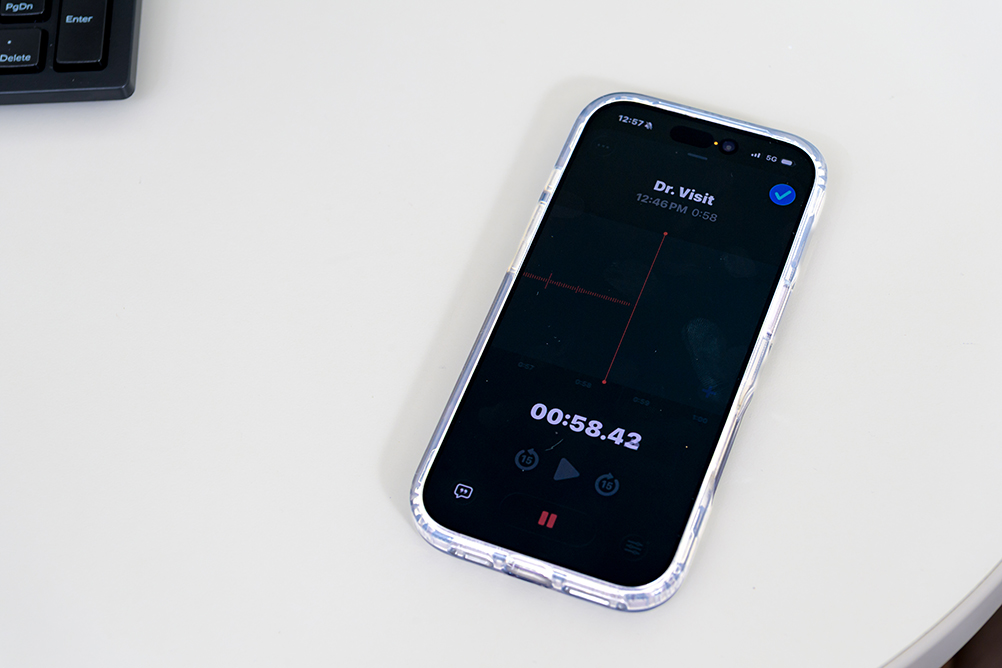
Studies have also shown that what the doctor believed was the most important part of a conversation and what the patient believed was the most important part are frequently not the same, a gap no after-visit summary is written to close.
Today that idea has grown into two federally funded multisite randomized trials Dr. Masel leads with longtime collaborator Dr. Paul Barr of Dartmouth and colleagues at Vanderbilt Health.
The REPLAY trial, funded by the National Institute on Aging, tests whether older adults who routinely receive audio recordings of their primary care visits manage their conditions better over time.
The CHRONICLE trial, funded by the Patient-Centered Outcomes Research Institute, sharpens the question for the open notes era. Patients can already read their doctors’ notes in the portal, so does audio add anything? Nine hundred older adults with multiple chronic conditions across New Hampshire, Tennessee, and Texas are helping answer it.
When early critics predicted the studies would miss enrollment targets because older people are not tech savvy, Dr. Masel treated the objection as a finding about the critics.
“It is an ageist point of view, and I respond with stats about the sustained rise in technology use among older adults. I also suggest that it is not up to us to decide that older people will not participate because they do not like tech. It is up to the potential participant themselves, which rolls into dignity and worth of the person and my duty to promote self-determination.”
Dr. Meredith Masel
She has long said she is willing to put herself out of business if the trials find no benefit. She doubts it will come to that, and her reasons have less to do with data than with the stories that started all of this.
“I’ve just heard too many stories of patients who feel helpless, even those who have the means to have all the appointments or procedures or medicines they need,” she said. “With audio, for example, what if someone waited months for this doctor appointment. Why on Earth would we expect them to leave without a recording in this day and age? Can you imagine how much your mind would be racing up until that meeting and then 30 minutes later, it’s all a blur, and you can’t press rewind to hear it again? Nonsense!”
A recording can do more than restore lost details, she argues. Hearing yourself commit to a plan, in your own voice, can turn a doctor’s instruction into a personal pledge. “Or, if they share a recording with a family member, now that pledge to go on more walks is ‘out there’ which can really help motivate someone to act.”
Communication is a clinical skill
Since 2012, nearly every medical resident at UTMB has passed through Dr. Masel’s interpersonal and communication skills training, a program she built with Dr. Thomas Blackwell and grew, with a $700,000 award from the Moody Foundation, into an interprofessional series that trains nurse residents alongside physicians.
The curriculum is full of small, time-neutral techniques with evidence behind them. Sitting down at the bedside leaves patients feeling the clinician stayed longer. Ask an open-ended question and simply wait, and the average patient talks for about a minute, not the endless monologue young doctors fear.
She is candid that this is learned technique, deliberate smiling and deliberate sitting that residents rehearse until it becomes habit, and she is careful to tell residents the goal is not to change who they are. Empathy, she teaches, can be conveyed through behavior whether or not it comes naturally, and the residents are never asked to take that on faith.
“We are teaching them because there is scientific evidence that things like clinician empathy are associated with health outcomes,” she said. “When we find references in the literature, we will show them because our doctors and nurses practice evidence-based medicine.”
That teaching also explains her name on the school’s newest publication. When the pandemic pushed appointments onto phone screens, Dr. Masel wanted to know what would happen to the facial expressions and body language she had spent years teaching clinicians to use. The Oliver Center sponsored the resulting study, and this year the team, led by Dartmouth’s Dr. W. Moraa Onsando with Dr. Masel as senior author, published its findings in Health Informatics Journal.
Among 522 U.S. adults who had both kinds of visits early in the pandemic, patient-centered communication scored measurably lower over telehealth than in person, and mask use was linked to lower communication scores for older adults even in person. Telehealth is not her research home, but the result lands squarely on her thesis — the connection between clinician and patient is valuable, fragile, and worth protecting deliberately.
Students find their way to her, too. A conversation with an MD/MPH student at a faculty mixer turned into a biweekly research meeting and then into Blood Buds, a newly approved student organization built around blood donation and health education, with Dr. Masel as faculty advisor and liaison to the business side of UTMB. And when medical students have asked her to sponsor research projects, she has talked them into adding MPH students to the team for their statistical training, turning a group of four into a group of seven.
Extra eyes, ears, and hands
When UTMB’s Journey to Zero initiative named a list of patient safety outcomes the health system wanted driven to zero, from falls to hospital-acquired infections, Dr. Masel noticed that The Care Partner Project, a nonprofit whose plain-language safety checklists she had known for years, already had patient education materials for most of them.
Checklists are how hospitals themselves maintain safety, she reasoned, so why not extend them to the family members at the bedside? A catheter line that loops and kinks like a garden hose invites an infection; a hospital bed left too flat raises the risk of pneumonia.
These are things a care partner can watch for without a day of medical training, and one person checking is more than zero. With support from nursing leadership and the Chief Medical Officer, the Oliver Center brought the checklists to UTMB.
Getting safety information in front of families turned out to be its own design problem. Hospitals hand out less and less paper, and emailed links assume a patient who is connected to the Wi-Fi and willing to click.
So, the center worked with The Care Partner Project to produce video versions of the checklists for inpatient televisions, closed-captioned so they can be read or listened to, each ending with a QR code that opens dozens more topics. The videos earned a 2024 President’s Cabinet Award, Dr. Masel’s second, following 2015 awards for the Healing Through Humanism and What Matters Most programs.
They are now live on inpatient TVs at all campuses, and recent MPH graduate Klarissa Lowrance helped build the rollout strategy, the staff navigation guides, and the tracking system that will show how often the videos are watched by unit, floor, and campus. The project sits in the same territory as the practical guidance AARP recently compiled for older adults leaving the hospital — unglamorous steps, taken by families, that keep bad days from becoming worse ones.
The next ten years at the bedside
Ask Dr. Masel to picture the bedside a decade from now, if the improvements she has watched across her career keep compounding, and she gives an answer that is hopeful and unsentimental in the same breath.
“I think that the bedside experience can be both efficient and patient centered. With time-saving policies that leverage technology, for example, the patients that need more from the clinician may get that. It’s an optimistic point of view because it leaves out that the decision has to be made what to do with extra time — give it to current patients or fit more patients in the day?”
Dr. Meredith Masel
That decision, she notes, is rarely a doctor’s or nurse’s alone to make; institutions and payers will weigh in. The question she most wants her research career to answer runs underneath all of it — whether patients’ confidence about their condition and treatment can be a “win-win,” easing the burden on health systems through fewer unnecessary visits while empowering patients to do the things that keep them well. She already has a follow-up queued. “Also, is there a way we can give patients/families a daily digest during their hospital stay?”
It is a social worker’s question, asked with a scientist’s tools. The first time she was asked to describe herself, she skipped her titles entirely. She is someone who wants to make sure people feel in control of their health and their health care. Everything else, the incubator, the trials, the checklists, the recordings, is a way of getting there.
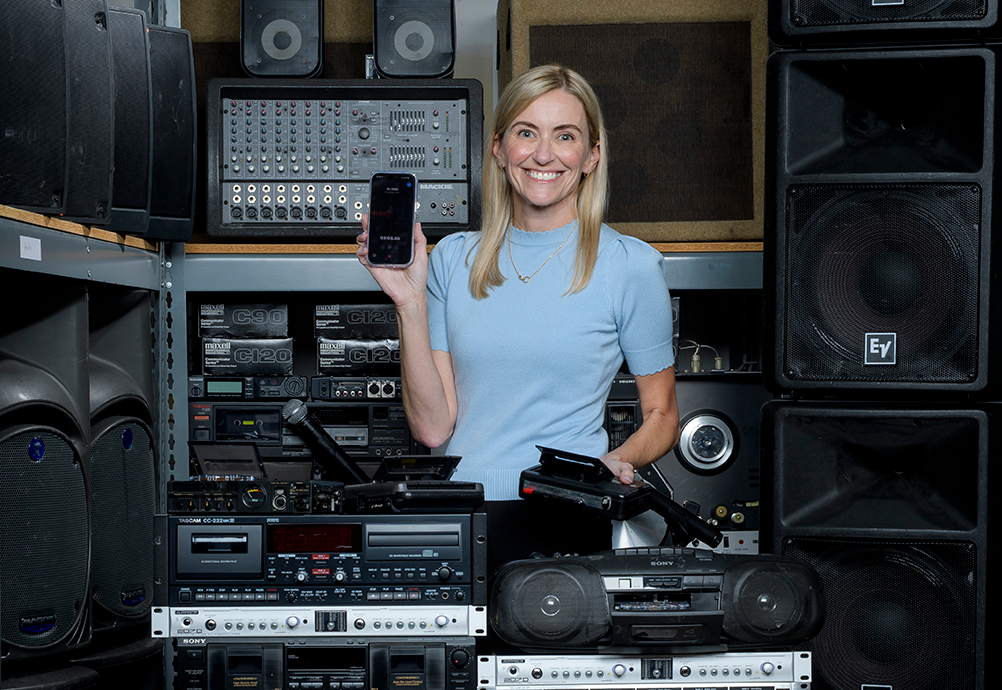
Photography by Mark Kinonen. The featured image shows Dr. Masel with audio recording equipment spanning cassette tapes to smartphones, staged by the Oliver Center for Patient Safety and Quality Healthcare.