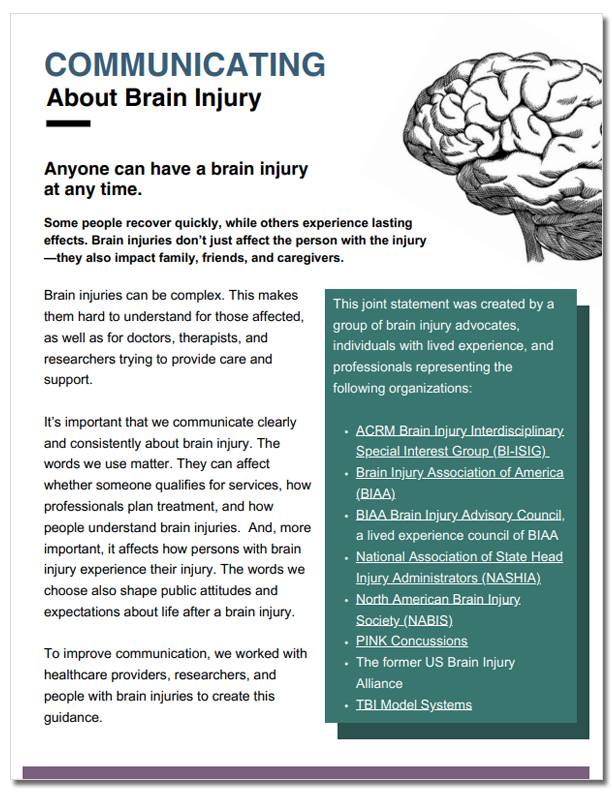
A yearlong, cross-organizational effort to align how the U.S. brain injury community talks about brain injury has culminated in a new joint statement. The guidance document, titled Communicating About Brain Injury, explains why consistent language can shape access to services, influence clinical decision-making, and affect how people understand life after brain injury.
Created with advocates, individuals with lived experience, clinicians, and researchers from organizations including ACRM’s Brain Injury Interdisciplinary Special Interest Group, the Brain Injury Association of America (and its Brain Injury Advisory Council), NASHIA, NABIS, Pink Concussions, the former U.S. Brain Injury Alliance, the Department of Veterans Affairs, and the TBI Model Systems, the statement aims to promote clear, practical messaging that the whole field can use.
“Words can help provide or take away services. Words can affect whether an insurance company approves a claim. Words can shape how a person sees themselves and how a family, neighbor, or employer responds,” said Monique R. Pappadis, MEd, PhD, FACRM, tenured associate professor and vice chair in UTMB’s Department of Population Health and Health Disparities. “Our goal is to communicate a balance of hope and realistic expectations, because every injury and every recovery journey varies.”
What the Statement Clarifies
The document defines brain injury in plain terms and lays out how traumatic causes (an external force) differ from non-traumatic causes (an internal medical event), while noting that together these are commonly referred to as acquired brain injury. It emphasizes that brain injury is a medical condition that may be diagnosed through imaging, bloodwork, or clinical examination.
Beyond definitions, the statement encourages consistent phrasing that avoids unintentionally minimizing ongoing symptoms or overstating certainty about recovery timelines, with the central theme that careful word choice can change eligibility decisions, treatment planning, and public expectations.
Key terms at a glance
- Traumatic brain injury (TBI): A brain injury from an external force such as a fall or crash.
- Non-traumatic brain injury: A brain injury from an internal cause such as stroke, tumor, infection, or lack of oxygen.
- Acquired brain injury (ABI): An umbrella term that includes traumatic and non-traumatic causes.
“This joint statement represents a great collaboration between the leading brain injury organizations,” said Rick Willis, President and CEO of the Brain Injury Association of America. “By working together, we’ve created guidance that can help ensure more clear and consistent communication between people with brain injury, caregivers, researchers, and healthcare professionals.”
Knowledge Translation in Action
Dr. Pappadis contributed to the statement as part of a knowledge translation workgroup within the National TBI Model Systems, collaborating closely with colleagues to shape every section of the document and ensure community voices were integrated throughout. The coalition’s approach brought together professional societies and lived-experience leaders to align messages across clinical, advocacy, and public settings.
The effort reflects Pappadis’s broader scholarship on minority aging, equitable care, and care transitions after TBI and stroke. She recently served as a panelist for the National Academies of Sciences, Engineering, and Medicine workshop on traumatic brain injury in older adults, an event that examined underrepresentation in research, the realities of recovery, and how to move knowledge into practice. In discussing her contribution, Dr. Pappadis highlighted the need to connect inpatient rehabilitation with primary care as people return to the community, while supporting caregivers and addressing social determinants that shape outcomes.
“Across our community, we share a mission to improve the lives of people with brain injury and their families,” Dr. Pappadis said. “This statement helps us speak with clarity and consistency, which is a concrete step toward that mission.”
Read the Statement
Communicating About Brain Injury is available for use by clinicians, advocates, researchers, support group leaders, people with brain injury, and families.
Related Resource
Proceedings from the National Academies workshop, Approaches to Address Unmet Research Needs in Traumatic Brain Injury Among Older Adults, summarize the landscape, care transitions, caregiver perspectives, and future research directions.
A selection of adaptable talking points and definitions from the joint statement appears above. Readers are encouraged to consult the full document for context and examples.