
A need for scientific literacy
Scientific literacy within the general population is imperative as research has massive policy implications. Only 28% of Americans are deemed as scientifically literate. Science remains inaccessible to the public because of high-level terminology and paywalls. Americans must have the tools to understand the studies that national leaders cite as a reason for policy changes. Without these skills, Americans may fall victim to misinformation and disinformation.
Where should I find my facts?
Scientific literature is the standard for scientific research, and is predominantly found in the form of peer-reviewed articles. “Peer-reviewed” means the research has been evaluated by field experts before publication. This process ensures the quality, validity, and originality of the work. Some highly ranked peer-reviewed public health journals are The Lancet Public Health, the American Journal of Public Health, BMC Public Health, and American Journal of Preventive Medicine. The Morbidity and Mortality Weekly Report from the Centers for Disease Control can also be a valuable tool, though currently unavailable due to the government shutdown. For global information, the Bulletin of the World Health Organization offers open-access to all of their articles.
Breaking down common research terms
Articles often follow this format: abstract (summary), introduction, methods, results, discussion, limitations, conclusion, acknowledgments, and references. Here are some terms that are frequently used in research articles.
| Term | Abbreviation | Definition |
|---|---|---|
| Variables | IV (independent), DV (dependent) | A characteristic that can be measured. |
| Null Hypothesis | H0 | No statistical significance between two variables. |
| Alternative Hypothesis | Ha | Indicates statistical significance between two variables. |
| Population Size | N | Total number of cases (or people) in all groups. |
| Sample Size | n | The number within a smaller group pulled from the population. |
| p-value | p p < 0.05: Significant p ≥ 0.05: Not significant | Probability of obtaining test results as extreme as those observed, assuming the null hypothesis is true. |
Red Flags in Research
Correlation versus causation is arguably the biggest red flag in research! Correlation is when two variables are associated; causation is when one variable causes the other. Variables can have an association without causation.
A common example of correlation without causation is shark attacks and ice cream sales. At first glance, one might think that ice cream sales are causing shark attacks or vice versa. So why does this relationship exist? Because in the summer, it is warm outside, inspiring people to both go to the beach and get ice cream. Summer and the heat would be an example of a confounder. A confounder is a third variable that is associated with both the variables in a study, distorting the true relationship between them.
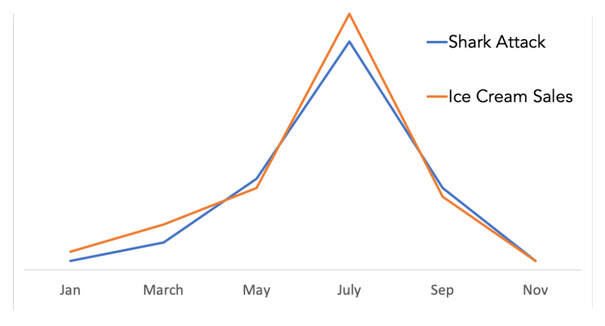
Photo Source: Family Physicians of Fairfax
Another red flag to look out for are small sample sizes. A small sample size may not be truly generalizable or representative of all people. Readers should also note where the sample was recruited from. If recruitment techniques are not listed, that is another red flag.
Location of the research can also be telling of its reliability. While social media and generative AI sites may provide scientific material, it is important to fact check these platforms using the peer-reviewed work. Always evaluate the source of the material. If no source is provided, this is an even bigger red flag! Citations should always be included.
All studies should include sections about funding and limitations. Funding or conflict of interest sections should always be provided. You should be critical of any source of scientific material that is not upfront about their funding. If you are receiving information from a source like social media, think critically about if the person or organization providing the information has anything to gain from the information that they are telling you. Do they happen to sell a product that they say cures a disease? Do they own stake in a company that will benefit from this research? Another important part of articles is the limitations section. Scientists should be aware and transparent of any issues with their research. If there is no mention of limitations, this should be taken into consideration when reading.
Call to action for scientists
As scientists, it is our responsibility to communicate our research to the general population. Public health without consideration for the public is not public health. When we isolate the public from our information, they get their information from others who may not have the best intentions. We must escape the ivory tower of academia and learn how to share our results. When writing a manuscript, challenge yourself to also write a version at an eighth grade level. Practice explaining your research to friends and family in different fields. We also must advocate for all research findings to be shared including insignificant findings to combat publication bias. Additionally, we must push for accessibility of research articles. Paywalls prohibit the public from increasing their knowledge of health. As public health researchers, professionals, and scientists, we must bring the public into our work; people’s lives depend on it.
Resources
- Research Terminology List
- Statistical Abbreviations Cheat Sheet
- Statistical Term Cheat Sheet
- Qualitative vs. Quantitative Fact Sheet
- Your Local Library! Librarians are trained in navigating literature and can assist in finding specific scientific topics.
- Rosenberg Library
- Causality Guidelines
- Types of Study Designs
- Confounding and Bias
- Publication Bias