
Graduate students in the UTMB School of Public and Population Health recently traveled to the Galveston County Health District (GCHD) headquarters in Texas City for a firsthand look at how local public health operates on the ground. The session, led by Dr. Philip Keiser, gave students a rare view of the full range of responsibilities that fall to a county health department and the local health authority who oversees them.
Dr. Philip Keiser holds a dual role that made the visit especially instructive. At UTMB, he serves as Associate Dean for Public Health Practice in the School of Public and Population Health. At the Galveston County Health District, he is the chief executive and the Galveston County Local Health Authority, a position established under the Texas Health and Safety Code that gives a licensed physician broad powers to enforce public health law within a county's jurisdiction. The visit was organized through the Public Health Practice II course, taught this semester by Leslie Stalnaker, SPPH's Director of Public Health Practice, and was open to all SPPH students interested in seeing how classroom concepts translate into daily public health operations.
What Falls Under a County Health Department
GCHD's jurisdiction spans a county with sharp demographic and geographic contrasts. League City is a suburban extension of Houston. Galveston Island draws millions of tourists a year and hosts a major cruise port. Hitchcock and parts of western Galveston County are rural. Texas City and La Marque include neighborhoods shaped by decades of industrial change, where refineries have automated and populations have shifted. Each community presents different health challenges, and the health district has to address all of them.
Dr. Keiser walked students through the 10 essential public health services and the programs that deliver them at the county level. GCHD's portfolio includes epidemiological surveillance and outbreak investigation, restaurant and pool inspections, immunization clinics, tuberculosis case management, sexually transmitted infection testing and treatment, HIV prevention and linkage to care, the Women, Infants, and Children (WIC) nutrition program, emergency medical services, emergency preparedness planning, vital records, air and water quality monitoring, animal services, and Coastal Health and Wellness, the district's federally qualified health center that provides primary care regardless of a patient's ability to pay.
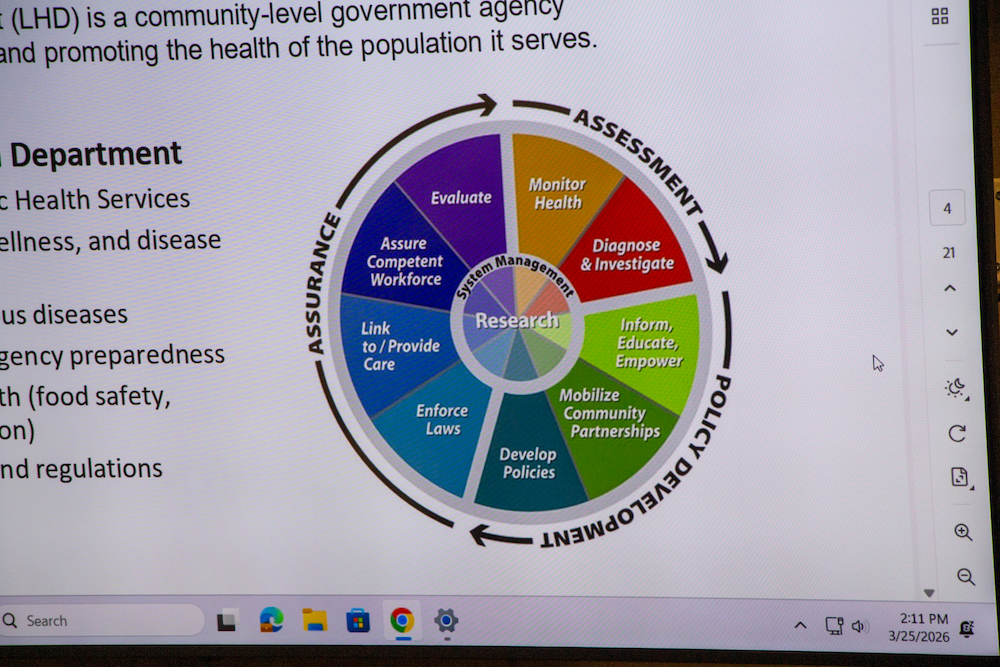
Dr. Keiser reviewed the 10 Essential Public Health Services framework during his overview of operations at the Galveston County Health District.
He also described challenges unique to the region. Cruise ships, which fall under federal jurisdiction while at sea, become the county's responsibility the moment they dock. The petrochemical corridor along the causeway carries the risk of industrial accidents, and Galveston County has experienced both the deadliest natural disaster in U.S. history, the 1900 hurricane, and the worst industrial accident, the 1947 Texas City explosion. And highly pathogenic avian influenza, which has appeared in migratory birds along the coast, required the health district to set up its own monitoring system in partnership with UTMB researchers, including Dr. Caitlin Cotter and Dr. Gregory Gray, after the initial state and federal response proved slow.
Mapping Overdose Hotspots to Distribute Narcan
One of the programs Dr. Keiser spent the most time on was the district's fentanyl overdose prevention effort. A few years ago, Galveston County's drug overdose death rate was on par with Houston's. Dr. Keiser's team convened a coalition, secured a supply of naloxone (Narcan), and set about figuring out where and to whom to distribute it.
The data told a story that surprised some students. The people most likely to die from a fentanyl overdose were not teenagers experimenting at parties. They were middle-aged, predominantly white, chronic users who had already been transported by EMS for overdoses multiple times. Using GIS data, the team mapped where overdoses were concentrating: Baycliff, an unincorporated area with minimal law enforcement presence at the time; parts of Galveston Island north of Broadway near 61st Street; and sections of Texas City and La Marque along Texas Avenue. All were areas with significant economic hardship.
The district placed Narcan in accessible locations throughout those communities, including refrigerator-style dispensing units that let people pick up kits without any interaction required. Combined with community outreach and education, the program contributed to a measurable drop in overdose deaths.
A Lead Poisoning Case That Uncovered Far Worse
The final portion of the visit centered on a real case that Dr. Keiser used to illustrate how a routine public health report can cascade into a complex, multi-agency intervention. The case began when the health department received a report that a four-year-old child living in a local children's shelter had dangerously elevated blood lead levels, above 20 micrograms per deciliter.
Before describing what happened next, Dr. Keiser assigned students to roles. One became the public health nurse. Another was the epidemiologist. Others played the environmental specialist and the shelter's director and attorney. The role-play forced students to work through the investigation in real time, deciding whom to call, what questions to ask, and how to navigate legal and political constraints.
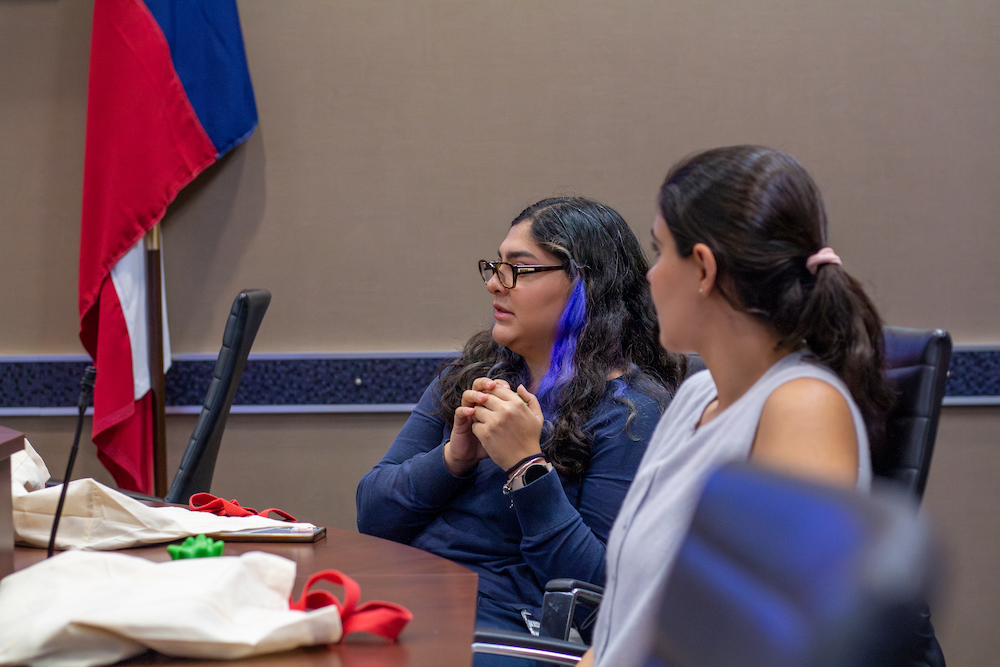
SPPH students played roles in a simulated lead poisoning investigation during the visit. The student at left served as the public health nurse conducting the initial case interviews, while her classmate took on the role of the environmental specialist.
In the actual case, the investigation quickly revealed conditions far beyond a lead exposure. Environmental specialists found rat droppings on infant beds, mold in ventilation systems, disconnected fire alarms and sprinkler systems, a single functioning sink for roughly 30 residents, and locked doors concealing additional living spaces. The shelter, which received state and federal funding to house vulnerable families, was charging the government for services it was not providing. Some staff members told Spanish-speaking residents not to cooperate with the health department's team.
Dr. Keiser described the legal and political layers involved. The building was owned by Galveston County, which made the county itself partly responsible for remediation. Using the Texas Public Health and Safety Code's provisions on contagion in buildings, Dr. Keiser issued an order to close the facility. The county fire marshal condemned the building for fire safety violations. The health department then worked with St. Vincent's House and rented temporary housing on the Seawall to relocate residents. Five additional children were found to have elevated lead levels. The shelter's operator did not contest the closure in court.
How Students Learn to Practice Public Health
The visit reinforced a principle that runs through the Public Health Practice II course. Public health practice draws on epidemiology, environmental science, law, communications, and community engagement simultaneously. A single investigation can require a nurse to interview a frightened parent, an environmental specialist to test floors and paint for lead, an epidemiologist to identify other cases, and a health authority to decide whether legal action is warranted.
Dr. Keiser told students that on most days, the work is routine: processing reports, inspecting restaurants, answering questions from the public. But cases like the shelter investigation show the full scope of what a local health authority can accomplish when it has a trained team and the willingness to act.
The School of Public and Population Health prepares students for the realities of public health practice through field-based learning experiences like this visit to the Galveston County Health District. Learn more about the school's programs and community partnerships.