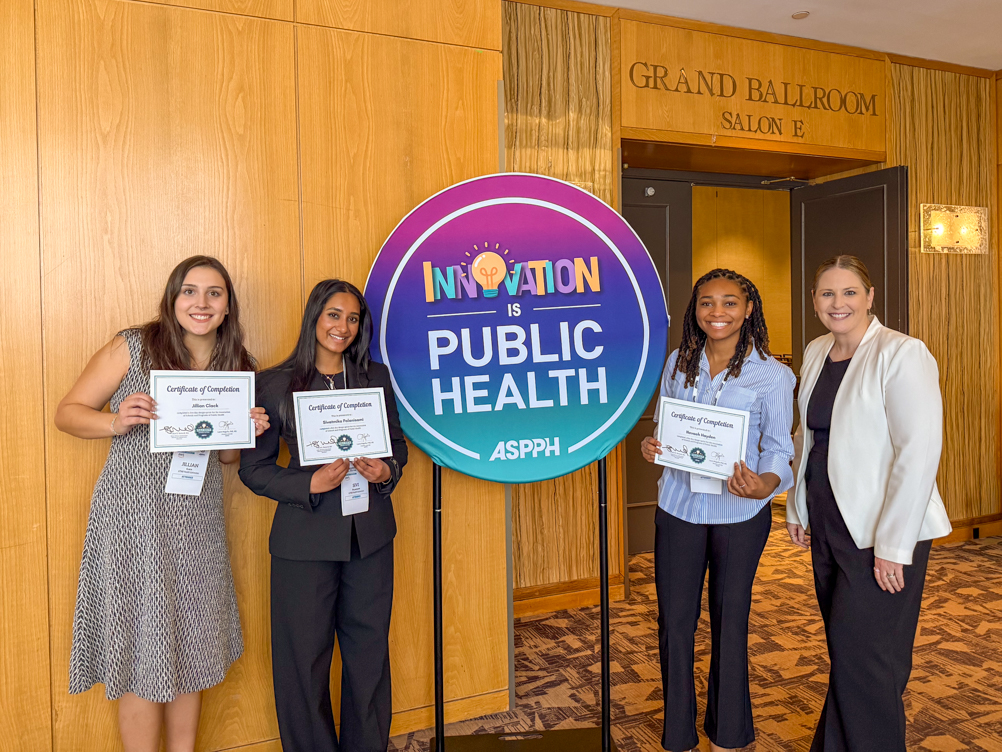
Three first-year MPH students from the UTMB School of Public and Population Health traveled to Arlington, Virginia, this March to compete in the Association of Schools and Programs of Public Health (ASPPH) Public Health Innovation Lab. Their project, SwipeSmart, earned the Audience Choice Award after two rounds of judging on the competition's final day.
Jillian Clack (Epidemiology), Nevaeh Hayden (Public Health Practice), and Sivi Palanisami (Bioethics) made up Team SwipeSmart, one of ten teams selected from a competitive applicant pool.
What the Innovation Lab Asks of Students
The ASPPH Innovation Lab trains students in human-centered design, a problem-solving approach built around the needs and experiences of the people a solution is meant to serve. Over the course of a week, teams map a public health problem, sketch potential solutions, build a prototype, test it with real users, and prepare a final pitch for a panel of judges. A $1,500 cash prize goes to the winning team.
The UTMB team chose to focus on online dating safety among young adults ages 18 to 24. According to a 2025 SSRS national survey, nearly two-thirds of adults in that age range have used a dating app, and Pew Research Center data show that 57% of female users under 35 have received unsolicited explicit messages through those platforms. Safety concerns are widespread enough that roughly half of all Americans say online dating is an unsafe way to meet people.
Five Days of Building and Testing
On day one, the team mapped the problem space around unsafe online dating culture and decided their solution would take the form of a mobile app. By day two, they had a working prototype and a storyboard showing how a user would interact with SwipeSmart.
Day three changed the direction of the project. The team interviewed potential users and heard firsthand which features felt useful, which caused confusion, and which they would actually rely on. SwipeSmart narrowed to five core tools, each designed to support a different moment in the online dating experience.
SwipeSmart's Five Core Tools
01 Chat Check | 02 Exit Call | 03 Ask AI | 04 Heads Up | 05 Check-In |
"Interviewing end users helped us focus our efforts on what people actually need, not what we assumed they need. That focus on real experiences, not just ideas, is what made SwipeSmart connect so strongly with the audience in the final round."
Jillian Clack, MPH Student, Epidemiology
Nevaeh, who led the user interviews, saw similar lessons take shape. "We learned that users value discretion, ease of use, and non-judgmental language for the prototype," she said. "This directly shaped our design to be intuitive, empowering, and not fear-based."
During the week, the team also toured the Amazon Web Services Skills Center and heard from Amazon's global health specialist about applications of artificial intelligence in public health. Several ideas from that session made it into the final version of SwipeSmart.
Semifinals to Finals on Pitch Day
On Friday, March 20, the team pitched SwipeSmart to a panel of semifinal judges and advanced to the final round, where they presented to a new set of judges and a larger audience.
Cara Pennel, DrPH, MPH, Associate Dean for Academic Affairs at SPPH, attended the ASPPH Annual Meeting and watched the team present. "Their presentation was extremely polished," Dr. Pennel said. "There was a seamless flow from one presenter to the next, and you could tell they all knew their stuff." She noted that the team handled questions from the four-judge panel especially well, calling it one of the areas where they stood out most.
The audience at the finals was largely made up of the five teams that had not advanced, meaning SwipeSmart's Audience Choice votes came primarily from peers who had spent the full week alongside them. "I think it says a lot that they won audience favorite and so many of their peers were the ones who voted for them," Dr. Pennel said. "They represented UTMB and SPPH well."
Tracie Seward, Senior Director of Educational Pathways and Undergraduate Education at ASPPH, organized the Innovation Lab. "The team from UTMB was amazing, engaged, enthusiastic, and committed to the process," Seward said. "I really enjoyed their energy, and their final solution."
"Advancing from semifinals to finals was both exciting and validating. Going first each time made us be more efficient and confident. It reinforced that our idea resonated and motivated us to refine our pitch even further."
Nevaeh Hayden, MPH Student, Public Health Practice
What Comes Next
All three students said they hope to continue developing the concept beyond the competition.
Leslie Stalnaker, Director of Public Health Practice, said the experience pushed the students in ways their coursework alone could not. "I am so proud of these three students for representing SPPH in this space alongside students from other schools and programs of public health," Leslie said. "The Lab challenged them and allowed them to learn things they wouldn't have learned in their required coursework. It was clear how seriously they took their participation and how much they grew through the process."
"I learned the importance of human-centered design as it relates to critical thinking and impact," Nevaeh said. "Especially the value of listening to users, iterating quickly, and grounding solutions in real-world experiences."
Jillian credited her coursework with helping her keep up during the early brainstorming sessions. The Innovation Lab compressed what can otherwise be a drawn-out development process into something fast and collaborative without losing sight of the end user.
The ASPPH Innovation Lab has run annually since 2024. Past winning projects have addressed campus food insecurity and clothing overconsumption among college students. SwipeSmart is the first project from a UTMB team to compete in the event.
The ASPPH Public Health Innovation Lab is open to undergraduate and graduate students nationwide. Learn more about upcoming ASPPH student opportunities.