Imagine this: Organ transplantation breakthroughs beginning hundreds of miles above Earth. Medications being manufactured on demand during missions to Mars. And the medical challenges of exploration entering uncharted territory as space travel expands beyond highly trained astronauts.
These possibilities are helping shape the future of aerospace medicine and the work ahead for the newly established Department of Aerospace and Exploration Medicine at The University of Texas Medical Branch (UTMB).
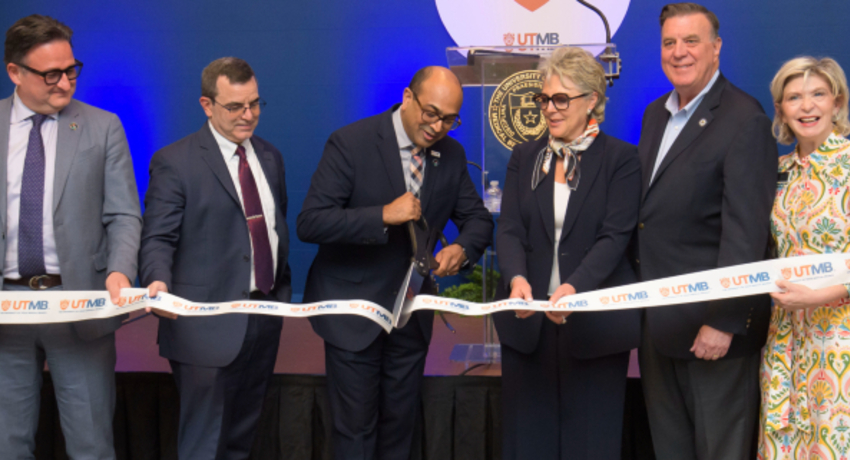
UTMB recently marked the department’s launch with a ribbon-cutting ceremony and a keynote lecture by James D. Polk, DO, NASA’s chief health and medical officer and a graduate of the aerospace medicine training program at UTMB.
In his presentation, “The Road Ahead in Space Medicine,” Polk described a rapidly expanding field driven by commercial spaceflight, emerging technologies, and scientific discoveries that could transform healthcare both in space and on Earth.
One of the most promising areas of research involves growing human tissue in microgravity, where scientists are exploring how the absence of Earth’s gravitational forces affects the development of three-dimensional structures.
Researchers have already experimented with printing liver, heart, and other tissues in orbit, Polk said, raising the possibility of one day growing replacement organs using a patient’s own stem cells.
Although such advances remain experimental, Polk said research in microgravity is providing insights that could lead to improvements in organ transplantation and tissue engineering on Earth.
Another emerging technology involves manufacturing medications on demand. Rather than transporting an extensive inventory of drugs aboard a spacecraft, future missions might carry the ingredients and equipment needed to produce medications as required.
“I can’t take the whole CVS pharmacy with me to Mars,” Polk said, noting that the potential applications extend well beyond space exploration, including the ability to manufacture specific drug dosages on Earth.
A changing frontier
As commercial companies expand their involvement in spaceflight, Polk said aerospace medicine must evolve beyond its traditional focus on protecting the health of government astronauts.
Commercial missions are bringing a broader range of people into space, including individuals whose medical histories and physical conditions differ from those of NASA’s carefully selected astronaut corps.
That raises new questions about managing chronic illnesses, assessing medical risks, and delivering care in environments where immediate access to a hospital is impossible.
Polk also described medical challenges already observed in astronauts, including cardiovascular conditions, blood clots, and vision changes associated with spaceflight.
Future missions to the moon and Mars will introduce additional challenges, particularly when communication delays make immediate consultation with physicians on Earth impractical.
Artificial intelligence, robotics, portable diagnostic equipment, and personalized medicine could play increasingly important roles in addressing those challenges.
But the expanding space economy also creates opportunities for healthcare professionals and researchers whose careers may look very different from those of traditional NASA flight surgeons.
Polk pointed to potential roles in occupational health, physical therapy, nursing, pharmaceutical development, and tissue engineering.
“Medicine in space, not space medicine,” he said, describing how the field is expanding beyond its traditional boundaries.
Building on a legacy
For UTMB, the new department represents the latest chapter in a relationship with the nation’s space program that spans more than six decades.
Ronak Shah, DO, the department’s inaugural chair, traced that history to Charles Berry, MD, an early UTMB faculty member who participated in the selection of the original Mercury Seven astronauts and supported the Apollo space program.
UTMB established its aerospace medicine residency in the 1990s and has since trained nearly 80 graduates who have pursued careers in government, military medicine, academia, and related fields.
What began as a single training program eventually became a division and now includes three training pathways, with a fourth planned, Shah said.
“For the first time, a civilian institution has created a Department of Aerospace and Exploration Medicine,” Shah said.
The addition of “exploration” to the department name reflects a broader mission that extends beyond conventional aerospace medicine, he explained.
“There is an innate spirit of exploration, and the word became a natural fit,” Shah said. “It defines who we are and why we do what we do.”
As commercial spaceflight expands and missions venture farther from Earth, the need for specialized medical expertise will continue to grow.
UTMB President Jochen Reiser, MD, PhD, said the department provides a foundation for connecting advances in space research with clinical care and innovation.
“Spaceflight brings biological and operational pressures together in ways no laboratory on Earth can fully reproduce,” Reiser said. “It offers a rare setting to advance medical knowledge through research and innovation.”
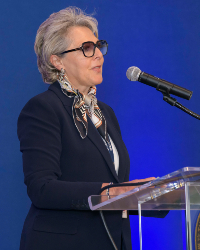 | 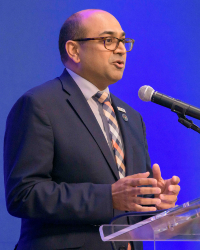 | 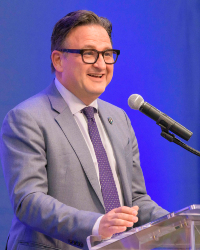 | 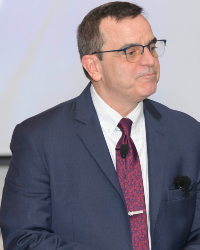 |
From left: Susan Chubinskaya, PhD, MS; Ronak Shah, DO; UTMB President and Health System CEO Jochen Reiser, MD, PhD; and guest speaker James D. Polk, DO, address the audience at the ribbon-cutting and launch of the newly established Department of Aerospace and Exploration Medicine at The University of Texas Medical Branch (UTMB).