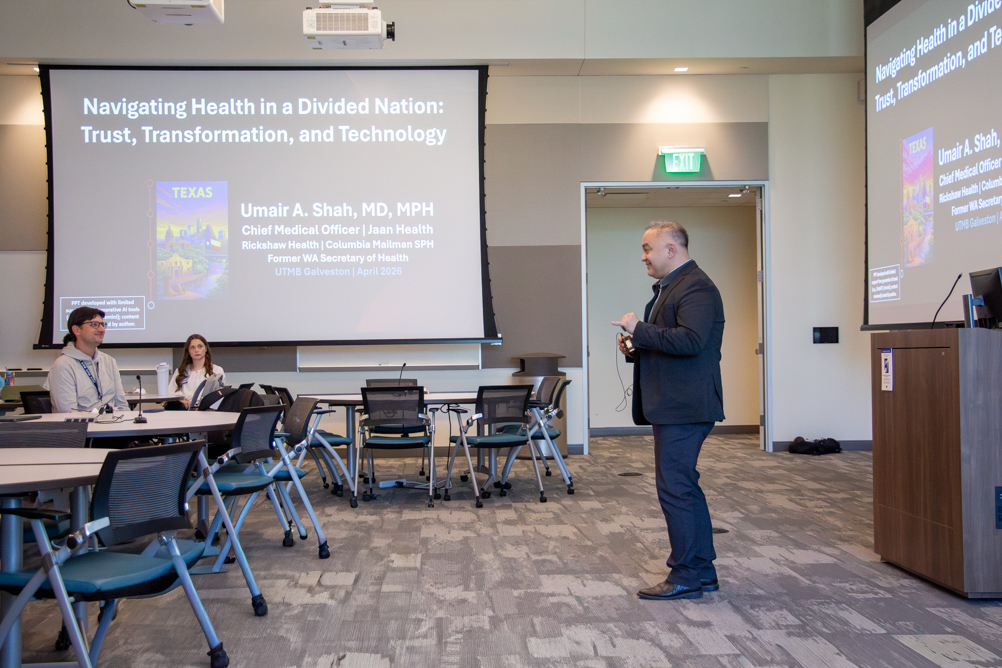
Dr. Umair A. Shah returned to Galveston on April 8 to deliver the keynote address at UTMB's 2026 National Public Health Week Symposium. A physician executive who began his public health career as the medical director of Galveston County Health District more than two decades ago, Dr. Shah spoke to students, faculty, and alumni about what it takes to lead in a political environment where trust in institutions is eroding and technology is advancing faster than the systems built to use it.
Dr. Shah currently serves as Chief Medical Officer of Jaan Health, an AI-powered care management company. He is also the founder of Rickshaw Health, a consulting practice, and teaches a course at Columbia University's Mailman School of Public Health titled "Navigating Health in a Divided Nation." Before entering the private sector, he served as Washington State Secretary of Health, where he led the state's COVID-19 response, and spent years running Harris County Public Health, one of the largest local health departments in the country.
His talk covered a wide range of territory in a short window, but several threads held it together. The first was a provocation he posed early and returned to throughout the afternoon. If health is the heartbeat of society, the shared work of public health should be a relentless pursuit of health, every day, without waiting for the next election cycle or the next emergency to force action. A kid in Detroit or a teenager in Mississippi cannot wait four years for the system to catch up.
Why Science Alone Has Not Been Enough
Dr. Shah was direct about what he sees as a persistent shortcoming in the field. Public health professionals know how to collect data. They know how to build evidence. But they have not figured out how to tell the story of that evidence in a way that earns trust across political and cultural lines. He described this as the central lesson of the pandemic. Science is necessary, but it is not sufficient. The field failed to explain itself in terms that people across the country could hear and act on.
He traced part of the problem to how public health communicates. Too often, he said, practitioners assume shared understanding where none exists. They present data without narrative context, send the wrong messenger to the wrong audience, and talk at communities instead of with them. The result is a widening gap between what the field knows and what the public trusts.
To illustrate how tribal thinking shapes health conversations, Dr. Shah recalled a late-night comedy segment where a TV host's team asked people on the street what they thought of the Affordable Care Act versus "Obamacare." The same people who said they hated one loved the other. The policies were identical. When health gets labeled politically, he argued, people stop evaluating the substance.
From Silos of Excellence to Systems of Excellence
A recurring theme in Dr. Shah's address was the difference between being good within a silo and being effective across a system. Public health agencies, he noted, tend to run strong individual programs—epidemiology here, environmental health there, maternal and child health in another division. Each one may perform well on its own terms. But these programs rarely connect their work across the boundaries that separate them, let alone across sectors like housing, transportation, and education.
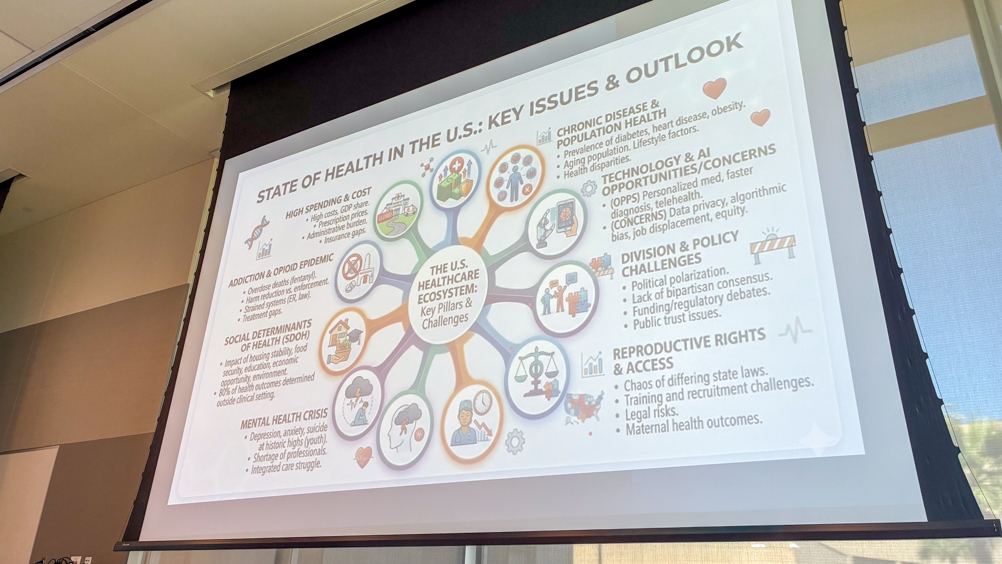
The same pattern plays out at the national level. The United States spends roughly 18 percent of its gross domestic product on health-related activities, but the vast majority goes toward treating illness after it occurs. Only about three cents of every healthcare dollar is invested in prevention and public health infrastructure. Dr. Shah presented data showing the U.S. as a consistent outlier among wealthy nations with the highest spending and returns that lag behind peer countries on measures like life expectancy and avoidable mortality.
Moving from silos to systems, he said, requires public health to stop admiring its own expertise and start building connections, both within the field and with partners outside it.
Technology as Connector, Not Replacement
Dr. Shah spent a portion of his talk on the role of artificial intelligence and digital health tools, a subject he engages with daily in his role at Jaan Health and through his work with the Coalition for Health AI and ASPPH's Task Force for the Responsible and Ethical Use of Artificial Intelligence.
AI will not replace physicians or public health professionals, but professionals who learn to use AI tools will have a clear advantage over those who do not. The field faces too much data, too many demands, and too few people to meet them. Technology can help close that gap, but only if it is designed around the real workflows and real barriers that patients and communities face, not around an idealized version of how care should work.
He described this as a "high-tech, high-touch" approach. Technology connects the people doing the work with the people being served, but if the human connection is missing, adoption will fail. Tools built for ideal users will not reach the people who need them most.
Storytelling, Shared Values, and the Art of Public Health
Dr. Shah made the case that public health leadership requires an artistic dimension that the field has underinvested in. Just as clinicians talk about the art of medicine, there is an art to public health. It is the judgment, communication, and trust-building that determine whether evidence-based interventions actually succeed.
He shared examples from his own career of using alliteration, sports analogies, and personal stories to make public health concepts accessible. In Harris County, he compared public health workers to the offensive line of a football team. Everyone knows the quarterback, but the offensive line makes the plays possible.
During the pandemic, Dr. Shah recalled a conversation with a state leader about vaccine hesitancy who could not understand why people would refuse a vaccine that could save their lives. Dr. Shah encouraged him to think about how certain media figures had framed the decision for their audiences. For many people who chose not to get vaccinated, he said, the decision was completely rational within their cultural context. Understanding that, rather than dismissing it as irrational, was the starting point for reaching them.
Some of the skills he outlined for navigating political divides were fundamental.
- Listening across differences
- Understanding the values behind people's decisions
- Anchoring messages in what communities share rather than where they disagree
- Using plain language with clear next steps
Check Your Own Pulse
Dr. Shah closed with advice rooted in his years as an emergency physician. The first thing you do at a code, he told the room, is check your own pulse. Not the patient's. Yours. You have to be calm before you can help anyone else. The same principle applies in a chaotic policy environment where funding is being cut, language is being policed, and federal agencies are being restructured. Reacting emotionally does not advance the work. Being proactive, staying calm, and returning to the reasons you entered the field is what keeps the work moving forward.
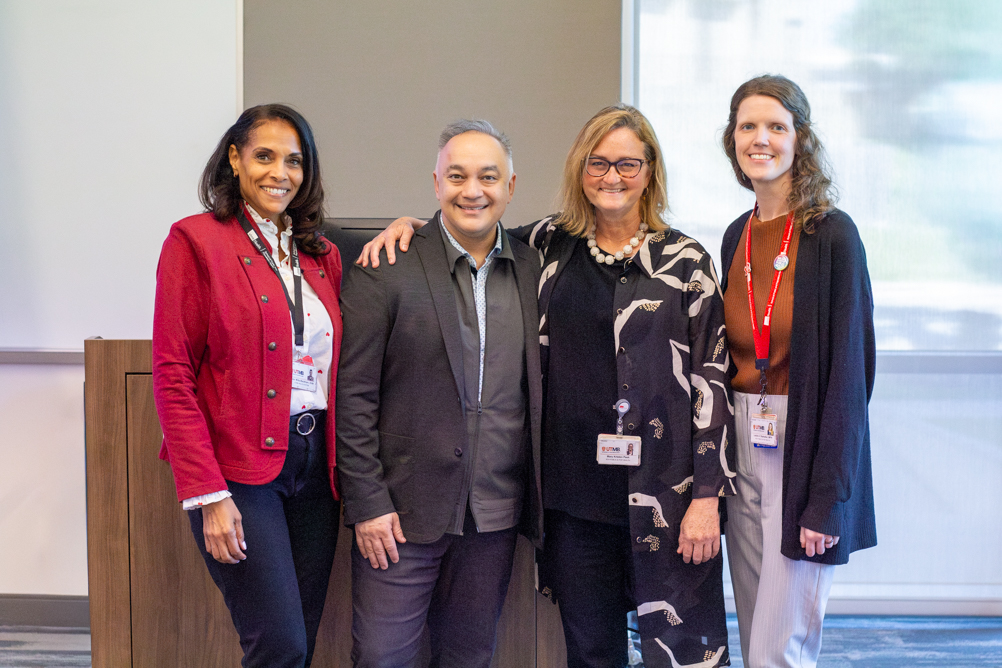
He urged the audience to leverage every partnership available, across sectors, across political lines, and across the public-private divide, and to take care of themselves in the process. You cannot give out of an empty well, he said.
His final image was of a kintsugi bowl, the Japanese art of repairing broken pottery with gold. A beautiful thing is never perfect. The field has cracks. It has made mistakes. But those fractures, repaired and visible, are what make it resilient, strong, and ready for the work ahead.
Dr. Shah's keynote was part of UTMB's 2026 National Public Health Week Symposium, held April 6 through 10. The week also included a community voices panel, career connections mixer, student poster session, biocontainment preparedness panel, and a beach clean-up service day. View the full schedule of events.