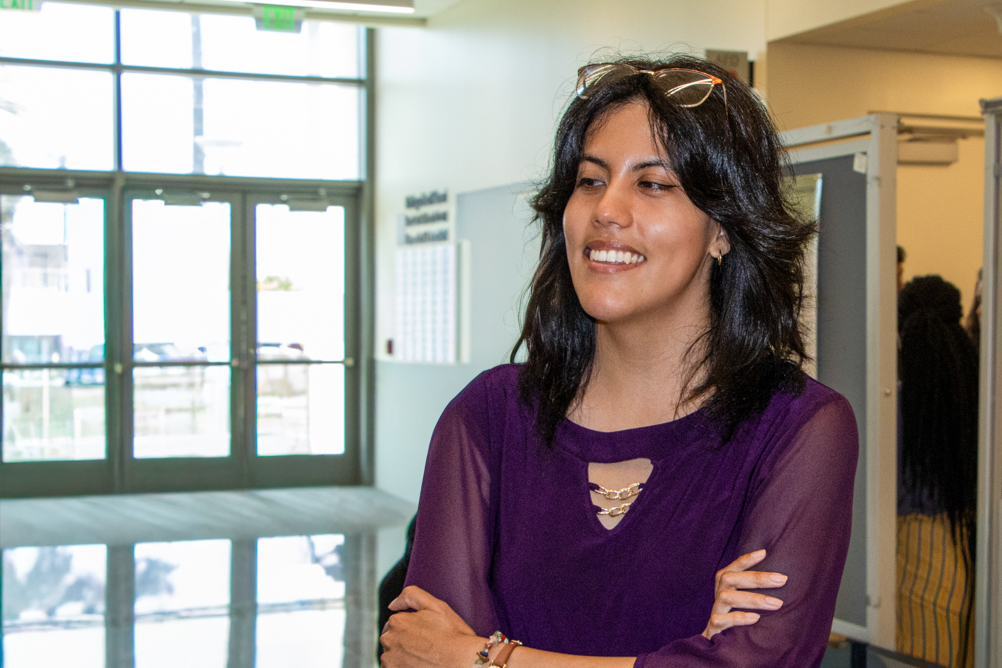
For her capstone research, Monserrat Hinojosa, MPH, pulled a cohort of more than three million patient records to ask whether a latent tuberculosis infection changes how patients with chronic kidney disease hold up over five years. It does. People living with both conditions showed sharply higher rates of heart disease, diabetes, serious infection, and malnutrition, a result that points clinicians toward a group worth watching more closely. The training that produced that finding also taught her to account for the people a database like that never records.
Why she works to leave a community better than she found it
The idea comes up often across SPPH, and Monserrat carries it into every project that touches real people. You go into a community to study it, and you leave it better than you found it, never the same way you arrived. She has lived that out screening patients for safety-net program eligibility at a Houston clinic, coordinating care for food-insecure patients with diabetes and hypertension, and building research protocols abroad.
"As a public health professional, I believe data collection should never be one-sided, it should benefit the community, patient, or individual in said study. Communities are sharing their experiences, challenges, and their stories. They have built trust with researchers, and we have the responsibility to give something back."
Monserrat Hinojosa, MPH in Epidemiology
Living up to that, she says, means going in with humility and cultural awareness, listening before assuming, carrying findings back to the people who shared them, and making sure the work leads to action rather than ending at a spreadsheet. By her own measure, if she leaves a community with stronger partnerships, better information, or evidence that guides a change, she has honored the trust placed in her.
Her capstone study of kidney disease and latent tuberculosis
For her integrative learning experience, the capstone of the Master of Public Health in Epidemiology, Monserrat ran a retrospective cohort study drawn from roughly three million adult records in the TriNetX U.S. Collaborative Network, which pools electronic health data from 70 health care organizations. She compared two groups of patients with chronic kidney disease at stages three through five, one carrying a latent tuberculosis infection and one without, then followed their outcomes across five years.
The group with a latent infection fared worse on nearly every outcome she examined.
| Outcome over five years | With latent TB | Without latent TB | Relative risk |
|---|---|---|---|
| Ischemic heart disease | 42.1% | 23.6% | 1.79 |
| Type 2 diabetes | 62.2% | 33.2% | 1.87 |
| Hypotension | 20.9% | 6.9% | 3.02 |
| Malnutrition | 11.1% | 2.9% | 3.89 |
| Pneumonia | 20.0% | 7.8% | 2.57 |
Adults with chronic kidney disease, stages three through five, followed for five years in the TriNetX U.S. Collaborative Network. Latent tuberculosis group n = 7,352; comparison group n = 3,203,959. Relative risk is the ratio of outcome rates between the two groups.
With about 3.2 million patients in the comparison group and about 7,350 in the latent-infection group, even tiny differences can clear the bar for statistical significance, so Monserrat reads the size of an effect rather than leaning on p-values alone. She is just as candid about the study's limits. Mortality came out slightly lower in the latent-infection group, a result she flags for closer analysis rather than overstating.
The practical message for physicians is to look harder at patients who carry both conditions. Tuberculosis and kidney disease each come with demanding drug regimens that can work against each other, and a latent infection can progress to active disease, which adds a serious illness on top of an already fragile baseline.
She co-authored the study with her faculty mentor Dr. Cesar Ugarte-Gil and Dr. George Golovko, with support from the UTMB Institute for Translational Sciences through a Clinical and Translational Science Award from the National Institutes of Health.
How to read a health study when it is your family on the line
Monserrat is firm that strong research and weak research differ on method, not opinion, and that anyone trying to make sense of a health question should slow down before trusting a single number.
"My best advice for reading science well is to avoid making decisions based on a single study. Research works best when findings can be replicated across multiple studies and different populations (unbiased). If you're trying to understand a health issue that affects your family, start by looking for consensus rather than singular claims, and look at the patterns!"
Monserrat Hinojosa, MPH in Epidemiology
The checks she relies on come down to replication, sample size, the makeup of the study group, and the credibility of the source.
| Look for consensus across several studies and populations, not one striking result. | |
| Check the sample size and who was included or excluded. | |
| Ask whether the study population resembles the people the findings are being applied to. | |
| Confirm there was a comparison group. | |
| Weigh the source, favoring peer-reviewed journals and health agencies over social media. | |
| Remember that correlation is not causation, two things moving together does not mean one caused the other. |
She points readers toward outlets such as The Lancet, the CDC's Morbidity and Mortality Weekly Report, the NIH, the American Journal of Preventive Medicine, and the World Health Organization. She has practiced the same discipline in her own work, using a blinded screening process in a tuberculosis literature review she co-authored so that one reviewer's calls could not sway another's.
What a paper surveillance form in Lima showed her about missing data
Monserrat's applied practice experience, carried out while she completed the Global Health Certificate, placed her with UPCH and the Peruvian CDC, where she helped develop a study protocol on dengue in pregnant patients and spent time inside Huascar XV, a Ministry of Health clinic serving a low-income district of Lima. Cases there were logged on paper forms and later entered into the national reporting system. When the internet was down or staff were stretched, records could be lost, entered twice, or misclassified.
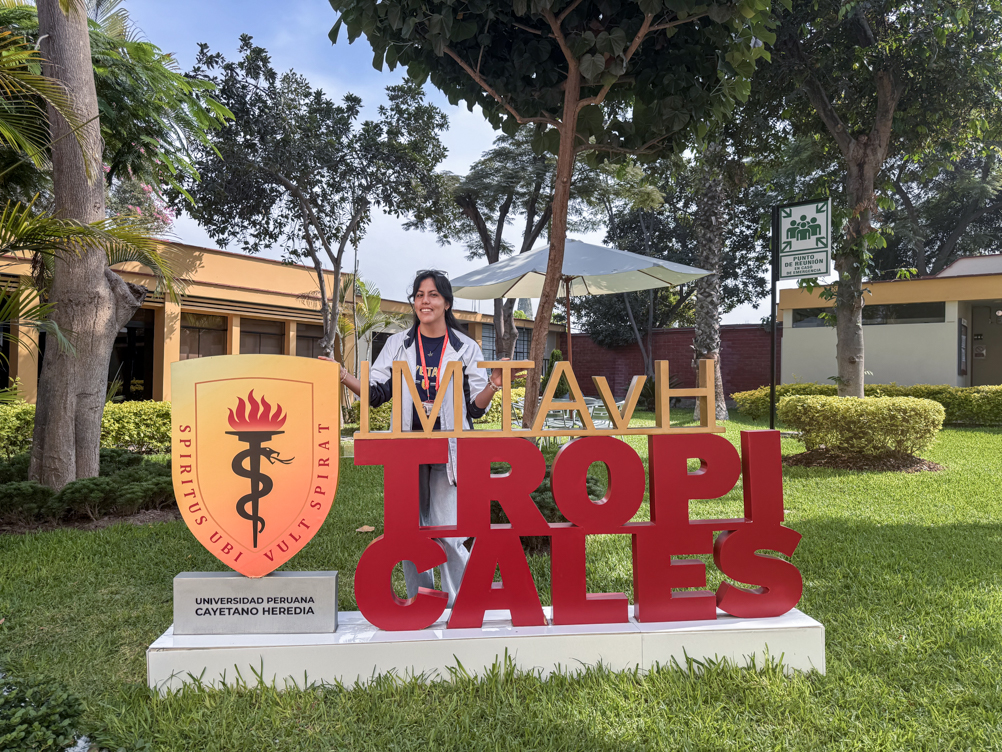
In epidemiological terms, those gaps produce underreporting and misclassification bias, which quietly weakens a country's read on how much disease is actually circulating. A duplicated dengue case, or one that never reaches the system, can mean a missed chance at contact tracing in a close community where infection moves fast.
She also saw the human side that no surveillance form captures. Men were slower to seek care, a pattern that surfaced in her database work too, where male patients carried a heavier share of poor outcomes. In both settings she came to describe the people left out of the count the same way, as patients who fall through the cracks.
Rather than stop at the data, she brought structural recommendations to MINSA and the Pan American Health Organization, arguing that sending teams into the field without lasting change only patches the problem.
01 Offline-capable reporting Expand digital reporting that works without a steady internet connection so clinics in low-resource areas lose fewer cases. | 02 Shared clinical rotations Partner UPCH with MINSA clinics so nursing and medical students staff under-resourced sites, easing shortages and shortening waits. | 03 Transportation and mobile screening Add bus cards and mobile units so patients are not forced to travel to another clinic for an X-ray or follow-up. |
Evaluating a health curriculum across five schools in Cambodia
Since January, Monserrat has worked as a program evaluator intern with Cambodia Global Health, measuring whether the organization's health-education curriculum is reaching its goals across five schools. Every other week she meets with the team to set targets and decide what each survey should ask, then sends the surveys out in the afternoon so they land in the morning for teachers on the other side of the world.
The surveys track knowledge, attitudes, behaviors, and engagement. She analyzes the responses for patterns across schools, compares fall 2025 with spring 2026, and writes up what changed in a presentation and an impact report. Her MPH and global health training show up at every step, in how she designs the surveys, watches for bias and data quality, and ties the numbers back to social determinants of health and the realities of putting a program into practice.
"My training has taught me that evaluation is not just about measuring outcomes, it's about developing evidence that can strengthen programs and improve the well being of communities."
Monserrat Hinojosa, MPH in Epidemiology
What she hopes to be for the next student
An epidemiologist once visited the undergraduate lab where Monserrat was working and walked the room through her research mapping under-resourced communities. It was the first time the field came into focus for her, and she wants to be that kind of presence for someone else.
"For the next person, I hope to be someone who makes public health feel at reach and meaningful. As a first-generation student, I know how important it is to see someone who has walked a similar path, with a similar background. I hope I can encourage students to pursue opportunities they may not think they're qualified for, and know that their perspectives and experiences have value in this field."
Monserrat Hinojosa, MPH in Epidemiology
She is aiming next at a fellowship with the CDC for hands-on work in tropical and infectious diseases, and she plans to keep doing infectious disease research while staying close to community outreach. The dengue-in-pregnancy protocol she helped write has cleared its review board and is moving toward publication.