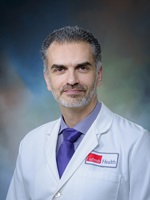
 A Message from the Chair
Department of Internal Medicine
Salim Hayek, MD, FAHA, FACC
Welcome to the University of Texas Medical Branch Department of Internal Medicine! We are proud to offer advanced medical care, research, and training in the region’s only academic health science center south of Houston.
Our work is shaped by the unique places we practice and the patients for whom we care. Based on Galveston Island and with hospital and clinic locations throughout our mainland communities, our medical practice is diverse in every way – the patients we have the privilege to serve, the illnesses we treat, and the places where we work.
Our vision combines top-notch clinical care with education and research, transforming how we care for patients, teach our students, and expand our knowledge. At UTMB, supported by the Galveston National Laboratory and the nation’s #1 Microbiology department for NIH funding, we create an environment where research and patient care go hand in hand. Through UTMB’s Clinical Translational Sciences Award, we operate a state-of-the-art Clinical Research Center to conduct clinical trials, PI-initiated studies, and industry-sponsored studies that will help shape the future of medicine. Our commitment to innovation drives new solutions, like AI tools that help clinicians practice more efficiently and improve patient care.
UTMB has formed important partnerships that push the boundaries of traditional medicine, making us stronger and more adaptable. We provide essential telehealth care to passengers at sea through our innovative cruise ship medicine program. Our Aerospace Medicine program prepares doctors to deliver care in extreme environments. Our expertise reaches the most remote locations through UTMB’s medical contract with the National Science Foundation in Antarctica. We train and practice in the secure UTMB – Texas Department of Criminal Justice Hospital, the only hospital for care of the incarcerated on a major academic medical center campus.
In a region that has endured many storms, UTMB is an indisputably resilient institution. From our beginnings as a safety-net hospital to our growth into a comprehensive health care system, we have always supported our community through natural disasters, explosions, a pandemic, and more. For prospective faculty, UTMB offers an environment where you can build a fulfilling career and live up to the mission of providing exceptional care to all. Our promise to our patients is this: no matter who you are or what your circumstances, we are dedicated to providing you with the best possible care.
Salim Hayek, MD, FAHA, FACC
Edward Randall and Edward Randall Jr. Distinguished Chair in Internal Medicine
Professor and Chair, Department of Internal Medicine