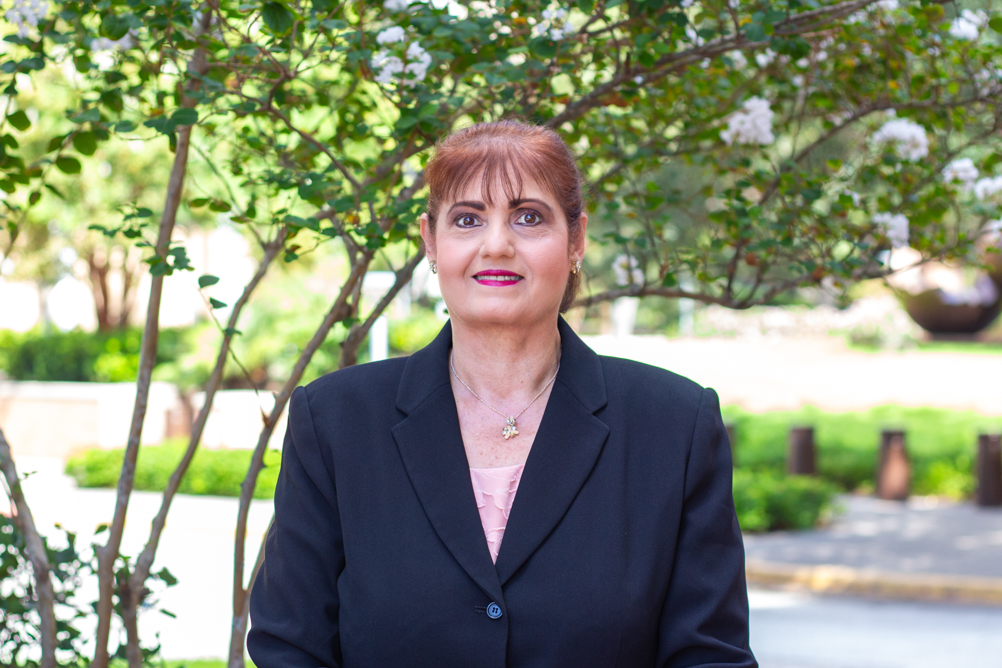
Soham Al Snih, MD, PhD, has spent nearly three decades studying whether older adults can regain the strength and independence they lose with age. Her research keeps finding that they can.
In recognition of that work, the professor in the Department of Population Health and Health Disparities at UTMB's School of Public and Population Health has been appointed to the Bertha and Robert Bucksch Distinguished Research Professorship. The five-year appointment took effect April 1.
"Being named to the Bertha and Robert Bucksch Distinguished Research Professorship is a real honor, and I'm very grateful for the recognition," Al Snih said. "At the same time, I see it as encouragement to keep doing the work that has always motivated me. I am still motivated by the questions we have yet to answer about aging and by the opportunity to do research that can improve the health and quality of life of older adults. There is so much more to learn, and I feel fortunate to be able to keep contributing to that effort."
From the clinic to the cohort
Al Snih's path to aging research began at the bedside. Trained as a physician in Venezuela, she practiced as a rheumatologist at the Hospital Universitario de Caracas and led the epidemiology section of the country's National Center of Rheumatic Diseases. A friendship between her department chief and UTMB's Dr. James Goodwin brought her to Galveston on Oct. 1, 1998, as a visiting scientist at the Sealy Center on Aging. She went on to earn her master's and doctorate in preventive medicine and community health at UTMB. She credits three mentors, Goodwin, Dr. Kyriakos Markides and the late Dr. Kenneth Ottenbacher, with training her as a researcher.
Much of that training came through the Hispanic Established Populations for the Epidemiologic Study of the Elderly, or Hispanic EPESE, a National Institute on Aging-funded study of Mexican American older adults in the Southwest led by Markides. The study has produced roughly 400 publications across nearly three decades of follow-up. Al Snih has worked with it since her first days on campus and now helps lead the Texas Resource Center on Minority Aging Research alongside Markides. She also co-leads the Pilot and Exploratory Studies Core of UTMB's Claude D. Pepper Older Americans Independence Center.
She helped establish hand grip strength, a test that takes seconds to perform, as a predictor of later disability, cognitive decline and death. Her frailty research showed that the condition is dynamic. Older adults can move from frailty back to pre-frail states, and those who do tend to live longer. Her team also found that older adults who walk 150 minutes or more per week are less likely to become frail.
"One of the most important messages is that aging does not mean giving up independence," she said. "Simple lifestyle habits such as staying physically active, eating healthy, and maintaining social connections can make a meaningful difference. I hope older adults and their families know that these opportunities exist and that it is never too late to benefit from healthy changes."
She also wants that message to travel beyond academia. "Research must reach beyond scientific journals," she said. "It needs to be shared in ways that older adults, families, healthcare providers, and communities can understand and use. If our work helps people make informed decisions that lead to healthier and more independent lives, then I feel we have made a meaningful contribution."
Paying the mentorship forward
Mentoring has been just as central to Al Snih's career. She has guided more than 100 students, junior faculty and visiting scholars, and in June the provost's office named her the 2026 recipient of UTMB's Faculty Excellence Award for Excellence in Mentoring.
Because no two mentees have the same needs, she adjusts her approach to each one, a habit she traces to her years treating patients. She also insists that mentees take first authorship on the papers they lead, so the responsibility and the credit are theirs.
"I have always believed that one of the most important parts of my job is helping the next generation of scientists succeed," she said.
She plans to use much of the professorship's support to send students to scientific meetings and to cover publication costs they often cannot afford on their own. "If this professorship allows me to help students attend conferences, present their work, or support the publication of their research, then I think it is an investment in their future and the future of aging research," she said. "Those experiences can open doors, build confidence, and help launch successful careers."
Winrose Windsor, a doctoral student who studied grip strength, cognition and fall risk among Mexican American older adults under Al Snih, credits her mentorship for the Excellence in Research Award she received at the 2025 Annual Forum on Aging. "Watching her navigate through complex research topics with perfection during the Applied Research Methods class has taught me to strive for excellence and resilience in all of my work," Windsor said.
"Dr. Al Snih is an exceptional mentor and teacher," said Minal Sonawane, a doctoral student studying walking activity and physical function in older Hispanic adults. "She brings decades of expertise in longitudinal studies of aging to everything she does, and she has a real gift for making rigorous epidemiological methods clear and approachable for students. It's easy to see why she has mentored so many students over the years."
Al Snih sees the professorship as a way to keep doing both.
"An equally important part of my work is mentoring students and early-career investigators," she said. "Watching them develop their own ideas, build successful careers, and make contributions to the field has been one of the most rewarding parts of my career. I hope to continue creating opportunities for them to grow and to help move aging research in new ways."
.png?sfvrsn=e5334853_1 "Oct 1_Lunch and Learn (1)")
.jpg?sfvrsn=7fd4453_1 "Jou headshot (photo credit Marie Etchegoyen, Rice University)")