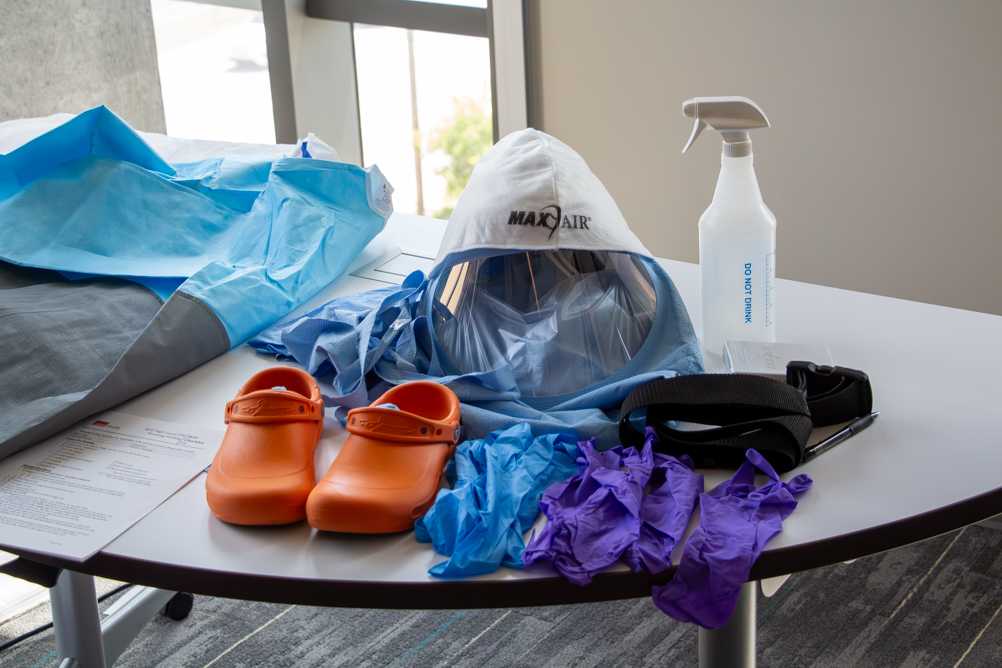
When a patient arrives at a hospital with a potentially deadly infectious disease, the medical response depends on years of preparation that most people never see. On April 9, a panel of researchers from UTMB's Special Pathogens Excellence in Clinical Treatment, Readiness, and Education (SPECTRE) program and the Department of Bioethics and Health Humanities explored how that preparation works, what ethical questions it raises, and why a six-room unit that may never admit a patient remains one of the most important pieces of public health infrastructure in the region.
The session, held during National Public Health Week 2026, brought together five faculty members from two different parts of UTMB for a conversation about biocontainment, safety, and the less visible work of staying ready for threats that may or may not arrive. Melissa Massey, SPECTRE's education and training program manager, moderated the discussion.
What SPECTRE Does and Why It Exists
Dr. Corri Levine, associate director of SPECTRE, assistant professor in the Division of Infectious Diseases, and SPPH alumnus (MPH '21), opened the session with a history of how the United States built its current biocontainment infrastructure. The catalyst was the 2014–2016 Ebola outbreak in West Africa, the largest since the virus was discovered in 1976. Nearly 30,000 people were infected and more than 11,000 died. The World Health Organization (WHO) declared a public health emergency of international concern.
The outbreak reached the U.S. through a single case in Dallas. A man who had traveled from West Africa presented to an emergency department, was discharged with antibiotics, and returned days later critically ill. He was eventually diagnosed with Ebola virus disease and died on October 8, 2014. Two nurses were infected during his care. Both survived, but the case exposed serious gaps in the country's readiness for high-consequence infectious diseases (HCIDs), from limited training on personal protective equipment (PPE) to a lack of any coordinated national system for containment care.
In response, the federal government began designating Regional Emerging Special Pathogens Treatment Centers (RESPTCs) across the country. There are now 13, with at least one in every U.S. Department of Health and Human Services (HHS) region. UTMB serves as the RESPTC for HHS Region 6, covering Texas, Louisiana, Arkansas, Oklahoma, and New Mexico. Its six-room Biocontainment Care Unit (BCU) is staffed and equipped to receive patients with Ebola, viral hemorrhagic fevers, severe respiratory diseases like SARS, or an entirely unknown pathogen.
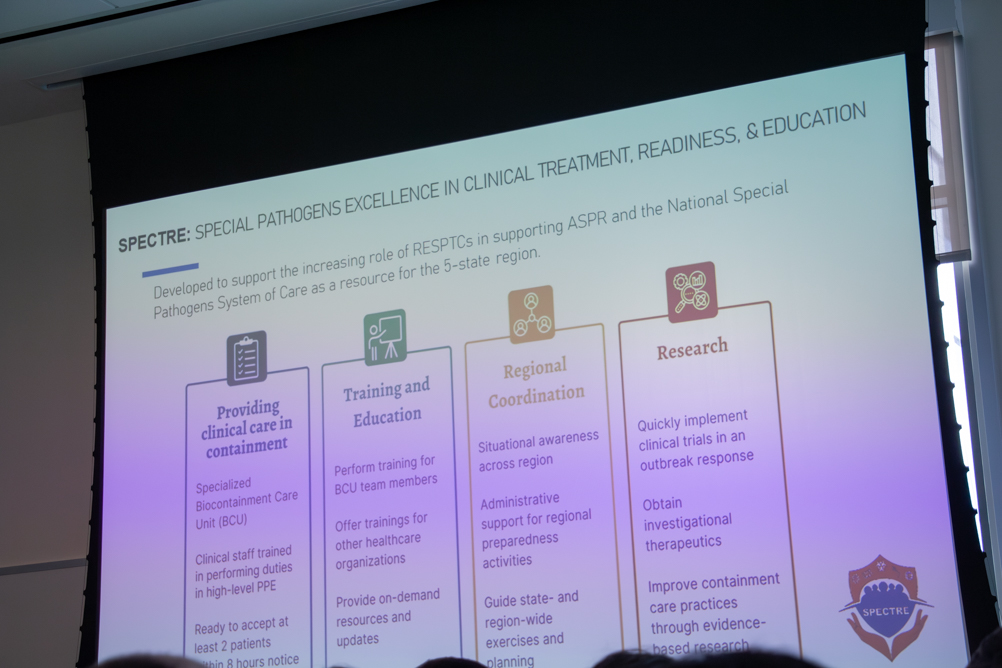
SPECTRE, established at UTMB in 2021, is the program that holds that readiness together. It coordinates clinical care in the BCU, trains frontline healthcare workers across the five-state region, works with emergency medical services and public health laboratories, and supports research on how to improve care in containment settings. Dr. Levine described the fundamental tension at the center of the work. The BCU exists for high-stakes, low-probability events. The skills required to operate it safely must be maintained constantly, yet the unit's value has to be continually justified precisely because it is rarely activated.
Studying the Ethics of a Place That Hopes to Stay Empty
Dr. Alberto Aparicio, an assistant professor in the Department of Bioethics and Health Humanities, presented findings from an ongoing collaboration between SPECTRE and his department. The project uses interviews and observations to examine how readiness and preparedness are actually produced inside the BCU and what ethical questions that process generates.
The team has conducted 11 semi-structured interviews with BCU staff so far. What they have found is that the BCU operates under a different set of norms than a typical clinical setting. One of the most immediate examples is the question of priority. In most hospital environments, the patient's needs come first. In the BCU, provider safety sits at the forefront of how care is delivered, because a healthcare worker who becomes infected cannot help anyone and may become a patient in a unit with limited capacity. That orientation shapes every clinical decision, from whether to perform CPR on a crashing patient to how aggressively to pursue treatments that may carry significant risk to the care team.
Dr. Aparicio outlined several other ethical dimensions the interviews have surfaced. Visitation policy is an ongoing challenge. If a patient is isolated in the BCU for days or weeks, under what circumstances should family members be allowed to visit? Can they safely use the required PPE? The question becomes especially acute when children are involved, or when a patient is dying. End-of-life scenarios force a painful tension between infection control and the deeply human need to be present with a loved one.
Admission and discharge raise their own questions. If a patient with a confirmed HCID is in the BCU, can they leave freely? What are the criteria for restraint if they try? And throughout all of it, there are emotional dimensions for the providers themselves, who may be caring for patients with diseases for which no effective treatment exists.
Safety as Something That Has to Be Built
A central argument in Dr. Aparicio's presentation was that the BCU should be understood as an infrastructure that produces safety, not merely a facility that contains dangerous pathogens. Safety, in this framing, depends on material components like ventilation systems, specialized equipment, and PPE. But it also depends on social and organizational conditions that make those tools effective in practice.
One of those conditions is what the research team calls a "speak-up culture." In the BCU, any team member, regardless of role or seniority, is expected to call out a problem the moment they see it. The unit also operates with flattened hierarchies. Doctors, nurses, and biosafety professionals all perform the same tasks. Everyone dons the same protective equipment. Everyone mops the floor. No one directs others from a position of authority in the way that hospital hierarchies typically allow. This matters because many of the critical procedures in the BCU cannot be negotiated in real time. They must be defined in advance and executed precisely, and the culture of the unit has to support that precision.
Dr. Aparicio also described how the Ebola outbreak and the Dallas case continue to function as a shared reference point for BCU staff, a lasting reminder of what can go wrong and why the work of staying prepared is worth sustaining even in the absence of an active threat.
Perspectives from the Panel
During the moderated discussion, Dr. Susan McLellan, SPECTRE's director and the BCU's medical director, spoke about her experience providing care during the West Africa Ebola outbreak. She drew parallels between the early days of HIV, when healthcare workers were afraid to touch patients, and the early months of the Ebola response, when the default approach was isolation and comfort care rather than aggressive treatment. When patients were evacuated to high-resource countries, the case fatality rate dropped from roughly 70 percent to 20–25 percent. The difference was access to basic intensive care, not experimental therapies. That realization helped shift international thinking toward investing in treatment capacity, not just containment.
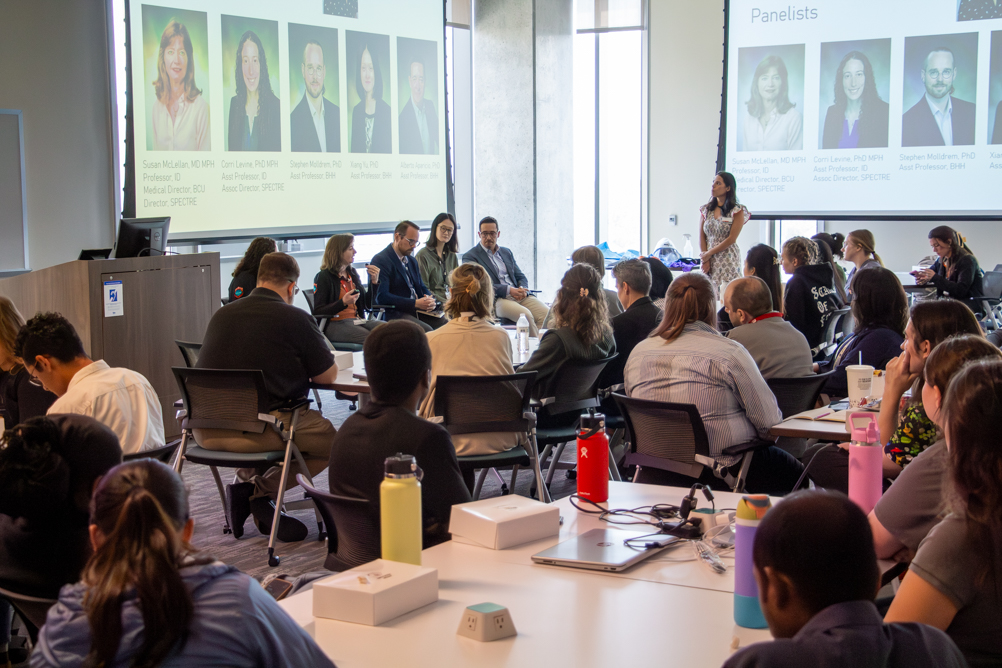
Dr. Stephen Molldrem, an assistant professor in Bioethics and Health Humanities whose research focuses on public health ethics and science and technology studies, described the BCU as a site of extreme exception within the healthcare system. UTMB's unit is unusual nationally because it exists as a permanent, purpose-built facility. Most other hospitals that serve as biocontainment sites convert existing ICU beds when needed. The level of interdisciplinary coordination required to keep UTMB's BCU operational, with clinical, biosafety, educational, and research functions all working in concert, is what the team's first paper aims to map.
Dr. Xiang Yu, also in Bioethics and Health Humanities, addressed ethical guidance from three perspectives. For patients, she emphasized the need for clear frameworks around isolation, treatment decisions, and visitation, along with counseling to address the stigmatization that often follows a diagnosis with a contagious disease. For the public, she argued that transparency during a BCU activation builds long-term trust, even if there is a short-term risk of panic. Rumors will spread regardless, she noted, and people are better served by accurate information that allows them to take precautions. For clinicians, she highlighted the importance of thinking through ethical dilemmas before they arise, including how to manage moral distress and burnout in a setting where the stakes are extreme and the outcomes uncertain.
What Comes Next
The research collaboration between SPECTRE and the Department of Bioethics and Health Humanities is still in its early stages. The team plans to expand its observations and interviews across the national network of biocontainment units to study how knowledge and best practices are disseminated and standardized at scale. They are also developing ethical scenarios to be incorporated into SPECTRE's training activities and exploring how storytelling and narrative can help convey the urgency of preparedness work to professionals who are, by design, preparing for events they hope will never happen.
The panel was part of UTMB's National Public Health Week 2026 programming. Learn more about SPECTRE and the Department of Bioethics and Health Humanities.