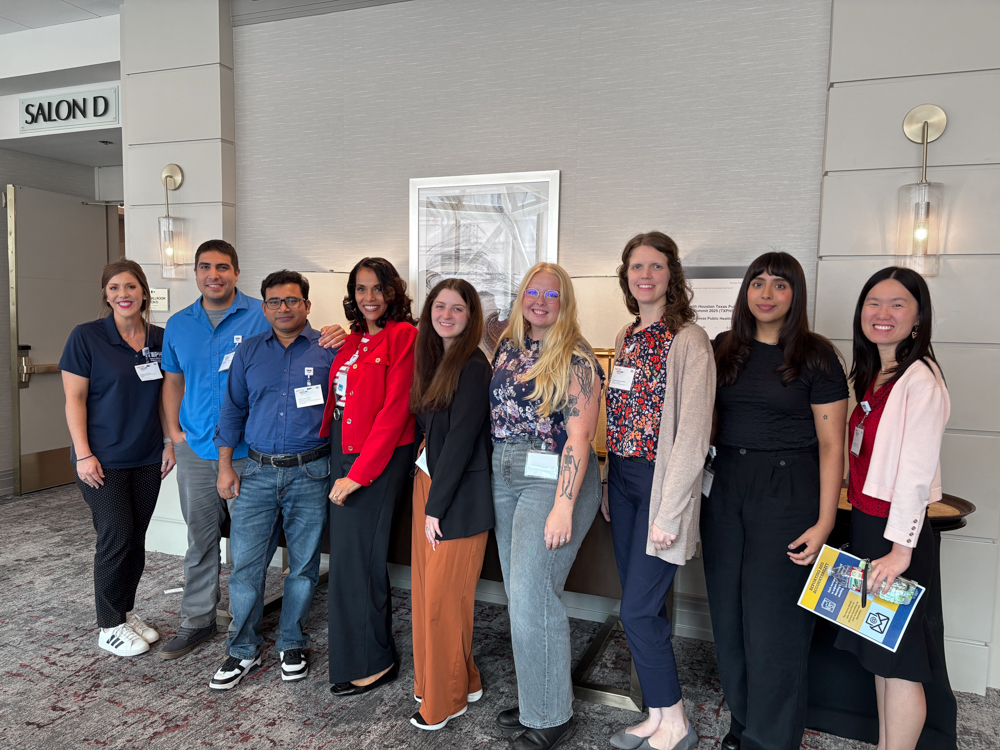
TXPHS25 gathered Texas practitioners, researchers, and public sector leaders around a shared question of readiness for 2050. The program moved through technology, transmission, and trust with an eye toward how decisions get made in real places with real constraints. Sessions drew on epidemiology, veterinary medicine, GIS, climate science, laboratory practice, and policy.
A consistent message came through about collaboration across sectors and the need for communication that earns confidence.
Utpol Das, MPH Student
“What stood out most to me at the Texas Public Health Summit 2025 was the emphasis on how technology alone cannot advance public health without collaboration and translation into communities. I was particularly struck by examples like the Marburg response in Rwanda, where nonprofits, governments, and technologists came together to create real-time dashboards and rapid response systems.
This highlighted for me how critical it is that epidemiologists, data scientists, and community health workers all work hand in hand. It connected strongly to my training in epidemiology, where we focus not just on generating data, but on ensuring it is accurate, trusted, and communicated in culturally appropriate ways. Overall, I left inspired to think about careers that bridge science, technology, and human connection in public health.”
Dr. Dana Wiltz-Beckham, Assistant Dean for Professional Programs
“Different diseases, different names, but the same truth. We can’t do this work alone. One Health tied it all together.
Most memorable experience: Seeing colleagues from across the state and reconnecting with leaders that I collaborated with; it was both refreshing and inspiring.
Impact on students: It was a true culminating moment for students to see classroom lessons coming alive in real-world action.
Key realization: Public health is huge, yet small enough to always know someone who knows someone, and to be reminded you can’t do it alone. It was also inspiring to see the future public health leaders.”
Izabella Galindo, MPH Student
“The Texas Public Health Summit was a powerful reminder that it is up to my generation of future public health professionals to carry forward the hard but necessary work of improving communities and driving change in our society. I left inspired to strengthen my storytelling skills, recognizing that stories are how data becomes meaningful to the public and how trust is built.
From Professor Cason Schmit, I learned about the concept of an infodemic, the widespread and often targeted spread of misinformation that raises complex ethical and legal challenges and undermines effective health communication.
Chief Epidemiologist Varun Shetty shed light on the emerging threat of New World screwworm (NWS) infestations, which currently lack both human treatments and FDA-approved animal drugs.
Most importantly, I will remember the words of Deputy Chief State Epidemiologist Dr. Diana Martinez, who emphasized that the key to progress in public health is collaboration. Her message, echoed by all the panelists, reinforced that controlling infectious diseases in Texas requires interdisciplinary cooperation across sectors.
During the Q&A, Andrew Tijerina (MPH student) drew on a summer course project with Dr. Denny Fe Agana to ask about trust between the public and public health professionals. Panelists responded with enthusiasm. Dr. Carlos Plasencia recognized UTMB SPPH’s program in Galveston and asked to see the project.”
Emily Edgar, MPH Student
“I was floored by the collaboration that TEPHI brought in to discuss various public health matters in a panel. When you first think of public health, the mind tends to go to physicians and perhaps public health officials. However, public health is everything. They had GIS experts there, a climate scientist, a veterinarian (which should always be present in the public health conversation), and a solutions engineer from a global health firm. These are people we should always collaborate with to have all the information to better the health of populations.
I will always remember Dr. Plasencia’s remarks when he won the Friends of TEPHI award. He took the time to thank everyone in the room for their dedication to public health and to keep going. He stated that these are hard times, but our work will be proven necessary in the future. It was a somber note for something intended to be very joyous, and I think that reflects the feelings of everyone who is actively working in public health currently.
New World screwworm is surprising and scary. I will be on the lookout for that, as this was the first time hearing about it.
In the first panel on ‘Transmission,’ they discussed modifying treatment of infectious disease to fit the patient. Traditionally, treatment can follow one approach that everyone must adapt to. In our infectious epidemiology class, we discussed how this is not effective for everyone, and Dr. Cesar Ugarte-Gil gave examples of patients with tuberculosis in Peru who followed DOT and still could not fit into the mold, resulting in loss of care. Hearing this discussed outside the classroom felt important.
The day felt intimidating while welcoming. People referred to it as a family reunion for public health of all shapes and sizes in Texas. I was inspired in ways I wasn’t expecting. Alongside state agencies, I heard about initiatives by nonprofits and companies working with government entities. As someone who worries about job prospects in the current reality, I felt like I once again had the world at my fingertips.”