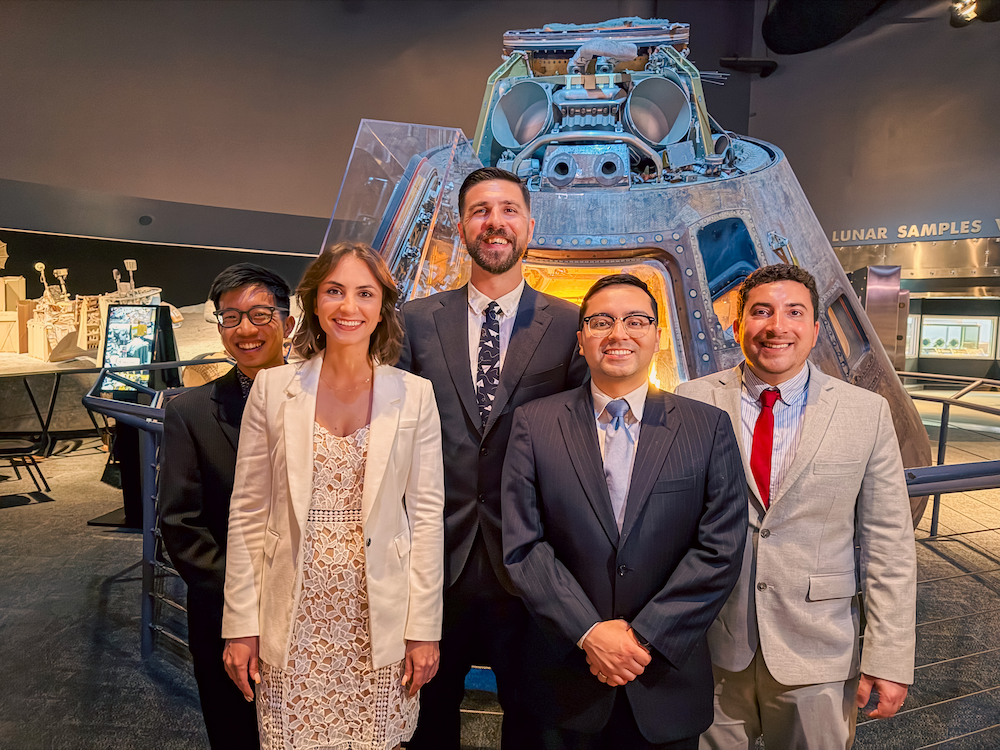
On the evening of June 11, surrounded by spacecraft and artifacts from the history of human spaceflight, five physicians gathered in the Starship Gallery at Space Center Houston to mark the end of one of the most specialized training paths in medicine. They are the 2026 graduating class of the UTMB Aerospace Medicine Residency, trained to protect human health in flight, in orbit, and in the operational settings most medicine never reaches.
Aerospace medicine is a small and demanding field. Its physicians care for the people who fly and the people who work in extreme environments, where there is often no hospital, no immediate backup, and little room for error. At UTMB, residents earn a Master of Science in Aerospace Medicine, including a mentored capstone project, in a single year while rotating and supporting events such as the Wings Over Houston air show. In the second year they fan out across the country and beyond for operational rotations. Program Director Amy J. Kreykes, MD, MPH, presided over the ceremony and recognized each graduate in turn.
Training physicians for flight since 1993
UTMB's residency was founded in 1993 in partnership with NASA's Johnson Space Center, and for more than three decades it has prepared physicians to practice across aviation, spaceflight, human performance, and occupational medicine. That depth is part of UTMB's longstanding role in the field, and it continues to grow. This year the program opened its Master of Science in Aerospace Medicine to professionals beyond physician residents, welcoming nurses, physician assistants, pharmacists, and other doctoral-level specialists. Several of this year's graduates had been recognized weeks earlier at the 2026 Aerospace Medical Association (AsMA) meeting, where UTMB residents, faculty, and alumni earned eleven awards and again won the RAM Bowl, the national quiz competition among aerospace medicine residencies.
Five physicians, five paths into aerospace medicine
Each graduate reached aerospace medicine from a different starting point, and each completed a capstone research project that contributed something usable to the field.
Andrew Zi-On Lam, MD, MS
Andrew came to aerospace medicine from family medicine. His capstone, "Recommending an Approach for NASA Toward Neurologic Decompression Illness," was mentored by Dr. Robert Sanders. He was named most valuable player of the RAM Bowl and, at the time, posted the highest individual score in the competition's history. He earned the Society of NASA Flight Surgeons Outstanding Student Award and was recognized repeatedly for his care at St. Vincent's Free Clinic. Dr. Kreykes pointed to his attention to detail and his willingness to own the hardest part of an aerospace medicine recommendation, the final judgment a physician puts their name behind.
Vasilis Caesar Mavratsas, MD, MS
Vasilis completed the combined Aerospace Medicine and Internal Medicine residency. With Brian Rodriguez, he wrote a capstone reference guide on the physiologic changes, injuries, and forensic considerations associated with human spaceflight, mentored by program alumna Dr. Samantha King and Dr. Kreykes. The two presented the work at NASA and to a forum convened by the National Association of Medical Examiners. Vasilis received the Julian E. Ward Memorial Award at AsMA and was nominated for the UTMB Outstanding Overall Resident Award. During a medical operations rotation with NASA's Commercial Crew Program, he was handed an operational risk problem the team had wrestled with for months and returned a careful analysis and recommendation the next morning.
Brian Rafael Rodriguez, MD, MS
Brian also completed the combined Aerospace Medicine and Internal Medicine residency and co-authored that reference guide. Dr. Kreykes first met him years earlier, when he reached out as a student through the Aerospace Medicine Student and Resident Organization, certain even then that this was the field he wanted. In a commercial spaceflight module the program developed with Virgin Galactic, residents close the course by serving as the chief medical officer of a spaceflight company of their own design, accounting for its medical requirements and life-support systems. Brian's presentation stood out as one of the strongest his instructors had seen.
Christine Cara Schwartz, MD, MS
Christine came to aerospace medicine from internal medicine. Her capstone built a clinical decision support tool for NASA's Exploration Medical Integrated Product Team, mentored by alumna Dr. Moriah Thompson. A previous recipient of the program's Community Service Award, Christine was known for candid, useful feedback and for advocating for her fellow residents, including on the program's evaluation committee. On rotations she drew praise for her communication, her attention to detail, and her care of pilots.
Ethan Stewart Stephens, DO, MS
Ethan came to the program from family medicine and completed a rotation in Antarctica during his training. He focused much of his work on dive medicine, taking on a task Dr. Thomas Skinner had described as nearly impossible, building and defending a decompression algorithm before a panel of dive medicine physicians, and later presenting the work at AsMA. His capstone assessed central nervous system toxicity risk in suited diving operations, mentored by alumna Dr. Kristi Ray. Across his rotations, colleagues described him as steady, prepared, and the kind of physician they would trust with their own families.
The people behind the residents
The ceremony also recognized the families and friends who make this training possible. Aerospace medicine asks a great deal of the people around a resident, who absorb long absences while residents travel for rotations across the country and beyond, and the program presented its "Behind the Scenes" award to the spouses, parents, partners, and friends who supported the class through the program's demanding training. Following a tradition begun by earlier graduates, each new alum signed a class book that the program keeps as a record of everyone who has trained there.
All five now join an alumni network whose members support human spaceflight at NASA, the Federal Aviation Administration, the U.S. military, and the commercial spaceflight companies expanding what is possible beyond Earth. As missions grow longer and reach farther, the need for physicians trained to protect human health in those environments keeps growing. The program's newest residents, the Class of 2028, are already training to follow them.
Congratulations to the UTMB Aerospace Medicine Residency Class of 2026. Wherever this work takes you, you carry UTMB with you, and the field is stronger for having you in it.