News

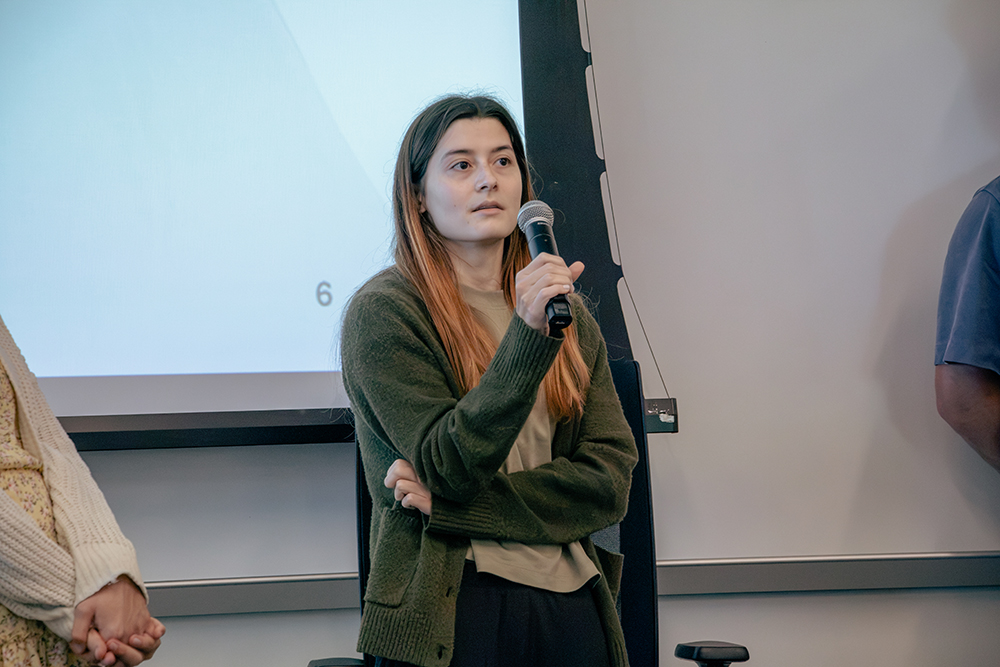
A member of Team ECHO takes a question from the judges during final presentations at the Clinical Informatics Datathon.

UTMB Students Tackle Real-World Clinical Questions in Inaugural H-COR Datathon

MD and PhD students from across UTMB tested real clinical questions against electronic health record data and learned that good science sometimes means changing the question. Organizers see the Datathon as the start of a pipeline.

On Aug. 19, three interdisciplinary teams of UTMB MD and PhD students worked through the critical early stages of a research study in a single day. Each team defined a clinical question, built a patient cohort from electronic health records (EHR), analyzed the data, found problems in its own analysis, changed direction where the data called for it, and defended its conclusions before a panel of faculty judges.

The inaugural Clinical Informatics Datathon was hosted by the Center for Health and Clinical Outcomes Research (H-COR), the outcomes research hub launched in May 2025. The event ran under the theme “Clinical Pathways to ADRD Development,” a focus on the clinical routes by which patients arrive at Alzheimer’s disease and related dementias.

At the end of the day, organizers asked each team whether, knowing what it now knew, it would choose the same research question again. Every team said no. Exploratory analysis had pushed each group to rethink assumptions, revise hypotheses, or change analytic strategy. George Golovko, PhD, assistant professor of pharmacology and toxicology and associate director of H-COR, who organized the event, counts that as the clearest sign the exercise worked.

Throughout the day, faculty and informatics mentors rotated among the teams in structured checkpoints, pressure-testing cohort definitions, outcome measures, and analytic strategies. A midday mini-plenary took on the discipline at the heart of the event, everything that can go wrong with real-world EHR data, from missing values and coding variability to confounding and data leakage.

That focus is what separated the Datathon from a hackathon. Making an analysis run was the baseline. The harder test, written into the judging criteria, was whether students could recognize when an analysis might be wrong. Final presentations were judged on clinical relevance, study design, analytical rigor, recognition of bias and limitations, reproducibility, and clarity of communication.

Participants were selected through a competitive review of their backgrounds and readiness, and the field they formed showed how widely computational interest now runs at UTMB, with students drawn from Pharmacology and Toxicology, Biochemistry and Molecular Biology, Human Pathophysiology and Translational Medicine, the MD program, and the MD/PhD program.

Three teams, three questions

First place went to Team ECHO, short for Estrogen and Cognitive Health Outcomes, which asked whether women who lose ovarian function early in life and begin systemic estrogen therapy soon afterward face a lower risk of Alzheimer’s disease and related dementias.

The team brought together Emily Cwiklik and Katherine Araya, PhD candidates in the Pharmacology and Toxicology program, Elizaveta Naydanova, an MD/PhD student in the Human Pathophysiology and Translational Medicine program, Riley Watson, a PhD candidate in the same program, and James Weatherhead, an MD/PhD candidate in the Experimental Pathology program.
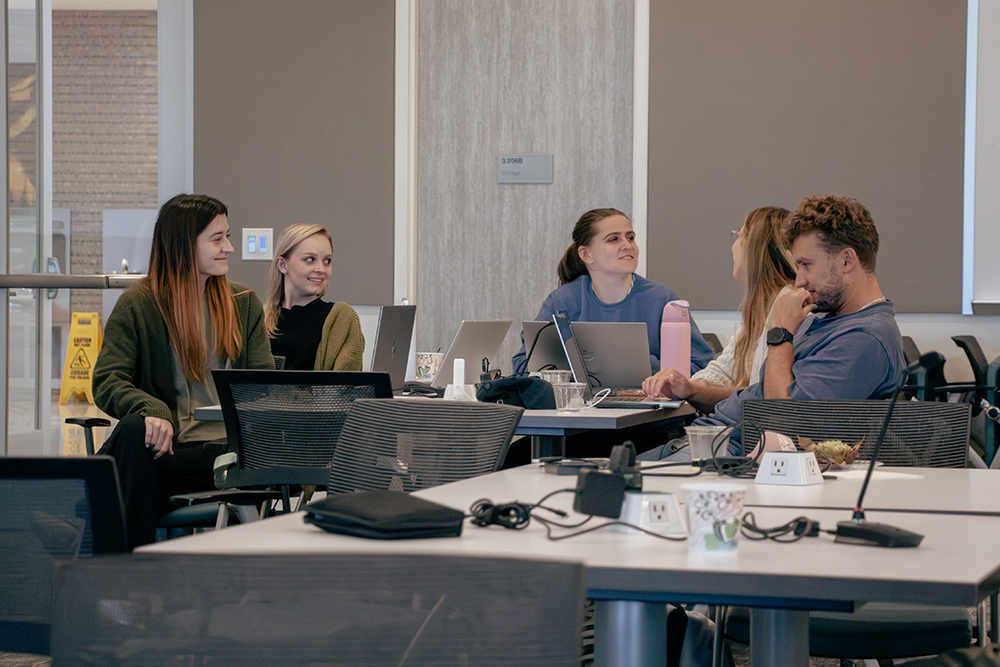
Students and mentors talk over laptops between working sessions at the Clinical Informatics Datathon.

The group picked its question because a strong body of literature already suggested a potential association, and because estrogen therapy seemed likely to be well documented in EHR data. “Alzheimer’s disease disproportionately affects women, so the possibility that hormonal changes or estrogen exposure may contribute to that difference is an important question,” the team wrote in a joint response.

Their matched-cohort analysis found no significant association. What impressed the judges was the team’s audit of its own data, which showed that patients who received estrogen therapy used the health care system far more often than those who did not, a gap that could distort any apparent protective effect.

“It taught us that these differences can introduce biases that may not be immediately obvious, so we have to be very intentional about identifying and accounting for them,” the team wrote. “The topic generated a lot of interest from faculty, so we are definitely open to continuing the work and exploring whether it could be developed further into a manuscript.”

Second place went to Justin Nguyen, Ibrahim Mortada, and Neel Drain, who built on emerging literature suggesting that nucleoside reverse transcriptase inhibitors (NRTIs), a class of antiviral drugs used to treat chronic hepatitis B and HIV, may be associated with reduced Alzheimer’s risk.
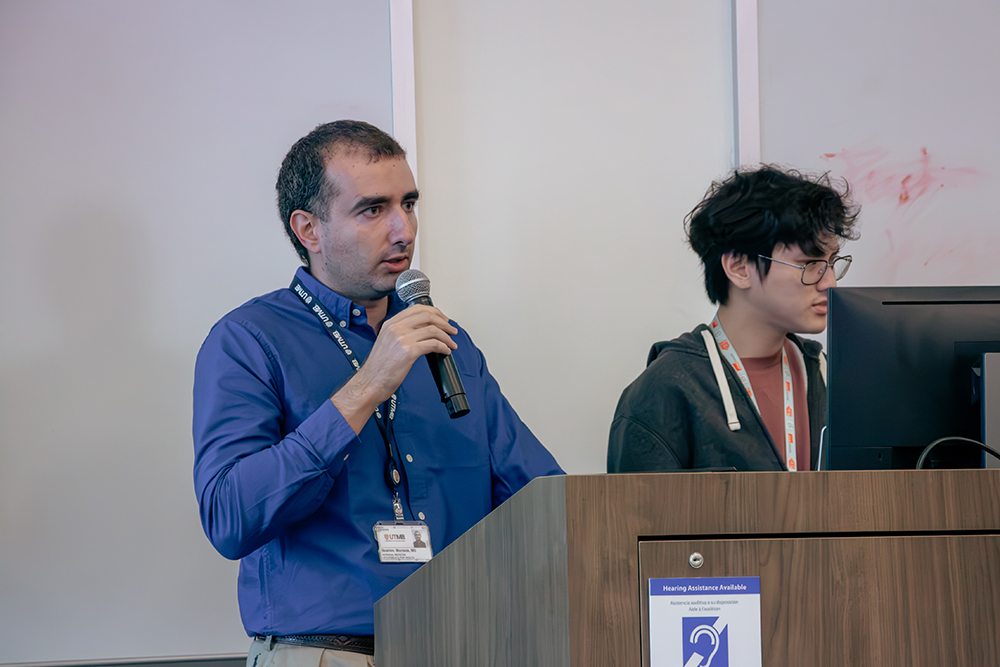
Ibrahim Mortada presents his team's analysis of antiviral drugs and Alzheimer's risk while a teammate runs the slides.

In its cohorts, the team observed an association consistent with previous reports of lower Alzheimer’s risk, then tested whether antivirals that penetrate the central nervous system more readily showed a stronger effect. They did not. Rather than bend the result toward the hypothesis, the team kept testing it through sensitivity and landmark analyses before presenting it.

The third team, MD/PhD student Jason Yeung and third-year medical students Jose M. Rojas and Bobby Bobby, took on the day’s most mechanistically adventurous question. The group examined whether new anti-amyloid antibody therapies for Alzheimer’s disease might increase the risk of herpesvirus reactivation, a possibility suggested by research proposing that amyloid plays an antimicrobial role in the brain.
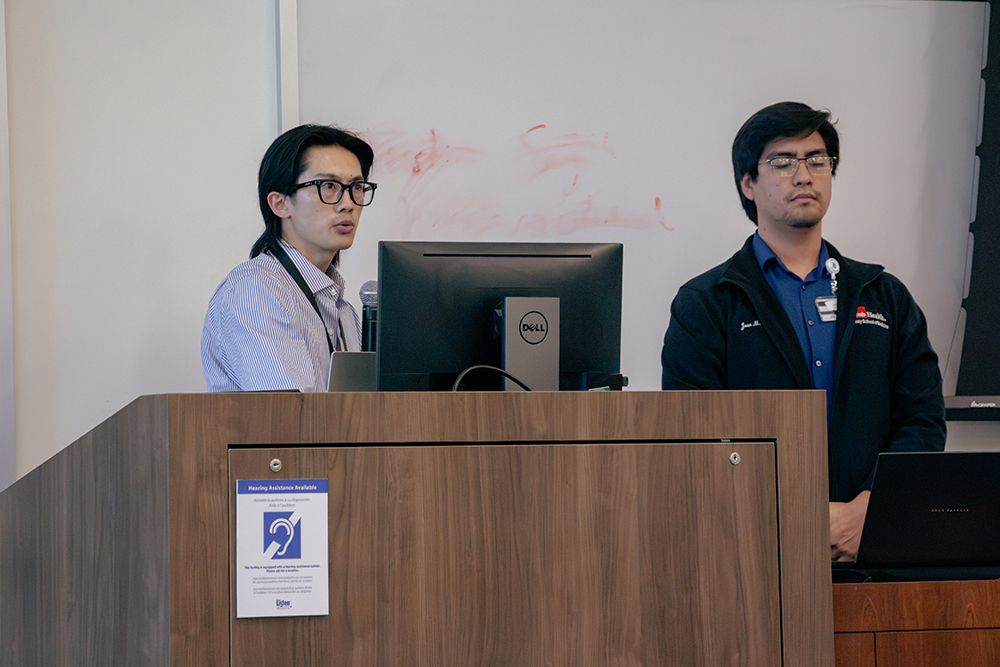
Jason Yeung and Jose M. Rojas present their analysis of anti-amyloid therapies and herpesvirus reactivation to the judging panel.

Combining U.S. Food and Drug Administration adverse event reports with EHR queries, the team scoped out the hypothesis despite thin data on the recently approved drugs. “It is one thing to learn about it in a classroom. It is a different thing entirely doing it and experiencing it,” Rojas said of the crash course in data research.

What good research should look like

What struck Golovko most, he said, was that no team reached for an easy question to improve its odds of finishing.

“They pushed into areas outside their existing expertise, and several teams substantially changed their original hypotheses or analytical direction after seeing what the data actually showed,” Golovko said. “That is exactly what good research should look like.”
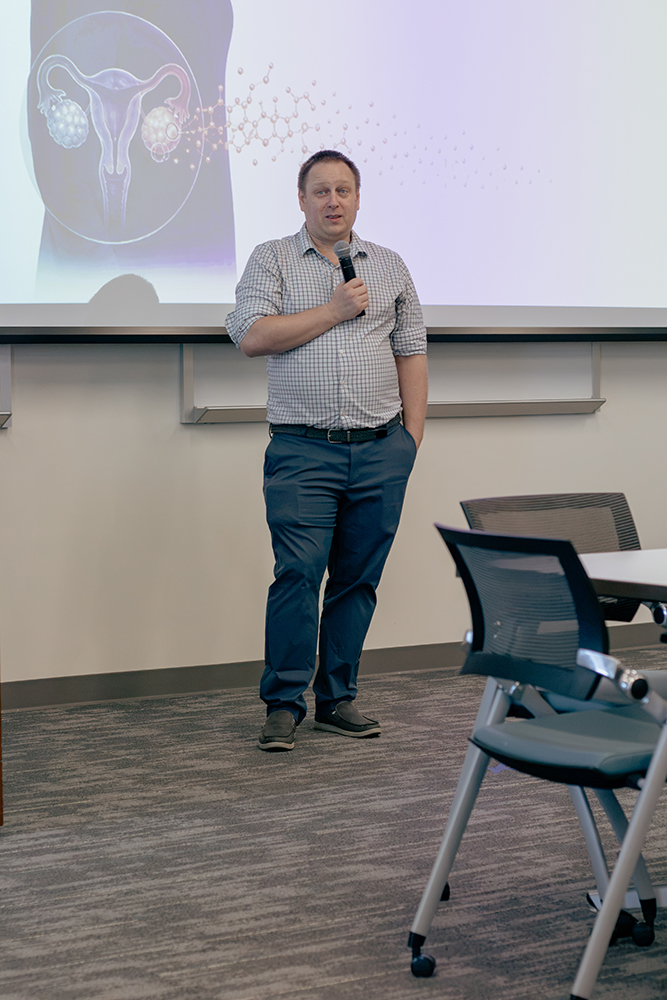
Dr. Golovko stands beside a slide showing reproductive anatomy and an estrogen molecule.

Golovko shared that the strongest projects are now continuing beyond the Datathon, with additional analysis and the goal of peer-reviewed publication.

Artificial intelligence played a role for some teams, he noted, but as one tool within a broader process of clinical reasoning, study design, and interpretation rather than a substitute for it. AI did not decide whether a question made sense, whether two cohorts were truly comparable, whether confounding was at work, or whether a result deserved to be believed. Those calls stayed with the students.

The judges, faculty drawn from departments and institutes across the university, including the Moody Brain Health Institute, along with an industry partner’s representative, helped design the competition in advance and stayed engaged with the teams throughout the day.

That sustained involvement, Golovko said, turned the event from a contest into a genuine scientific environment. The participants felt it too. “It was a pleasure to talk to experienced mentors with clinical, basic science, and data science backgrounds at the event and have them sincerely engage with our ideas,” Yeung said.

Building a pipeline

The Datathon was the first competition of its kind at UTMB, combining clinical informatics, real-world data, interdisciplinary teams, a time-limited format, active faculty mentorship, and formal judging in a single event.

For students with computational, clinical, and quantitative interests, who sometimes develop those skills in isolation within individual labs, Golovko said the day offered evidence that a community for this work exists at UTMB. Conversations among faculty, students, and the industry partner that began at the event are continuing beyond it.

“For me, the event emphasized the increasing role of team science, the value of different ways of ‘knowing,’ and the spontaneity and fun that can be found in research,” Yeung said.

Golovko wants the Datathon to grow into more than a yearly competition. His goal is a pipeline that brings students into clinical informatics and data science, puts real research problems and real data in front of them, connects them with faculty mentors, and carries the strongest projects forward. Over time, he envisions an internal UTMB process feeding a larger multi-institutional event, where biomedical trainees would work alongside students from engineering, computer science, statistics, and other quantitative disciplines.

Just as important, he said, is widening the on-ramp for trainees from fields that are not traditionally computational.

“A successful program should not simply identify the students who already know how to do computational science. It should progressively expand the population that is capable of doing it.”

George Golovko, PhD

Events

Exception occured while executing the controller. Check error logs for details.

By the Numbers

Strength in numbers—driven by dedicated faculty, ambitious students, and impactful research funding shaping the future of public health.

* Approximations subject to change

From the Seas to the Skies, We Are Public Health

Exploring health from every angle—land, sea, and sky—our diverse expertise shapes the future of public health.

SPPH Research

Advancing health through innovative, data-driven research that informs policy, improves care, and impacts communities globally.

 Discover Our Research

Student Spotlights

Celebrating our students’ achievements, impact, and excellence—inside the classroom and beyond.

A member of Team ECHO takes a question from the judges during final presentations at the Clinical Informatics Datathon.

UTMB Students Tackle Real-World Clinical Questions in Inaugural H-COR Datathon

MD and PhD students from across UTMB tested real clinical questions against electronic health record data and learned that good science sometimes means changing the question. Organizers see the Datathon as the start of a pipeline.

On Aug. 19, three interdisciplinary teams of UTMB MD and PhD students worked through the critical early stages of a research study in a single day. Each team defined a clinical question, built a patient cohort from electronic health records (EHR), analyzed the data, found problems in its own analysis, changed direction where the data called for it, and defended its conclusions before a panel of faculty judges.

The inaugural Clinical Informatics Datathon was hosted by the Center for Health and Clinical Outcomes Research (H-COR), the outcomes research hub launched in May 2025. The event ran under the theme “Clinical Pathways to ADRD Development,” a focus on the clinical routes by which patients arrive at Alzheimer’s disease and related dementias.

At the end of the day, organizers asked each team whether, knowing what it now knew, it would choose the same research question again. Every team said no. Exploratory analysis had pushed each group to rethink assumptions, revise hypotheses, or change analytic strategy. George Golovko, PhD, assistant professor of pharmacology and toxicology and associate director of H-COR, who organized the event, counts that as the clearest sign the exercise worked.

Throughout the day, faculty and informatics mentors rotated among the teams in structured checkpoints, pressure-testing cohort definitions, outcome measures, and analytic strategies. A midday mini-plenary took on the discipline at the heart of the event, everything that can go wrong with real-world EHR data, from missing values and coding variability to confounding and data leakage.

That focus is what separated the Datathon from a hackathon. Making an analysis run was the baseline. The harder test, written into the judging criteria, was whether students could recognize when an analysis might be wrong. Final presentations were judged on clinical relevance, study design, analytical rigor, recognition of bias and limitations, reproducibility, and clarity of communication.

Participants were selected through a competitive review of their backgrounds and readiness, and the field they formed showed how widely computational interest now runs at UTMB, with students drawn from Pharmacology and Toxicology, Biochemistry and Molecular Biology, Human Pathophysiology and Translational Medicine, the MD program, and the MD/PhD program.

Three teams, three questions

First place went to Team ECHO, short for Estrogen and Cognitive Health Outcomes, which asked whether women who lose ovarian function early in life and begin systemic estrogen therapy soon afterward face a lower risk of Alzheimer’s disease and related dementias.

The team brought together Emily Cwiklik and Katherine Araya, PhD candidates in the Pharmacology and Toxicology program, Elizaveta Naydanova, an MD/PhD student in the Human Pathophysiology and Translational Medicine program, Riley Watson, a PhD candidate in the same program, and James Weatherhead, an MD/PhD candidate in the Experimental Pathology program.

Students and mentors talk over laptops between working sessions at the Clinical Informatics Datathon.

The group picked its question because a strong body of literature already suggested a potential association, and because estrogen therapy seemed likely to be well documented in EHR data. “Alzheimer’s disease disproportionately affects women, so the possibility that hormonal changes or estrogen exposure may contribute to that difference is an important question,” the team wrote in a joint response.

Their matched-cohort analysis found no significant association. What impressed the judges was the team’s audit of its own data, which showed that patients who received estrogen therapy used the health care system far more often than those who did not, a gap that could distort any apparent protective effect.

“It taught us that these differences can introduce biases that may not be immediately obvious, so we have to be very intentional about identifying and accounting for them,” the team wrote. “The topic generated a lot of interest from faculty, so we are definitely open to continuing the work and exploring whether it could be developed further into a manuscript.”

Second place went to Justin Nguyen, Ibrahim Mortada, and Neel Drain, who built on emerging literature suggesting that nucleoside reverse transcriptase inhibitors (NRTIs), a class of antiviral drugs used to treat chronic hepatitis B and HIV, may be associated with reduced Alzheimer’s risk.

Ibrahim Mortada presents his team's analysis of antiviral drugs and Alzheimer's risk while a teammate runs the slides.

In its cohorts, the team observed an association consistent with previous reports of lower Alzheimer’s risk, then tested whether antivirals that penetrate the central nervous system more readily showed a stronger effect. They did not. Rather than bend the result toward the hypothesis, the team kept testing it through sensitivity and landmark analyses before presenting it.

The third team, MD/PhD student Jason Yeung and third-year medical students Jose M. Rojas and Bobby Bobby, took on the day’s most mechanistically adventurous question. The group examined whether new anti-amyloid antibody therapies for Alzheimer’s disease might increase the risk of herpesvirus reactivation, a possibility suggested by research proposing that amyloid plays an antimicrobial role in the brain.

Jason Yeung and Jose M. Rojas present their analysis of anti-amyloid therapies and herpesvirus reactivation to the judging panel.

Combining U.S. Food and Drug Administration adverse event reports with EHR queries, the team scoped out the hypothesis despite thin data on the recently approved drugs. “It is one thing to learn about it in a classroom. It is a different thing entirely doing it and experiencing it,” Rojas said of the crash course in data research.

What good research should look like

What struck Golovko most, he said, was that no team reached for an easy question to improve its odds of finishing.

“They pushed into areas outside their existing expertise, and several teams substantially changed their original hypotheses or analytical direction after seeing what the data actually showed,” Golovko said. “That is exactly what good research should look like.”

Dr. Golovko stands beside a slide showing reproductive anatomy and an estrogen molecule.

Golovko shared that the strongest projects are now continuing beyond the Datathon, with additional analysis and the goal of peer-reviewed publication.

Artificial intelligence played a role for some teams, he noted, but as one tool within a broader process of clinical reasoning, study design, and interpretation rather than a substitute for it. AI did not decide whether a question made sense, whether two cohorts were truly comparable, whether confounding was at work, or whether a result deserved to be believed. Those calls stayed with the students.

The judges, faculty drawn from departments and institutes across the university, including the Moody Brain Health Institute, along with an industry partner’s representative, helped design the competition in advance and stayed engaged with the teams throughout the day.

That sustained involvement, Golovko said, turned the event from a contest into a genuine scientific environment. The participants felt it too. “It was a pleasure to talk to experienced mentors with clinical, basic science, and data science backgrounds at the event and have them sincerely engage with our ideas,” Yeung said.

Building a pipeline

The Datathon was the first competition of its kind at UTMB, combining clinical informatics, real-world data, interdisciplinary teams, a time-limited format, active faculty mentorship, and formal judging in a single event.

For students with computational, clinical, and quantitative interests, who sometimes develop those skills in isolation within individual labs, Golovko said the day offered evidence that a community for this work exists at UTMB. Conversations among faculty, students, and the industry partner that began at the event are continuing beyond it.

“For me, the event emphasized the increasing role of team science, the value of different ways of ‘knowing,’ and the spontaneity and fun that can be found in research,” Yeung said.

Golovko wants the Datathon to grow into more than a yearly competition. His goal is a pipeline that brings students into clinical informatics and data science, puts real research problems and real data in front of them, connects them with faculty mentors, and carries the strongest projects forward. Over time, he envisions an internal UTMB process feeding a larger multi-institutional event, where biomedical trainees would work alongside students from engineering, computer science, statistics, and other quantitative disciplines.

Just as important, he said, is widening the on-ramp for trainees from fields that are not traditionally computational.

“A successful program should not simply identify the students who already know how to do computational science. It should progressively expand the population that is capable of doing it.”

George Golovko, PhD