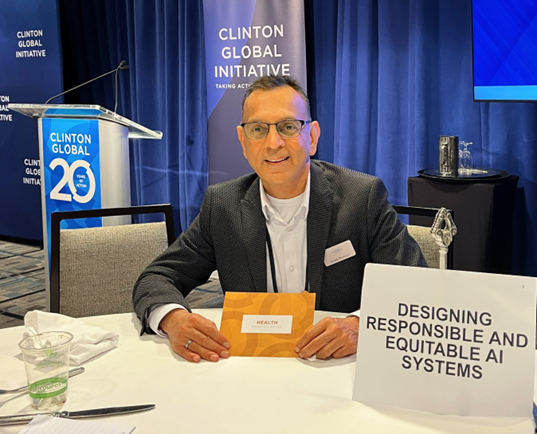
"Translation is not a finish line; it is a frequent handshake."
Dr. Suresh Bhavnani
Dr. Suresh Bhavnani is being recognized this month by the National Institutes of Health (NIH) through a simultaneous "triple spotlight" on his work by the AIM-AHEAD consortium, the All of Us Research Roundup, and at All of Us Science Day. The recognition follows his selection last year as a Presidential Leadership Scholar.
We caught up with Dr. Bhavnani to discuss this national recognition and how his work is helping to bridge the gap between artificial intelligence and public policies to better address community needs.
What sparked the national recognition
"It reflects a transition in my research from focusing mainly on developing AI methods for analyzing biomedical data, to one that also embraces the translation of the results to address real-world needs. This journey began during a course on policy design at Rice University’s Baker Institute for Public Policy, and was further refined during my time as a Presidential Leadership Scholar. I remember discussing the potential of using AI to design ‘precision policies’ with President Clinton, who then personally invited me to the Clinton Global Initiative for discussing the work with global change makers. More recently, program officers of both the AIM-AHEAD and the All of Us programs noted that such a translation was exactly their original intent, especially when it directly impacts communities."
Dr. Suresh Bhavnani
How precision policies address unmet needs
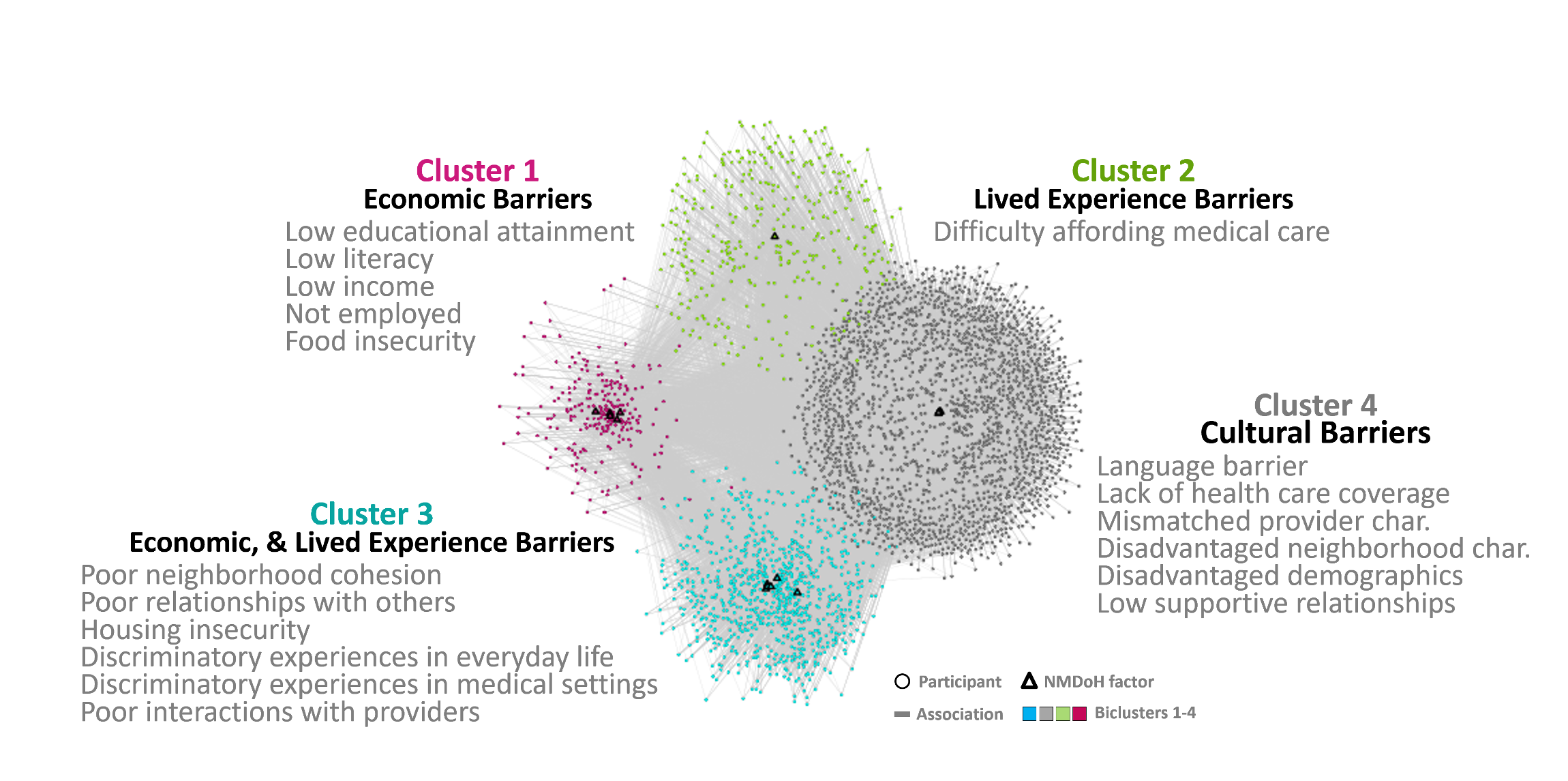
How needs co-occur among Americans. Dr. Bhavnani’s research uses human-centered AI to identify clusters of non-medical determinants of health, revealing the co-occurring needs that precision policies aim to address.
"Current state and federal public benefit policies often fall short because they rely on eligibility criteria that are too broad, using proxies of need like parenthood and income, instead of the actual need. Furthermore, most policies target single needs in isolation such as transportation to a clinic, when in reality many Americans face multiple interconnected challenges.
Precision policies use human-centered AI to identify and address these co-occurring needs. In the short term, it helps Americans navigate the 'bureaucratic hurdles' of navigating fragmented services across agencies reflecting the siloed public benefit policies. In the long term, it will lead to policies designed to address multiple needs and risks simultaneously, making more effective and equitable use of limited resources."
Dr. Suresh Bhavnani
Why translation requires continuous engagement
"We often hear that translation is the 'final mile,' implying it's the last step in a long relay race. To me, translation is not a finish line; it is a frequent handshake, which takes place throughout the analysis, design and implementation process. That is why I designed the Translational AI Loops (TRAILS) framework."
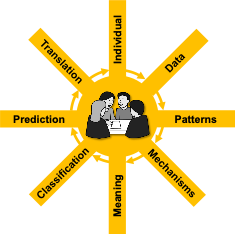
The TRAILS Framework. The outer loop shows the technical progression of data using AI methods starting and ending with individuals. This loop is guided by a human-centered core of experts that provides continuous feedback, ensuring every step is intentionally translational.
"The TRAILS framework has an outer loop which shows the technical progression of data using AI methods. This progression is guided by an inner human-centered core of experts that provide constant feedback for translational relevance, domain interpretability, and regulatory compliance. TRAILS captures the notion that translation isn't the finish line; it’s continuous learning that happens when human experts guide AI results back to the individual. For example, when I was building a prediction model using All of Us data, I was fortunate to discuss it with Dr. Deborah Banerjee, Bureau Chief at the Houston Health Department. She emphasized that our model needed to function in tandem with other needs, not just to predict risk, but also to help Americans navigate safety net agencies that currently provide fragmented and interdependent services. That was a lightbulb moment which radically changed my trajectory; inspired by the lessons I learned during the Presidential Leadership Scholars program, coupled with this national validation, I am dedicated to transforming the promise of precision policies into an everyday reality that works for all of us."
Dr. Suresh Bhavnani
What leaders and collaborators are saying
"While many researchers focus strictly on the clinic, Dr. Bhavnani is helping community members navigate a fragmented landscape of public benefit policies through human-centered AI."
Kristen Peek, PhD, Dean of the School of Public and Population Health, UTMB
"Dr. Bhavnani’s translation of human-centered AI research to help communities is truly inspiring as it could transform how services are accessed by millions of Americans across the country."
Deborah Banerjee, PhD, Bureau Chief, Houston Health Department
"Dr. Bhavnani is leading the way toward a new kind of 'AI-to-policy' translation. This complements the traditional 'bench-to-bedside' model and is a moral imperative for modern research."
Randall Urban, Director of the Institute for Translational Sciences, UTMB
"Dr. Bhavnani’s TRAILS framework operationalizes the very foundations of team science focused on delivering on the promises of federal funding agencies like NIH."
Alan Landay, PhD, Vice President, Team Science, UTMB
"Precision policies can be the foundation for a new theory of public policy which integrates AI as a core part of its DNA."
Chris Kulesza, Policy Analyst and Educator, Rice University