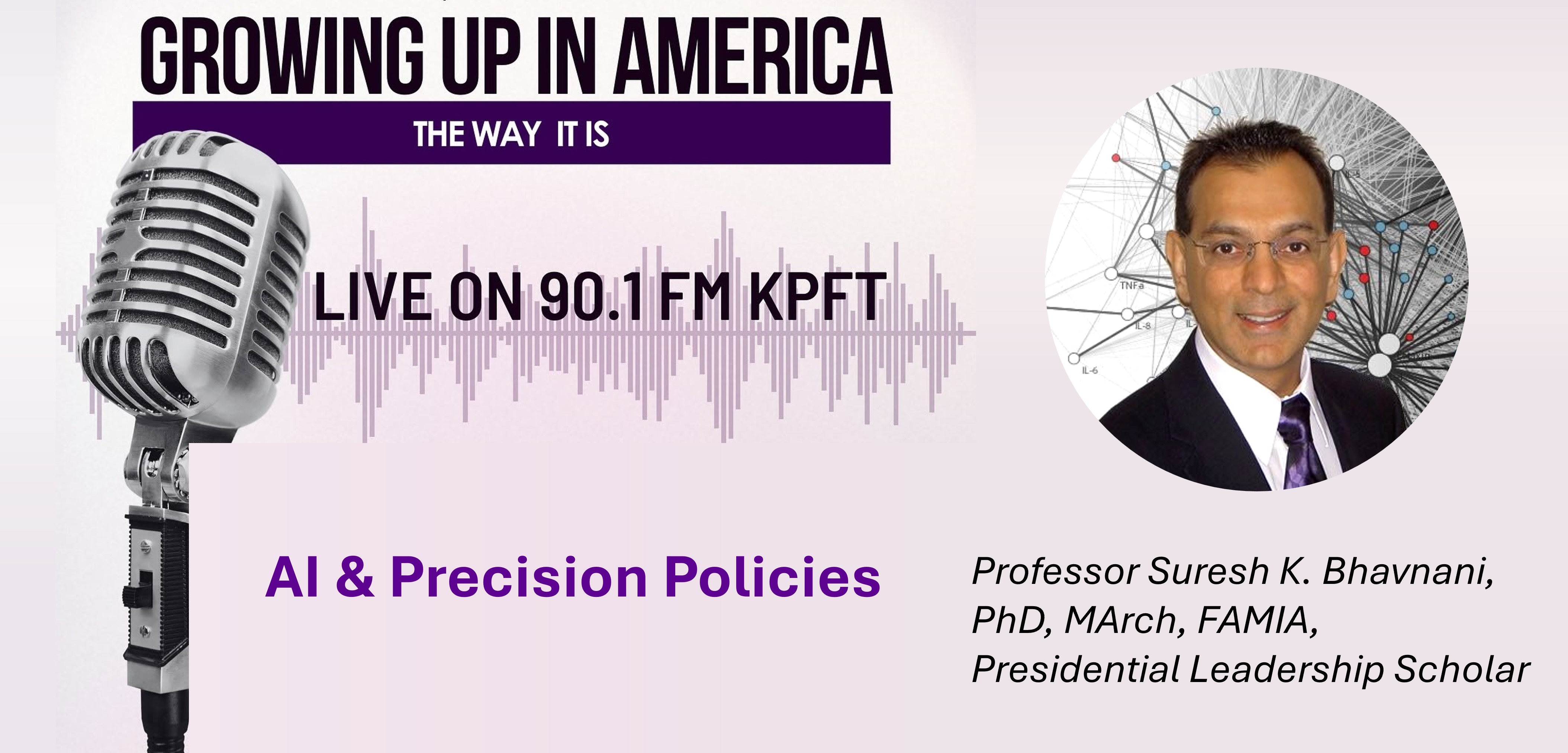
"… more than $100 billion from safety net programs go unused each year ... this is a tragedy, not of money or morality, but rather of imagination of how policies are designed."
Dr. Suresh K. Bhavnani
GALVESTON, Texas — Dr. Suresh K. Bhavnani, Professor in the Department of Biostatistics and Data Science at UTMB, was interviewed live on the premier radio program and podcast Growing Up in America: The Way It Is (90.1 FM KPFT Houston). Presented by the advocacy organization Children at Risk, the program was hosted by Dr. Chris Kulesza ("Dr. Data") and co-host Owala Maima.

Dr. Suresh K. Bhavnani (top right) in session with hosts Dr. Chris Kulesza and Owala Maima (top left) during the live broadcast of "Growing Up in America" on KPFT Houston.
The following summarizes Dr. Bhavnani’s interview, which focused on how AI methods can shift public policies from broad-brushed social programs, to targeted and data-driven "Precision Policies."
1. How did you go from AI research to policy design?
Dr. Bhavnani summarized his journey that started when he took a policy course at Rice University’s Baker Institute for Public Policy. During the course, he realized that scientific researchers are trained to analyze phenomena in fine detail—such as how a human transitions from youth to old age—but such data alone cannot answer the policy question of when a person should officially be called old. “Some people believe it’s 55, some believe it’s 67, and yet others believe 80, so who is right?”
Drawing from the seminal book Policy Paradox by Deborah Stone, Dr. Bhavnani learned that all such answers are correct, hence the paradox. Because these questions are rooted in the values, beliefs, and assumptions of citizens, they cannot be answered by science alone; rather, policymakers must resolve the paradox by understanding cultural norms.
Another divide is occurring in AI, where views fluctuate wildly between a utopian perspective (“cure all diseases”) and a dystopian threat (“take our jobs and kill us”). Observing such debates, he wondered whether he could be "the person in the middle" to bridge such divides, especially between AI research and policy design. Encouraged by the course faculty, he proposed a project using AI methods to make public policies more precise to serve real-world needs, which led to his selection by the Presidential Leadership Scholars Program. Dedicated to driving social impact, the program allowed him to fully operationalize the concept of "Precision Policy" that anchors his current research focus at UTMB.
2. Can you give us an in-depth description of what exactly is a precision policy and how can it help Americans?
Dr. Bhavnani explained that current safety net policies do not address the combination of needs that many Americans encounter in the real world. For example, the TANF safety net policy states that if you’re a parent with an income below some threshold, you get an income benefit per month. But consider a citizen like Mary who has breast cancer, recently lost her job, and has no healthcare. “If she gets a voucher for transportation to the clinic, where can she leave her kids? If she gets a car to buy food, but there's no groceries to get nutritious food, how can she turn her health around?”
He realized that although there were many safety net policies to help Mary, they were either fragmented based on single needs, or had eligibility criteria that were proxies of needs based on broad sociodemographic variables like income in TANF. This complexity results in a huge cognitive tax on Mary to navigate a complex maze of policies to address multiple needs. “I was shocked that more than $100 billion from safety net programs go unused each year. This is a total tragedy. This is a tragedy, not of money or morality, but rather of imagination of how policies are designed.”
Dr. Bhavnani briefly described an AI application that his lab is working on with the Houston Health Department to enable policies to be more targeted to the combination of needs faced by Americans. This application operationalizes the notion of a precision policy, which enables a caseworker to enter multiple needs of Mary, and an AI driven system interactively shows the minimum number of agencies that Mary needs to visit to address all her needs. “Think about it as Google Maps for the safety net,” he said. “It's visual, it's interpretable, it's interactive.”
3. Could you talk about, kind of, the other side of the hype in terms of AI and using it in this way?
Dr. Bhavnani emphasized that many AI systems tend to be “black boxes” where it’s difficult to understand how they generate answers, and when they are wrong, how to trace and fix the errors. To address this cultural need to trust AI, Dr. Bhavnani’s lab uses human-centered AI approaches.
“So, when Mary comes to the Houston Health Department, she's not just given an answer that the AI has produced for her, but rather she's sitting with the caseworker, with the community health worker, and they are together working through her life and her needs interactively.” Such approaches ensure that while powerful algorithms bridge fragmented policies to be more targeted, humans are always in the loop to ensure that the process is transparent and meets Mary’s needs.
4. What is your vision for using AI in policy design that will help families?
Dr. Bhavnani explained that while the AI application he described addressed the short-term need of stitching current fragmented policies together, his long-term vision was to develop algorithmic policies that are dynamic, interpretable, and responsive to the time, space, and specific needs of citizens. “…I have this vision where families are really served better by policies that are dynamic, and it could lead to a new social contract between government benefits and specific needs of citizens, not just in the U.S., but also globally.”
Continuing the Dialogue
Dr. Bhavnani has been invited for a follow-up interview on Growing Up in America to delve deeper into the topic of AI in healthcare, with the broadcast date to be announced. Continue the dialogue by reading the transcript of this interview, and corresponding with Dr. Suresh K. Bhavnani.
What leaders and collaborators are saying
"Human-centered AI offers tremendous potential to help our clients and case/community workers navigate the complex and dynamic policy landscape. We look forward to the exciting solutions that Dr. Bhavnani is leading based on critical public-private partnerships."
Deborah Banerjee, PhD, Bureau Chief, Houston Health Department
"Dr. Bhavnani is seamlessly integrating AI and policy design with his short-term and long-term vision of precision policies. This is exactly the outcome we hoped for when we designed the Executive Policy Research Program at the Baker Institute for Public Policy."
Chris Kulesza, PhD, Scholar, Child Health Policy, Baker Institute for Public Policy
"Meeting Dr. Bhavnani at the Clinton Global Initiative conference last year was one of the best outcomes of my trip. We look forward to working closely with his team and the Houston Health Department to build the human-centered AI systems for navigating the complex policy landscape"
Himalesh Kumar, CEO, Deep Impact AI, Inc
Continue the Conversation
We invite you to continue the conversation on LinkedIn and share your thoughts on how human-centered AI and precision policies can help make public programs more targeted, interpretable, and responsive to the real-world needs of individuals and families!