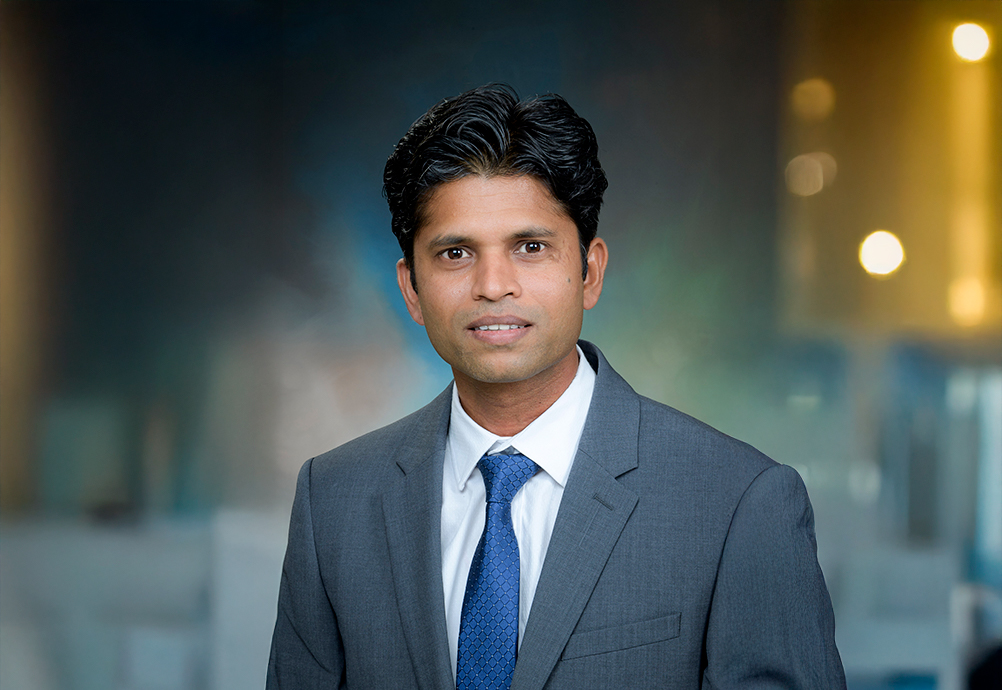
As part of the Meet the Experts seminar series, Dr. Vibhuti Gupta, associate professor in the Department of Biostatistics & Data Science at UTMB's School of Public and Population Health, shared an overview of how modern AI methods are being applied in healthcare and where UTMB teams can access machine learning–enabled research support.
A practical framing for AI in healthcare
Big data is everywhere, but value comes from turning data into decisions. Dr. Gupta described how today's AI toolbox — especially deep learning and newer generative AI approaches — can automate parts of pattern-finding that used to require extensive manual feature engineering, making it feasible to analyze complex data types at scale: images, audio signals, longitudinal sensor streams, and high-dimensional clinical records.
Not every problem needs machine learning. If the task is straightforward and deterministic, a traditional analytic workflow may be the better fit.
Machine learning and deep learning become most useful when inputs are complex, high-volume, or difficult for humans to interpret consistently — radiology and pathology images, speech signals, wearable sensor streams, or large EHR-derived time series.
Four areas where Dr. Gupta can support UTMB research
Dr. Gupta outlined four broad areas where he has built methods and can support UTMB projects through consultation and collaboration.
01 Machine learning & deep learning in healthcare From framing the research question to evaluating model performance, Dr. Gupta helps teams decide whether deep learning is warranted or whether more interpretable modeling will get to an answer faster. | 02 Mobile health & digital health analytics Wearable and mHealth data are inherently messy. Dr. Gupta builds preprocessing pipelines to handle missingness, outliers, inconsistent sampling, and device noise before any modeling begins. |
03 Multimodal data integration Rather than modeling data sources in isolation, he designs pipelines that combine clinical variables, imaging, and genomics — demonstrated in a prostate cancer risk prediction project that outperformed single-modality models. | 04 Ethical AI, fairness & transparency Bias can enter through imbalanced inputs, skewed training data, or miscalibrated outputs. Dr. Gupta's work includes methods to detect and reduce bias and support responsible deployment when models influence clinical decisions. |
Why getting from model to deployment takes longer than expected
A key closing point was the gap between building a model and deploying something safe, reliable, and generalizable. Dr. Gupta outlined three requirements healthcare AI routinely demands before a model is ready for real-world use.
✓
| Validation across multiple datasets and settings — results that hold at one institution do not automatically transfer to another. |
✓
| Careful testing for generalizability beyond a single institution or patient cohort. |
✓
| Ongoing monitoring for fairness and model drift once a system is in active use. |
That translation burden is real, but it also clarifies what teams need early: tighter problem definitions, stronger data preparation, and evaluation plans that match the intended real-world use.
Connect through OBIOS consulting & collaboration support
UTMB researchers exploring machine learning, digital health analytics, multimodal modeling, or responsible AI practices can connect with the Data Science Consulting and Collaboration team through the Office of Biostatistics (OBIOS) in the Department of Biostatistics & Data Science.
Request Consulting ServicesThe team supports a range of project needs:
Upcoming speakers in the Meet the Experts series
Feb 19 | Dr. Vibhuti Gupta
Completed
Machine learning · mHealth · Multimodal data integration · AI fairness & transparency |
Mar 19 | Network visualization · Machine learning · Explainable AI · Health policy analytics |
Apr 16 | R programming · Cloud computing · Statistical modeling |
May 21 | Biomedical ontologies · NLP · Health informatics · AI ethics |