"As a student, I learned that science and art are two sides of the same coin; as a professor, I learned how to flip it so they both blur into an integrated whole."
Dr. Suresh K. Bhavnani
GALVESTON, Texas — Dr. Suresh K. Bhavnani has received an educator award from the Academy of Master Teachers (AMT) for the Spring 2026 semester. This is his third award for the course Introduction to Visual Analytics in Healthcare, offered by the Department of Biostatistics and Data Science in the DIVA Lab at UTMB. The academy honors faculty members who demonstrate dedication, innovation, and mentorship in education. We spoke with Dr. Bhavnani about the educational approach he uses for this award-winning course.
Your students often say that this course changes how they look at data. What is the foundational approach that leads to such a shift?
My teaching philosophy was imprinted early in my career while I was a PhD student at Carnegie Mellon University. I remember expressing my anxieties to Nobel Laureate Herbert Simon about taking his demanding cognitive course on human problem solving given my computer-aided design background. He explained that science and art are two sides of the same coin: similar because they both aim to reveal new ways to describe reality; different because while the process of science demands public scrutiny, the process of art can be private and intuitive.
This early encounter stamped my approach to designing the course. The scientific principles guide the identification of statistically significant patterns in large biomedical data; the art principles, applied to visualizations, guide the interpretation of those patterns. Together, they leverage the speed and scalability of AI methods, and the sensemaking capabilities of human cognition.
“As a student, I learned that science and art are two sides of the same coin; as a professor, I learned how to flip it so they both blur into an integrated whole.”
It seems challenging to weave principles from science and art into a single semester especially for public health students with diverse backgrounds. How do you make this integration work?
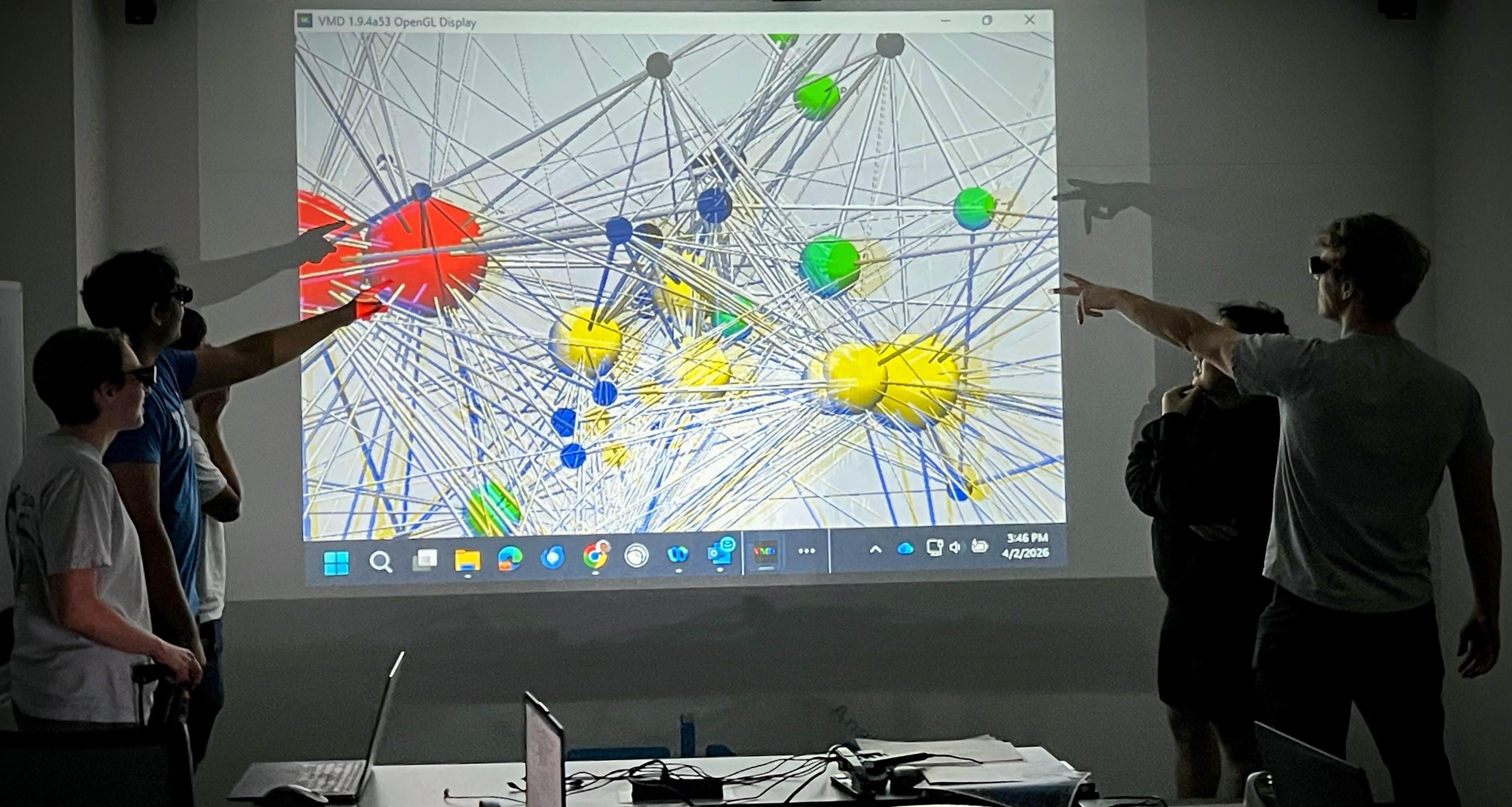
As a student, I learned that science and art are two sides of the same coin; as a professor, I learned how to flip it so they both blur into an integrated whole. For example, the course introduces network analysis, which uses machine learning methods to automatically identify statistically significant subtypes in the data, along with visualizations to interpret the results. However, because standard visualizations of large networks often fail to be interpretable by humans, the course introduces graphic design principles such as the “pop-out” effect to modify the color, shape, and distance of elements in the network, including through 3D stereo. These changes enable the statistically significant results to be interpretable and inspectable by humans.
Interestingly, this tight integration of science and art concepts often reveals flaws in the analytical method itself such as revealing data and algorithm bias, which triggers a reexamination of both. The visualizations, rather than being a one-shot presentation and interpretation of the scientific results, are therefore an integral part of both interpreting the results, and providing insights into the very analytical methods that generate them.
Students are often overwhelmed with a heavy course load. How do you ensure that this integrated science/art conception of data lasts beyond the semester?
Having flipped the coin, I need to ensure it lands on its edge and continues its spin in the real world. The course does this by building real-world intuitions of scientific and art concepts, inspired by the power of narrative I learned as a Presidential Leadership Scholar. For example, when teaching “heuristic search” from machine learning, I use the real-world example of searching for a parking spot in a garage—when you are late to a meeting, the best spots on the lower levels are already taken, so a heuristic or rule of thumb is to go directly to the upper floors to improve your chances.
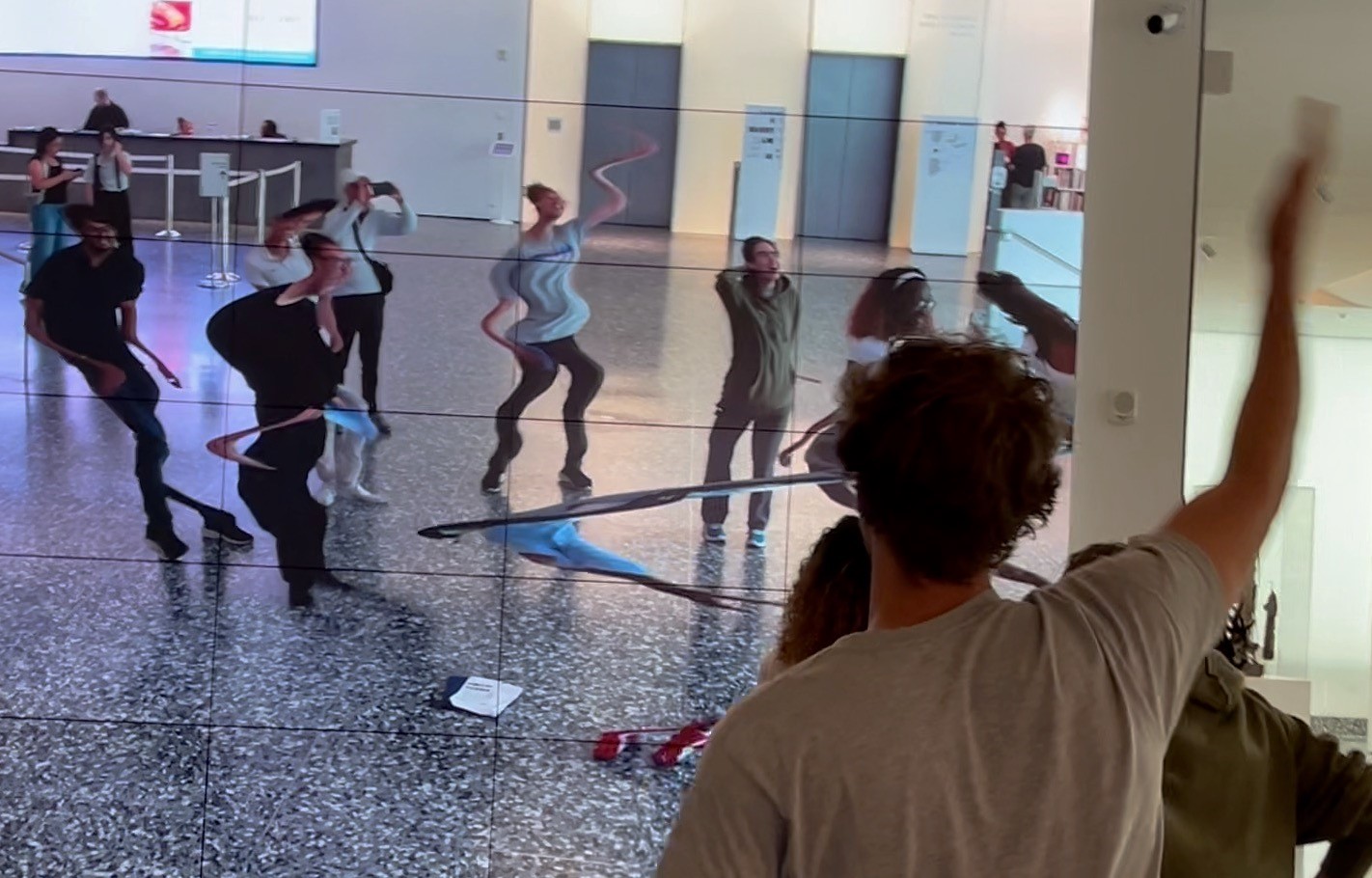
Students at the Museum of Fine Arts in Houston, interacting with a video installation that distorts their movement relative to its speed and direction in real time (William Forsythe, City of Abstracts).
This year I also included a site visit to the Museum of Fine Arts, Houston to demonstrate how artists throughout history have used new techniques to provide novel conceptions of reality: cubist artists captured multiple views of a subject on a static canvas; impressionist artists captured light using opaque paint; and contemporary artists record, distort, and project the movement of people passing by a screen to enable them to experience a new conception of themselves in real-time.
But one can never be sure that a course has a lasting impact—although sometimes there are clues. I remember after class, a pensive student murmured, "This class is not just about learning visualization methods; it’s also about learning how to think." His revelation mirrored my own experience as a student where Simon’s coin triggered a cognitive restructuring of how science and art can reveal new ways of seeing reality. The spinning coin is finally carrying forward the promise of seeing the world anew.
What leaders and collaborators are saying
"A student's father recently discussed with me how his son was strongly influenced by Dr. Bhavnani's teaching and student engagement. Such engagement is critical for attracting high-quality students into our new Data Science program."
Yong-Fang Kuo, Chair, Department of Biostatistics and Data Science, UTMB
"Dr. Bhavnani has a unique skill for explaining complex scientific and art principles in an understandable way to a broad audience. This skill is especially relevant in the fast-changing world of AI technologies"
Randall Urban, Director, Institute for Translational Sciences, UTMB
"I have enjoyed interacting with Dr. Bhavnani, who uses real-world analogies and clear explanations of complex scientific concepts. This is critical for our collaborative work in translating his AI research on precision policies into real-world solutions to achieve broad social impact"
Himalesh Kumar, CEO, Deep Impact AI, Inc
Continue the Conversation
We invite you to continue the conversation on LinkedIn and share your thoughts on how integrating science, art, AI, and human cognition can shape the future of data science education!