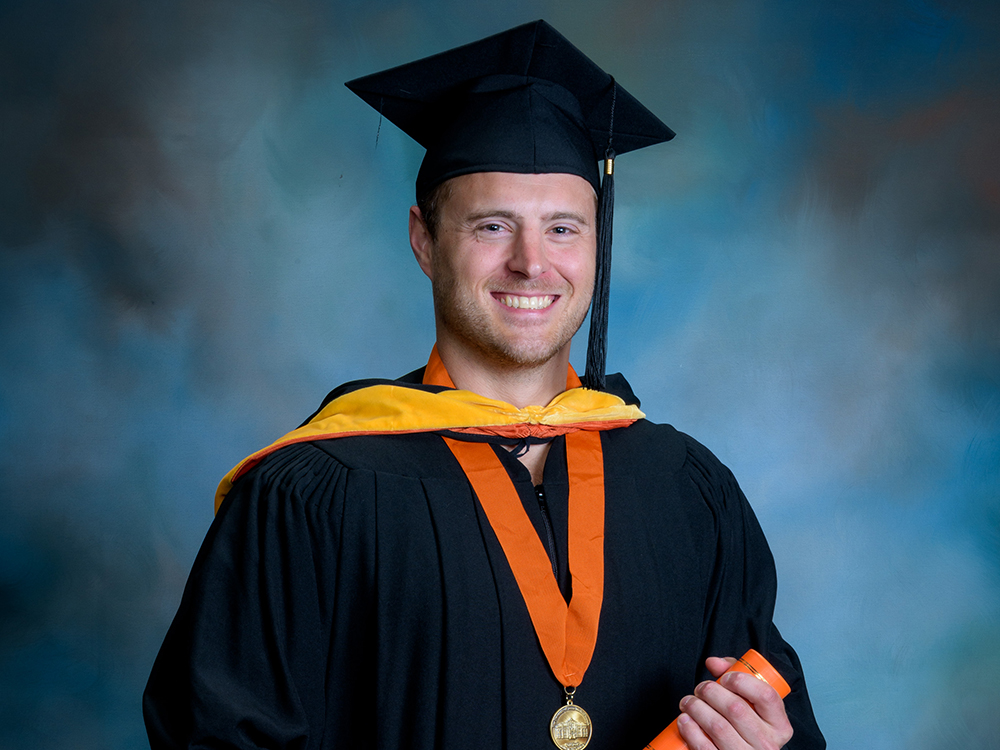
Christopher Kurinec ('25 MS Biostatistics) found his passion for biostatistics after military service and a series of career changes that led him to statistics coursework. Now a Research Scientist at the University of Colorado Anschutz Medical Campus, Chris demonstrates how diverse experiences can culminate in a fulfilling biostatistics career.
Finding Direction Through Service
After finding college challenging right after high school, Chris enlisted in the U.S. Army, serving as an Infantry Squad Leader with the 1st BCT 82nd Airborne Division. During his five years of service, he developed the work ethic and discipline that would later propel him through his academic journey.
"I tried college several times before the Army," Chris reflects. "I just hadn't developed the work ethic yet. The military changed that for me."
Following his service, Chris worked as a machinist in Texas, where interactions with engineers and physicists reignited his desire for higher education. He applied to universities across Texas and Colorado, ultimately choosing the University of Colorado Colorado Springs when they were first to offer admission.
Discovering Biostatistics
Initially pursuing mechanical engineering, Chris found the program structure frustrating for a student eager to dive into coursework. He shifted to biology, drawn by Colorado's outdoor environment and his growing interest in conservation. During his undergraduate studies, one required course changed everything: Biostatistics.
"Biostatistics made sense to me, and it sparked a curiosity to learn how data guide real health decisions," Chris recalls.
When personal circumstances required him to find a traditional nine-to-five career path rather than field-based biology work, Chris remembered his affinity for biostatistics. He researched programs and found UTMB's biostatistics program particularly appealing. "UTMB was on an island. I'd never lived on an island," he says with characteristic candor about his decision-making process.
Thriving at UTMB
At UTMB, Chris flourished in the MS Biostatistics program, discovering that his instincts about the field were correct. The graduate-level coursework introduced him to programming languages like R and SAS, probability theory, and real-world applications that went beyond the hand calculations of his undergraduate course.
As a Graduate Assistant in the Department of Biostatistics and Data Science, Chris gained invaluable experience providing statistical analysis for projects investigating associations between pulmonary outcomes and HIV/ART status in Kenyan TB patients. He also assisted in developing a novel non-parametric weighted resampling method for predicting patient recruitment in clinical trials.
"The things that helped me most were interacting with professors outside of classes, getting to know them, asking about their career trajectories," Chris explains. "When you see their code, you're essentially seeing their thought process. How they view problems, how they attack them, what strategies they implement."
Landing at CU Anschutz
The job search proved challenging in a difficult market. Chris applied to over 50 positions before securing his current role. His persistence paid off when CU Anschutz circled back after their initial candidates didn't work out.
"Networking was crucial," Chris emphasizes. "Dr. Heidi Spratt knew people at various universities through statistical associations. She was able to reach out and check on hiring status when many of us weren't getting responses."
As a Research Scientist at CU Anschutz's Center for Innovative Design & Analysis (CIDA), Chris manages a diverse portfolio of projects. Sixty percent of his time supports the EFFECT trial, a landmark $29 million study evaluating fibrinogen therapy for trauma patients. The remaining forty percent involves various projects for the Department of Anesthesiology, from analyzing postoperative circadian rhythm disruption using wearable devices to examining healthcare disparities in obstetric procedures.
"I enjoy the variety," Chris says. "There's always something new developing. You never really have the answer, but you always have an idea of the direction to start in."
Chris particularly appreciates the autonomy in his position and the opportunity to apply the skills and problem-solving approaches he developed at UTMB directly to his work.
Advice for Current Students
For students navigating today's competitive job market, Chris offers some practical wisdom:
- Cast a wide net: Apply broadly and don't limit yourself geographically unless necessary
- Master multiple tools: "Don't box yourself into one language. If you only know R, you're limiting yourself. SAS is still huge in pharmaceutical companies and many departments."
- Network actively: "Talk to professors, ask if they know anyone hiring. Use those connections."
- Persist through rejection: "I didn’t make the first group. Most of my out-of-state applications were rejected, and months passed without news. Then CU offered an opportunity. That stretch taught me to stay patient and persistent. You may not succeed on the first try or on the timeline you expect."
Chris also emphasizes that biostatistics careers remain in demand despite current funding challenges. "The need for statisticians in research isn't going away. Once funding comes back, there will be tons of work to do."
Settled back in Colorado where he can enjoy mountain weekends and outdoor lunches without Texas humidity, Chris continues to immerse himself in his field. "When I’m on my phone, I’m looking up stats papers and methods," he laughs. "I probably need to work on that balance, but when you enjoy what you do, it doesn't always feel like work."