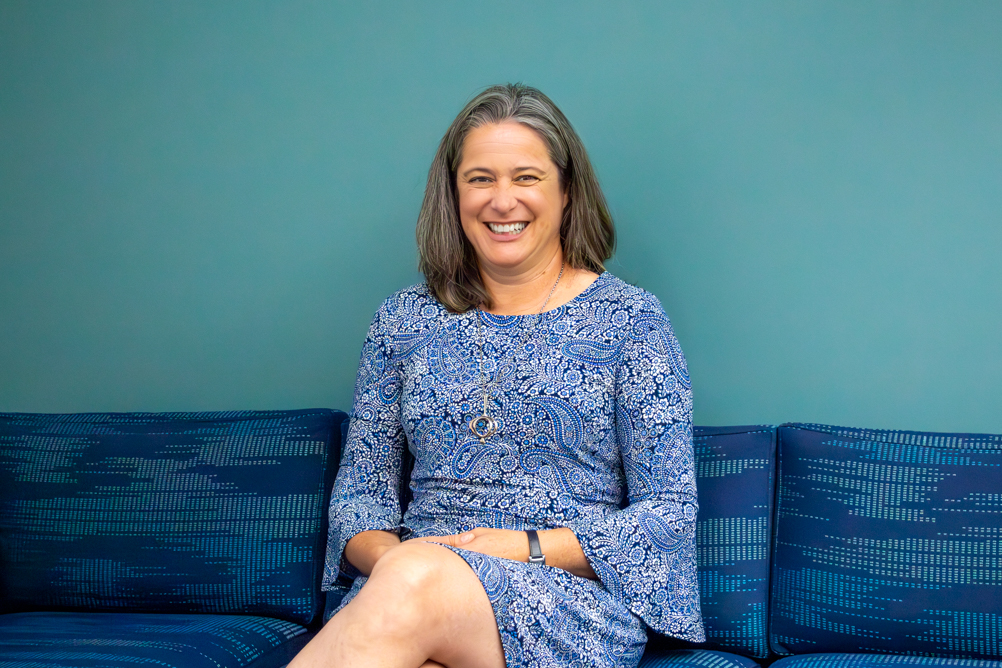
The Association for Clinical and Translational Science (ACTS) has named Dr. Heidi Spratt to the inaugural cohort of Fellows of ACTS, recognizing her for more than a decade of leadership, mentorship and service across the clinical and translational science community. Thirty-six fellows were selected from a membership of nearly 6,000.
Dr. Spratt, a tenured professor in the Department of Biostatistics and Data Science at the UTMB School of Public and Population Health, was inducted at Translational Science 2026 in Milwaukee on April 21. She is one of the organization's most active members, currently serving on the ACTS Board of Directors, chairing the Membership Committee and serving as past president and treasurer of the Association for Clinical and Translational Statisticians.
The Fellows of ACTS program launched this year as a way for the organization to recognize members whose sustained contributions have shaped both the field and the society itself.
"I am honored to be recognized by ACTS in its inaugural Fellows cohort. This recognition reflects years of collaborative work, mentorship and service, and I am grateful to do that work from UTMB alongside colleagues who value team science and translational research."
Dr. Heidi Spratt
A specific kind of statistician
To understand what the fellowship recognizes, it helps to understand what Dr. Spratt does for a living, which is not what most people picture when they hear "biostatistician." In her field, a PhD typically leads one of two directions. Methods researchers develop new statistical techniques, usually leading their own R01-funded labs with a small team of graduate students. Collaborative biostatisticians embed themselves across research teams, bringing quantitative rigor to studies designed and led by clinicians and basic scientists in other fields.
Dr. Spratt is the latter. At any given time, she may be working across ten or more teams on wholly different questions. In recent years her co-authorships have included work on dengue fever pathogenesis, biomarker panels for the early detection of liver cancer, respiratory syncytial virus in children, recovery outcomes after severe burns, and molecular signatures of Alzheimer's disease. What connects those threads for her, she says, is the methods themselves. The predictive modeling and machine learning tools she applies across domains give her a consistent toolkit, and the quieter skill underneath it is learning enough of each investigator's science to ask useful questions of it.
Early in her career she developed a habit she still uses in first meetings with new collaborators. She lets the investigator talk about their study for ten minutes without interrupting, writing down the keywords she wants to come back to. Once they relax into their own subject, she starts asking the statistical questions. "They're not scary anymore," she said. The technique sounds small, but it reflects a whole theory of what a collaborative biostatistician is supposed to do. Running the analysis is part of the job. The larger part is translating between the two sides of a research question so that the clinician's instinct and the statistician's rigor meet in the middle.
From junior member to senior mentor in ACTS
Dr. Spratt joined ACTS as an individual member in 2014, though her involvement in its predecessor committees goes back further. She first attended what was then a required in-person meeting of biostatistics, epidemiology, and research design core leaders as a junior faculty member around 2009, sent in place of her supervisor. Those annual meetings became the seed of the Biostatistics, Epidemiology and Research Design (BERD) Special Interest Group (SIG), one of the first two SIGs formed inside ACTS, and the BERD community became her professional home.
She rose through it in successive roles. Chair-elect of the BERD SIG in 2017. Chair from 2019 to 2020. Immediate past chair. Planning committee member for the annual Translational Science meeting. Member of the membership committee. Elected to the board of directors in 2023 and reelected this cycle. Along the way she also served as secretary, then president-elect, president, and is now past-president and treasurer for the Association for Clinical and Translational Statisticians, which holds its own annual meeting each summer.
The role the BERD community played in her own development is the same role she now plays for junior members. When asked which aspect of her work the fellowship most clearly recognizes, she said it was less about research than about leadership, mentorship and what she called education, though she meant something specific by that word. The BERD community has published a body of papers together over the years that function as best-practice guidance for collaborative biostatisticians. Recent examples include guidance on designing a machine learning study using electronic health record data, on peer review of clinical and translational research manuscripts, and on essential team science skills for biostatisticians on collaborative research teams. Dr. Spratt is co-author on all three and corresponding author on the machine learning and peer review pieces. She does not think of those papers as research contributions so much as training materials for the next generation of the field.
Where the gaps are
When she accepted her nomination to the ACTS board in 2023, Dr. Spratt flagged two priorities she wanted to push on. The first was helping new members feel engaged once they joined. The second was building stronger support for mid-career investigators, a group she has come to see as an area where the organization still has real work to do.
ACTS has a strong track record with trainees and with senior investigators, she said, in part because CTSA-funded institutions have line items to send predoctoral and postdoctoral scholars to the annual meeting, and core leaders often have similar travel support. The middle of the career arc is where that support thins out. People who finish training and move into their first faculty positions, sometimes at institutions without a CTSA, can fall out of the community just as they are starting to find their footing. The board recently finalized a three-year strategic plan, and a task force is now working on what ACTS can do to keep those mid-career researchers engaged and retained.
Building a workforce at UTMB
Alongside her national service, Dr. Spratt directs the MS in Biostatistics and Data Science degree program at SPPH and serves as biostatistics education director for the department, which gives her oversight of how biostatistics is taught across the school's curricula. She has taught categorical data analysis, introduction to machine learning and, for seventeen years, the introductory biostatistics course for basic science graduate students at UTMB. She inherited that course as a postdoctoral fellow and rebuilt it around what she calls the teachable middle, giving students enough statistical literacy to run the right tests on their own data and ask sharper questions of the statisticians they collaborate with later.
She also directs the UTMB Summer Institute in Biostatistics and Data Science, a seven-week NHLBI-funded workforce development program that brings rising junior and senior undergraduates to Galveston for paired didactic and applied training. Students live in shared housing at Galveston College, attend morning lectures, and spend their afternoons working on real research projects with a biostatistics faculty mentor and a basic science or clinical mentor. The program is now entering its fifth year. Every participant presents a poster at the end of the summer, often for the first time in their academic lives. What Dr. Spratt wants them to take away, she said, is that a career in biostatistics can be "extremely rewarding," that the work changes with every project and every team, and that the mind stays sharp because no study is ever quite the same as the last one.
Advice for the next generation
The advice Dr. Spratt gives early-career researchers who want to contribute to team science but do not yet see themselves as leaders is the same advice that shaped her own path. Find your people. Join the organization that feels like a professional home, start attending the monthly calls, show up at the annual meeting, and let the relationships build from there. The people in those rooms become the colleagues who will eventually write your recommendation letters, hire your graduating students, and give you the sounding board you need when you are stuck on something new.
For her, that professional home has been ACTS for more than a decade. The fellowship, she said, is a recognition from a community she has put substantial energy into and from people she now counts as friends. After 23 years at UTMB and more than a decade of national service, what still keeps the work interesting is straightforward. Every project is different. "It's never the same old, same old."