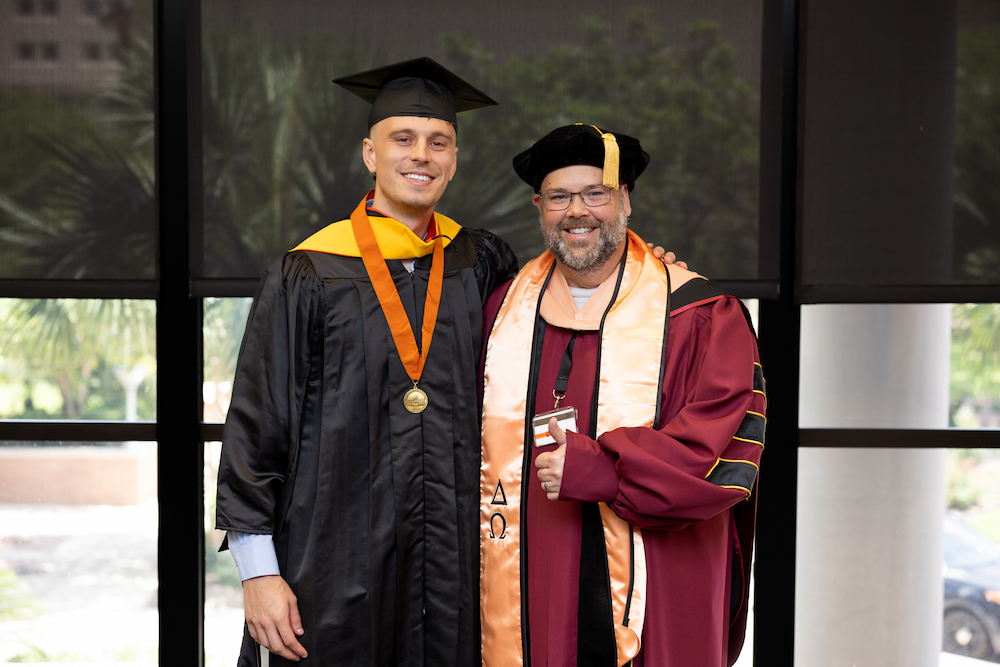
Griffin Baillargeon didn't originally plan to pursue a career in biostatistics. As a psychology student at Texas A&M University, he became interested in understanding the behavioral and cognitive processes that shape human decision-making. During his final year of college, he discovered statistics and realized it offered a different way to answer many of the same questions. Instead of studying behavior through theory alone, statistics provided tools to test ideas, analyze evidence, and better understand the world through data.
Shortly after graduation, he participated in UTMB's Summer Institute in Biostatistics and Data Science, where he worked on a research project examining immune responses to respiratory syncytial virus (RSV) in infants. The experience introduced him to statistical research for the first time and showed him how data could be used to answer important questions in health and medicine.
The experience also set him on an unexpected path. Coming from a psychology background, Griffin entered graduate school without the traditional mathematics training that many biostatistics students bring with them. There were moments when the learning curve felt insurmountable, particularly in courses such as probability and statistical theory that assumed a stronger mathematical foundation. Rather than viewing that as a disadvantage, Griffin saw it as a privilege and an opportunity to fill gaps in his knowledge one concept at a time.
Looking back, he believes that challenge ultimately strengthened his understanding of the field by forcing him to learn the foundations behind the methods rather than simply applying them.
Today, whether he is conducting research or developing healthcare analytics tools for UTMB Correctional Managed Care, Griffin is motivated by the same idea that first drew him to the field — using data to solve practical problems and improve health outcomes. His work focuses on turning complex information into tools and insights that help healthcare teams make better decisions and deliver care more effectively.
He enjoys helping people make sense of data and believes that clear communication is just as important as the analysis itself.
"I like taking something that seems complicated at first and breaking it down into something people can actually use."
Griffin Baillargeon, MS in Biostatistics and Data Science
Putting data that already exists to work
His capstone takes on a problem that comes up often in clinical research. Picture a trial testing a new cancer treatment with 100 patients, half randomly assigned to the new treatment and half to the current standard of care. Randomization makes the two groups comparable, so differences in their outcomes can be attributed to the treatment itself.
The difficulty starts when a clinical trial has a limited sample size, which can reduce the precision of the estimated treatment effect. Earlier studies of similar patients often already exist, and they contain information that can be leveraged to strengthen the analysis. Bringing in external control data is "almost like having access to a larger pool of patients," Griffin said, which can improve the reliability of the results.
However, borrowing information from previous studies is not as simple as combining the datasets. Patients in older studies may differ from those in the current trial in important ways. They might be older, sicker, or have received care under different conditions. If those differences are ignored, researchers can end up comparing fundamentally different patient populations and draw misleading conclusions about how well a treatment works.
His method addresses this challenge by reweighting the pooled control patients from both the trial and external studies. The goal is to ensure that the treatment and control groups remain comparable, allowing researchers to leverage additional data without compromising the validity of the treatment comparison.
Inside the calibration approach
To address this problem, Griffin's capstone focused on a calibration-based approach that combines weighting and outcome modeling. The method adjusts the contribution of each control patient so the pooled control population more closely reflects the patients enrolled in the trial, allowing researchers to leverage external data while preserving a fair comparison between treatment and control groups.
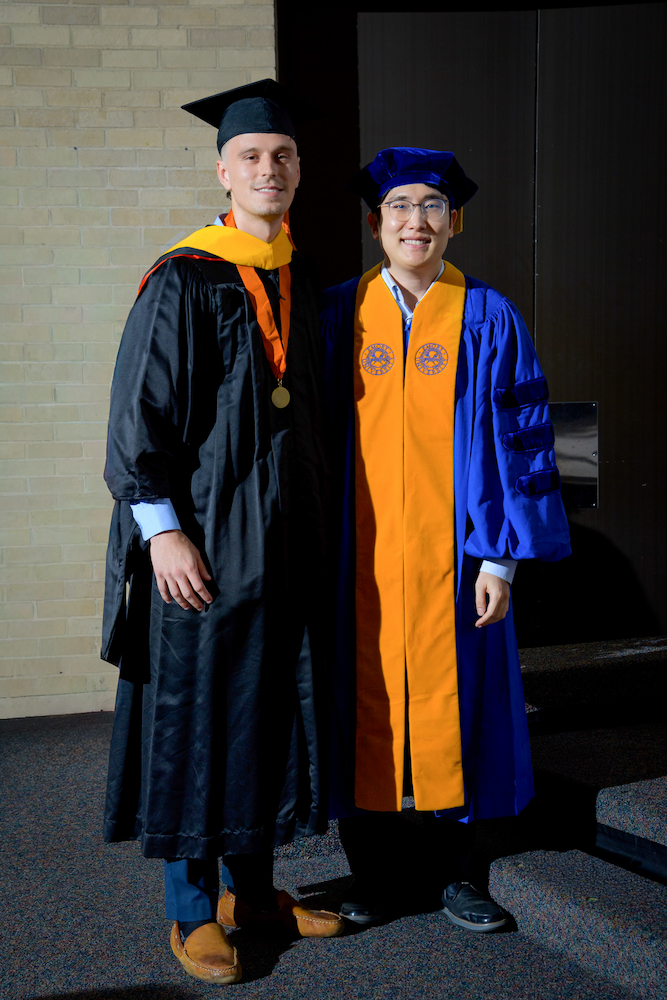
With Dr. Jeong Hoon Jang at UTMB graduation
To evaluate the approach, under the supervision of his mentor, Griffin conducted a series of simulation studies designed to mimic a wide range of clinical trial settings. Unlike real-world data, where the true treatment effect is unknown, simulation allows researchers to generate data under controlled conditions where the correct answer is known in advance.
Across scenarios that varied the degree of similarity between the trial and external populations, as well as the accuracy of the underlying statistical models, the calibration-based approach performed favorably compared with several established methods. It often produced more precise estimates and remained stable even under challenging conditions that are commonly encountered in practice.
The work, conducted under the mentorship of Dr. Jeong Hoon Jang, is ongoing and will next be evaluated using real clinical trial data. Griffin hopes the project will contribute to ongoing efforts to make clinical trials more efficient by responsibly incorporating information from external data sources and potentially improving the way clinical trials are designed and how patients are recruited.
Breaking a big problem into smaller pieces
Ask Griffin how he approaches a new dataset, and he starts by trying to understand it. Before fitting models or testing hypotheses, he explores the data, looks for patterns, and develops an understanding of the problem being studied.
"A lot of the time, the hardest part is just getting started. Once I begin looking at the data and understanding what it's actually about, the problem usually becomes much more manageable. Whether it's a disease process, a healthcare system, or a patient population, understanding the context behind the data helps you ask better questions, identify important variables, and recognize patterns that might otherwise be overlooked. At that point, it feels like a lot more than just crunching numbers."
Griffin Baillargeon, MS in Biostatistics and Data Science
Whether he's conducting research, building dashboards, or developing automated workflows, Griffin believes that understanding the context behind the data is often just as important as the analysis itself.
He compares the work to science itself — an iterative process of asking questions, testing ideas, learning from the results, and then asking better questions.
One lesson Griffin has carried with him throughout graduate school and his professional work is that most problems become manageable once you create a structured plan and start working through it. Whether he is analyzing data, learning a new programming tool, or building an automated workflow, he approaches challenges by breaking them into smaller pieces and focusing on one step at a time.
"I've learned that most problems seem a lot bigger before you start working on them."
Staying curious instead of certain
That same patience shows up in how Griffin reads a result, including his own. Every model, dataset, and analysis carries limitations, he points out, and no study can account for every factor that shapes an outcome. So when a new finding lands, his first move is to ask how the study was designed, what assumptions it made, and whether the result would hold up if someone tried to replicate it or apply it in a different setting.
He credits Dr. Suresh Bhavnani, whose Big Data and Visual Analytics course pushed him to look past the surface of a dataset, with sharpening that instinct. The course emphasized that every analysis, model, or visualization offers only one perspective on a much larger and more complex reality.
"Every analysis provides valuable insight, but it's important to know that it may not capture the entire story."
Griffin Baillargeon, MS in Biostatistics and Data Science
An early award that built his confidence
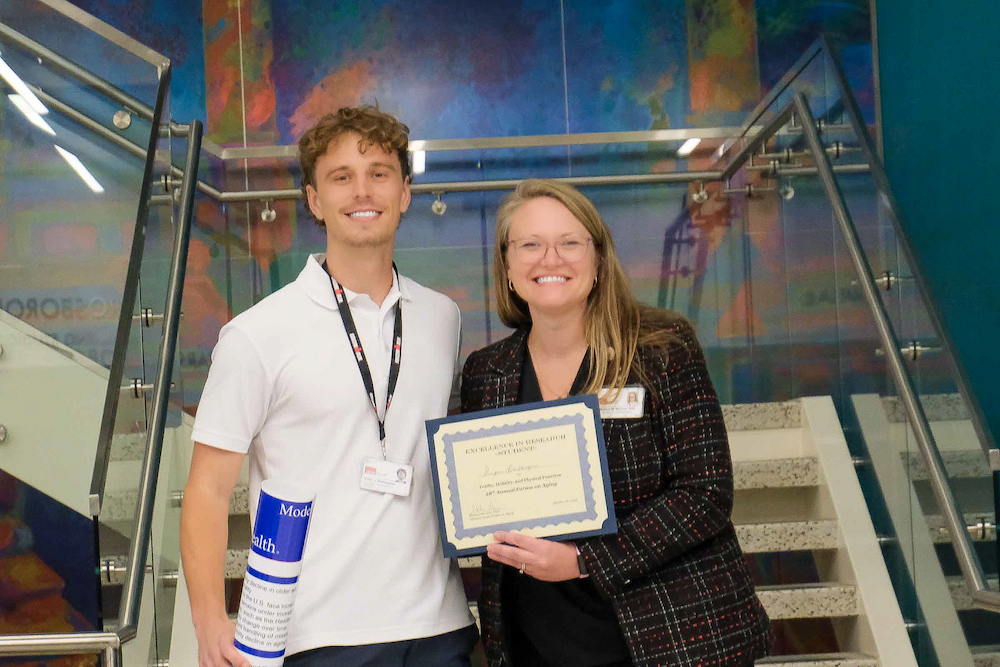
With Dr. Melissa Morrow at the Annual Forum on Aging
A psychology degree from Texas A&M University gave Griffin a footing in study design and in reading the output of a statistical model, which he counts as an advantage in a field that rewards careful interpretation.
The work began to feel like his own after he took part in the Summer Institute in Biostatistics and Data Science, an opportunity Dr. Heidi Spratt opened up for him. There, he worked on a project examining immune markers associated with RSV infection in infants and presented his first research poster. The experience gave him an early introduction to analyzing biomedical data and communicating findings to a scientific audience.
Later, a project for Dr. Moumita Chakraborty's class, built on data from the Health and Retirement Study, examined factors associated with mobility decline in older adults and earned him a poster award in the mobility functioning category at the Annual Forum on Aging.
For the first time, Griffin was responsible for the entire analytical process — from developing a research question and assembling data across multiple survey waves to cleaning the data, conducting the analysis, and interpreting the results. At the time, the project felt daunting, but working through each step gave him a much clearer understanding of what biostatisticians actually do. More importantly, it showed him that he could tackle a complex research problem from beginning to end.
The project introduced him to longitudinal data analysis and methods for handling missing data, including multiple imputation. He describes both the experience and the recognition that followed as the point where he gained real confidence working with real-world data.
Those experiences helped prepare him for later work in causal inference and the use of calibration weighting methods to incorporate external control data, topics that became the focus of his capstone research.
Tracking care quality in real time
Griffin already puts those skills to work as a Data Analyst Intern on the Data Solutions team at UTMB Correctional Managed Care. There, he develops dashboards, automated workflows, and Power Platform solutions that support healthcare operations across correctional facilities.
One of his projects supports telehealth operations across the correctional healthcare system. Through automated reporting processes, he helps identify video clinic encounters that require follow-up so healthcare teams can resolve outstanding documentation and maintain compliance with performance targets.
He has also worked on improving internal workflows by integrating Power Apps into existing SharePoint and Power Automate processes, helping make data collection more efficient and standardized.
What Griffin enjoys most about the work is seeing how data and technology can support healthcare delivery. Whether through reporting, automation, or workflow improvements, he values being able to help implement tools that help healthcare teams spend less time searching for information and more time acting on it.
What he wants running through his career
What keeps Griffin interested in the field is that there is always something new to learn. New data, new technologies, and new analytical methods continually create new questions to answer and new problems to solve.
"Whether I'm working with researchers, healthcare teams, or students someday, I want to help people make sense of complex information. That's what drew me to statistics in the first place, and it's what I hope continues to guide my career."
Griffin Baillargeon, MS in Biostatistics and Data Science
Learn more about UTMB SPPH's Master of Science in Biostatistics and Data Science and how the program prepares graduates to turn complex data into evidence that improves health outcomes.