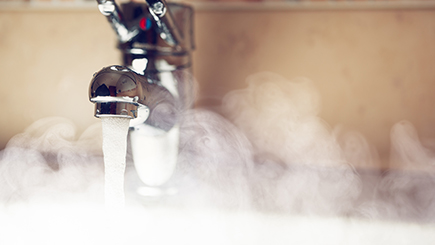
Burn prevention of all types of burns is a worthy goal. Burns account for over 100,000 pediatric emergency department visits in the US each year. In burn units across the United States, 22.5% of the patients are children and most of these children are admitted for scald burns. Scald burns occur from accidental spills of hot liquids or from hot tap water. Most scald burns involved the preparation or consumption of food or drink. Large burns not only hurt but can result in significant pain, permanent scarring, loss of the use of limbs and even death. Most scald burns can be prevented.
Because young children have thinner skin, they develop deeper burns at lower temperatures. Exposure to hot tap water at 140 degrees F for just a few seconds can result in full thickness burns requiring hospitalization and possible skin grafting. Scald burns happen most often in children under the age of five and the elderly.
Several things can be done to prevent these burns. To prevent accidental spills always make sure that the handles of pans are turned away so that young children cannot reach up and grab them and extension cords to coffee pots and other electric cookers are not hanging off the counter.
K.P. Quinlan, MD et al. in Pediatrics February 2021 reported severe scald burns caused by children as young as 2 years opening a microwave door and spilling the heated contents over their face and chest.
The boiling point of water is 212 degrees F. Approximately a one second exposure to 160 degrees F water will result in a third degree burn which is the most severe burn and will leave a scar. Thirty seconds of exposure to 130 degrees F will cause a third-degree burn. This means that children and the elderly will be burned severely in a very short time less than ½ of a minute. Please set the hot water heaters to120 degrees. Never leave a young child unattended in the bathtub.
Children between 15 months and 4 years can open a microwave with a push mechanism, open one with a pull mechanism, remove the container from a microwave, and turn on the microwave. They found that children as young as 17 months could open a push and a pull type microwave door, remove what was in the oven and even turn it on. Nearly all children were able to perform these tasks by 2 years.
Suggested changes for opening the microwave door require two simultaneous but dissimilar actions to open the door. This is similar to the pill bottle push and turn at the same time. In 2023 the design of microwave doors changed so children will no longer be able to easily open the door.
Treatment of scalds is to place the scalded skin in cold water or apply cold wet cloths. If still red, hurting or blistered after 30 minutes, go the ER. Do not apply any cream, ointment, oil or ice.
Blog written by:
Dr. Sally Robinson MD
May 2026
Also see:
https://kidshealth.org/en/parents/safety-burns.html
https://www.shrinershospitalsforchildren.org/shc/bawtips
https://www.utmb.edu/pedi/academic-divisions/general-academic-pediatrics